
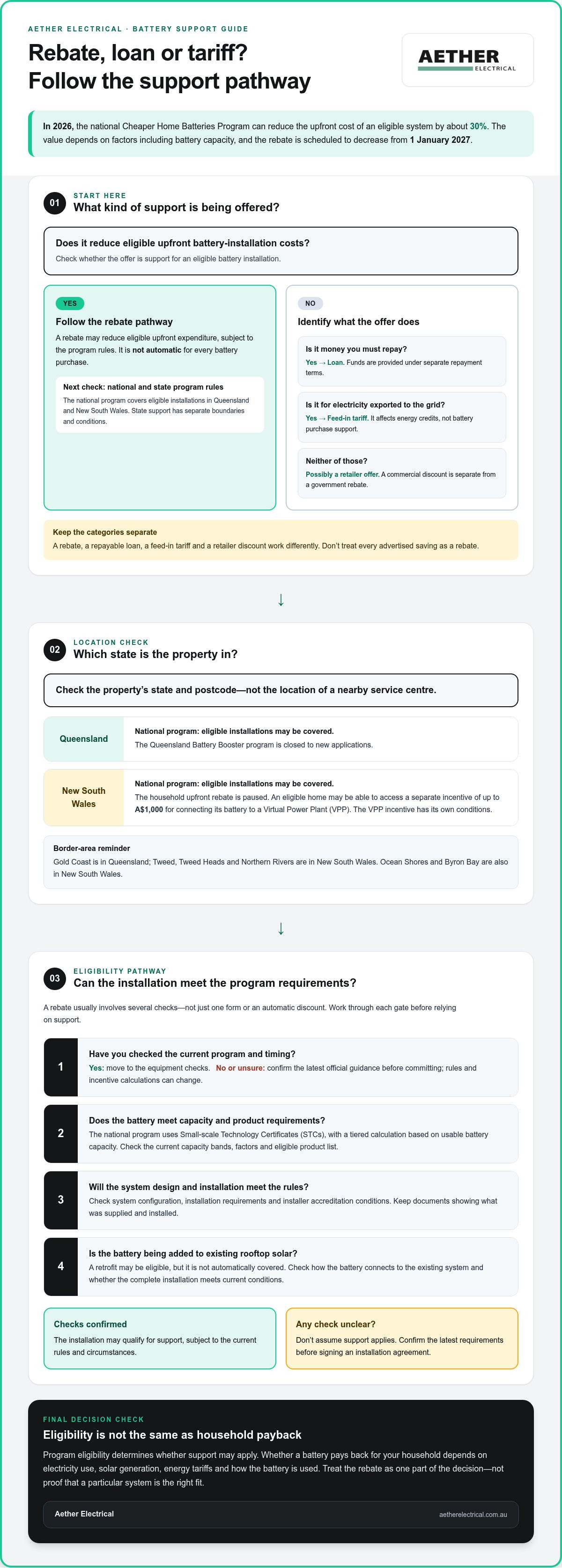
Could the battery you choose affect the solar battery rebate you receive? In 2026, the Australian Government’s Cheaper Home Batteries Program can reduce the upfront cost of an eligible system by about 30%. The value depends on factors including battery capacity, and the rebate is scheduled to decrease from 1 January 2027.
It’s easy to mix up a national rebate with a state incentive, a low-interest loan, a feed-in tariff or a retailer discount. They work differently, and the programs that apply can depend on your postcode and circumstances.
This guide explains what homeowners in Queensland and northern New South Wales should check, how eligibility and changing rebate values can affect your plans, and what to consider before choosing a battery or signing an installation agreement. You’ll also find practical ways to compare approved equipment, installation requirements and battery design against your home’s solar use.
Key Takeaways
- Learn how to distinguish a solar battery rebate from loans, feed-in tariffs and retailer offers.
- Compare program rules, battery suitability and installation requirements as separate parts of eligibility.
- Use a practical checklist to review your postcode, current deadlines and required documents before signing an agreement.
- See how battery design can be planned around your existing solar system and property needs.
- Understand how Aether Electrical’s solar and battery installation work supports homes across the Gold Coast, Tweed, Tweed Heads and Northern Rivers.
What is the solar battery rebate in Australia, and who may benefit?
A solar battery rebate is financial support for an eligible battery installation, not an automatic discount on every battery purchase. In 2026, the national Cheaper Home Batteries Program is the main battery incentive for Australian households. Eligibility depends on the program’s current rules and whether the battery, system design and installation meet its requirements.
Keep different types of support separate when comparing offers. A national incentive can apply across Australia, while state programs have their own boundaries and conditions. A retailer offer is a commercial discount, not a government rebate. A loan must be repaid. A feed-in tariff relates to electricity exported to the grid, not support for buying a battery.
These incentives sit within a longer history of solar policy, including support for rooftop solar through Small-scale Technology Certificates. For broader context, read about the history of solar incentives in Australia. That background doesn’t determine whether a particular battery installation qualifies today. Current program rules do.
Does the solar battery rebate apply in Queensland and northern New South Wales?
The national program covers eligible installations in both states, but state support isn’t identical. Queensland’s Battery Booster program is closed to new applications. In New South Wales, the household upfront rebate is paused, while an eligible home may be able to access a separate incentive of up to A$1,000 for connecting its battery to a Virtual Power Plant (VPP). A VPP incentive has its own conditions.
Check the state and postcode of the property, particularly near the border. A Gold Coast home is in Queensland; Tweed, Tweed Heads and Northern Rivers homes are in New South Wales. The same distinction applies when planning work in Ocean Shores or Byron Bay. A nearby service centre doesn’t determine which state’s rules apply.
What is the difference between a rebate, loan and feed-in tariff?
A rebate may reduce eligible upfront expenditure, subject to the program rules. A loan provides funds that must be repaid under separate terms. A feed-in tariff is a rate for electricity exported to the grid, so it affects energy credits rather than battery purchase support. Retailer offers are separate again. Identifying the type of support helps you compare the actual benefit without treating every advertised saving as a rebate.
Before planning an installation, check the latest program status, eligible product requirements and timing. The system design and installation date can affect access, so review the rules before committing. Aether Electrical installs and services solar and battery systems across the Gold Coast, Tweed, Tweed Heads and Northern Rivers, including Ocean Shores and Byron Bay, with battery planning tailored to the property and existing solar setup.
How solar battery rebate programs work in 2026
A rebate usually involves several checks, not just one form or an automatic discount. First, identify the program that applies to your property. Then check that the battery system meets its requirements, have it installed in line with the program rules, and keep the documents needed to show what was supplied and installed.
Program eligibility determines whether support may apply; it doesn’t determine whether a battery will pay back for your household. Payback depends on your electricity use, solar generation, energy tariffs and how the battery is used. Treat the rebate as one part of the decision, not proof that a particular system is the right fit.
Which rules can affect the rebate amount or eligibility?
For the national Cheaper Home Batteries Program, current Australian Government guidance sets requirements around battery capacity, approved products and installation. The program uses Small-scale Technology Certificates (STCs), with a tiered calculation based on usable battery capacity. Check current official guidance for the capacity bands and factors, eligible product list and installer accreditation conditions before relying on them.
Location and timing matter too. State support may differ between Queensland and New South Wales, while scheme rules or incentive calculations can change over time. An older online example may describe a previous rate, product list or deadline. Check the latest Clean Energy Regulator and program guidance when you plan to commit, and save a copy for your records.
Can an existing solar system qualify for battery support?
A battery added to existing rooftop solar may be eligible, but a retrofit isn’t automatically covered. The current scheme rules and proposed system configuration determine whether support applies. Check how the battery will connect to the existing solar setup and whether the complete installation meets the relevant program conditions. Don’t base your decision on an example involving a different battery, property or installation date.
There are two separate checks: whether the setup may qualify for support, and whether its design suits your home. Aether Electrical plans battery installations around existing solar systems and property requirements. For a clearer view of the factors that shape a project, read the solar battery price guide.
Before signing an installation agreement, confirm the current scheme rules, eligible system requirements and timing. Aether Electrical installs and services solar and battery systems across the Gold Coast, Tweed, Tweed Heads and Northern Rivers. Explore solar and battery installation as a practical next step in planning your system.
Solar battery rebate eligibility: what to compare before relying on support
Separate three questions before you decide: Could the installation qualify? Does the battery suit your household? Does the full project make sense? A rebate may help with eligible costs, but it doesn’t prove a system is the right size or guarantee lower bills. Don’t choose an unsuitable battery just to pursue support.
Use this comparison to identify what to check. Program requirements can change, so rely on current official guidance for the scheme that applies to your address.
| Program condition | What to check | Where uncertainty needs verification |
|---|---|---|
| Location | Confirm the property’s state and postcode. | Check whether the program covers that location and whether separate state conditions apply. |
| Battery and system | Compare the proposed battery’s capacity and configuration with your household’s energy use and solar setup. | Verify the current eligible-product rules and how system design affects eligibility. |
| Installation timing | Establish when the system will be installed and what records will be provided. | Check current deadlines and whether the installation date affects the applicable rules. |
| Whole project | Consider the battery, existing solar equipment and any electrical work as one plan. | Clarify which parts of the project the program considers eligible, rather than assuming every cost is covered. |
Does a rebate mean a battery will pay for itself?
No. A rebate and a battery’s value are different calculations. Results depend on when you use electricity, how much solar power your home generates, your electricity arrangements, the system design and battery performance. A fixed payback promise can’t account for every household. Base your decision on your own usage and a property-specific assessment, not the advertised incentive alone.
A battery is one part of a wider energy setup. If you’re planning solar as well, the solar panel installation guide can help you consider how the components work together.
Should you add a battery to existing solar or plan both together?
A retrofit can make sense when your existing solar system suits the battery you’re considering. A combined project lets the solar and battery design be considered together from the outset. Either way, the existing inverter, switchboard and solar-system details can shape what’s practical. Aether Electrical plans solar and battery installations around the property, rather than treating the rebate as the design brief.
For more on the factors involved, read the home solar battery storage buyer guide. When you’re ready to plan a system, explore solar and battery installation with Aether Electrical.
How to check and claim a solar battery rebate: a practical checklist
A clear process helps keep rebate paperwork aligned with the system plan. Rules can vary by program and change over time, so check the current official guidance before entering an installation agreement. Don’t assume a rebate is approved before you receive confirmation.
- Check the property’s postcode. Confirm whether the home is in Queensland or New South Wales, then identify the national and state programs that currently apply to that location.
- Read the latest program rules. Check the eligibility criteria, application sequence, installation window and deadlines. Note whether approval or another step is required before work begins.
- Match the proposed system to the requirements. Confirm that the battery and its planned installation meet the scheme’s current conditions. Don’t rely on an old product list or an example from an earlier program period.
- Plan the installation around the rules and the property. Make sure the system design, existing solar equipment and proposed timing are understood before you sign. Keep the written information about the proposed setup and installation date.
- Follow the scheme’s claim instructions. Submit or retain only the records the official guidance requires. Check what evidence is needed, who submits it and when. Keep copies of the specified documents and any confirmation you receive.
- Recheck before lodging. Review current eligibility and deadlines again before submitting a claim. Follow the latest instructions, even if you researched the solar battery rebate earlier in your planning.
What should you check before booking a battery installation?
Focus on three things: the program’s current status, the eligible installation window and the steps required before work starts. Then compare the proposed battery and installation with the scheme’s current requirements. Record key system details and organise documents only as directed by official instructions. This keeps your records relevant and avoids relying on a generic checklist that may not fit the program.
What if the rebate rules change before installation?
Pay attention to when a change is announced, whether transition arrangements apply and which date the program uses to assess eligibility. The announcement date, agreement date and installation date may not mean the same thing under every scheme. Review official program updates before committing and again before lodging a claim. An announced incentive is not confirmation that your installation will qualify.
Aether Electrical plans solar and battery installations around the property and system requirements. Plan a battery installation with a local electrical team serving the Gold Coast, Tweed, Tweed Heads and Northern Rivers, including Ocean Shores and Byron Bay.
Plan a solar battery installation with a local electrical team
Rebate rules are one part of the decision. The system still needs to suit your property, existing solar equipment and household energy needs. Aether Electrical plans solar and battery installations with these practical details in view, connecting incentive research with a system design suited to the home.
What does battery installation planning involve?
Planning starts with what’s already on site. The existing solar equipment and inverter, switchboard setup, available battery location and the way your household uses electricity can all shape the design. A battery added to an existing system may need a different approach from solar and storage planned together. The right configuration depends on the property, not just the incentive on offer.
It also helps to be clear about what you want the battery to do. Your priorities might include using more of your solar power at home or having stored energy available at particular times. These needs inform the design, but they don’t determine whether a system meets a rebate program’s rules.
How can Aether Electrical help with solar and battery storage?
Aether Electrical installs and services solar systems, and installs battery storage for homes and businesses. The team can plan the work around your existing solar setup or consider solar and battery together, with the design shaped by your property and energy needs. Service coverage includes the Gold Coast, Tweed, Tweed Heads and Northern Rivers, including Ocean Shores and Byron Bay.
Keep the two checks distinct: installation planning is about designing a suitable system, while rebate eligibility is decided by the relevant program’s current conditions. A well-planned installation doesn’t guarantee that a solar battery rebate will be approved. Check the official scheme rules and required steps separately, then make sure the design and timing align with them.
If you’re weighing up a battery or planning a broader solar project, a conversation can help clarify practical next steps for your property. Talk with Aether Electrical about solar and battery installation.
Make your next solar decision with confidence
A solar battery rebate can help with eligible installation costs, but it’s only one part of the decision. Check which national or state program applies to your postcode, review the current eligibility rules and timing, then assess whether the battery design suits your home and energy use. Keep rebate approval separate from expected savings, and follow the scheme’s instructions for any required documents.
Aether Electrical installs and services residential and commercial solar systems, with battery storage installation across the Gold Coast and Northern Rivers region, including Tweed and Tweed Heads. Planning around your existing solar equipment and property requirements helps turn incentive research into a practical system plan, without treating a rebate as a guaranteed outcome.
If you’re considering a battery or planning solar and storage together, take the next step. Talk with Aether Electrical about solar and battery installation and discuss what could work for your property. A clear plan makes it easier to move forward with confidence.
Frequently Asked Questions
Is there a solar battery rebate in Australia in 2026?
Yes. The Australian Government’s Cheaper Home Batteries Program provides support for eligible battery installations through Small-scale Technology Certificates (STCs). Eligibility depends on the current program rules, including battery and installation requirements. The incentive is not a guaranteed discount on every purchase. Check official guidance for the rules applying to your installation date, and distinguish the national program from separate state offers or loans.
Can Queensland homeowners claim a solar battery rebate?
Queensland homeowners may be eligible for the federal battery incentive if their system meets the program rules. Queensland’s Battery Booster program is closed to new applications, so don’t assume an older state rebate guide still applies. For homes on the Gold Coast, check the property’s postcode and current federal requirements before committing. Eligibility depends on the installation, not simply on being a Queensland resident.
Can I get a rebate for adding a battery to existing solar panels?
Possibly. A battery retrofit may qualify if the battery, system configuration and installation meet the current scheme conditions. Having solar panels already doesn’t automatically establish eligibility, and the existing inverter or other system details may shape the design. Check the official rules for retrofit installations and the relevant installation date before signing an agreement. Keep the records specified by the program.
How much is the solar battery rebate in 2026?
For May to December 2026, the federal incentive is valued at approximately A$252 to A$272 per kilowatt-hour of usable battery capacity, under the current scheme settings. The calculation is tiered: capacity above 14 kWh and 28 kWh receives a lower STC factor. These figures can change, so use current Clean Energy Regulator guidance for an estimate. Your final support depends on the eligible system and applicable rules.
What happens if the solar battery rebate rules change after I get a quote?
A quote doesn’t lock in rebate eligibility or the program’s calculation. Changes may include new rates, dates or transition arrangements, and the scheme may use a particular event, such as installation, to determine which rules apply. Before entering an agreement, review the latest official updates and clarify the proposed installation timing. Check again before lodging a claim. An announced incentive is not confirmation that a claim will be approved.
Do I need solar panels to qualify for a battery rebate?
Don’t assume a battery qualifies on its own. The federal program has specific requirements for the battery system and how it is installed, so check current official guidance on whether it must connect to a new or existing solar system. If you have no panels, confirm the scheme conditions before planning a battery-only installation. A system assessment can also show whether solar and storage should be designed together.
Does a solar battery rebate guarantee lower power bills?
No. A rebate may reduce eligible upfront expenditure, but it doesn’t guarantee bill savings or a particular payback period. Outcomes depend on household electricity use, solar generation, battery design, electricity arrangements and how the system performs. A suitable plan starts with your property and energy needs, then considers any incentive separately. Aether Electrical installs and services solar and battery systems across Tweed, Tweed Heads, Northern Rivers, Ocean Shores and Byron Bay.


