

A standard power point may seem like the simplest way to charge an EV at home, but it can be slow for a busy routine. A dedicated charger can make overnight charging more convenient. The right option depends on your vehicle, how far you drive and how long the car is parked at home.
Before choosing equipment, consider how your car’s charging limit affects speed, whether your switchboard and circuit are suitable, and when solar power might be available. These factors depend on your home setup, not just the charger you select.
This guide compares power points and dedicated chargers, explains the electrical checks to consider before installation, and shows how charging can fit around solar generation. With a setup matched to your routine, home charging can become a straightforward part of the day.
Key Takeaways
- Match your home charging setup to your vehicle, parking arrangements and everyday driving routine.
- Compare a suitable power point with a dedicated charger to find the option that fits your household.
- Before installation, have the circuit capacity and switchboard assessed for a safe, suitable setup.
- Decide where the vehicle usually parks and where a charger could be mounted to help plan the installation.
- To charge an EV at home with solar, consider when your system generates power and when your vehicle is plugged in.
How to charge an EV at home: start with your daily routine
Home EV charging means replenishing your car’s battery while it’s parked at your residence. Unlike charging at a shared public station, home charging takes place where you regularly park. The routine is simple: park, connect the vehicle to suitable charging equipment, then unplug it when you’re ready to drive.
Charging speed depends on three main factors: your vehicle’s charging limits, the equipment and the electrical supply available at home. A higher-capacity charger won’t necessarily make every vehicle charge faster. For a general overview of electric car charging, including home and public charging, see Wikipedia.
To charge an EV at home in a way that suits your household, start with a typical week rather than an equipment catalogue. A car parked in the same spot overnight has different charging needs from one that’s home only briefly between trips.
What equipment do you need to charge an EV at home?
Your vehicle connects to a power source through charging equipment. Depending on your vehicle and setup, this could be suitable portable equipment connected to a power point or a dedicated wall-mounted charger. The power point or charger provides the connection, while your home’s electrical supply provides the electricity. The vehicle’s own charging limits also affect how quickly it can take power.
How does your routine affect the charging setup?
Consider how far you drive on a typical day, where the car parks and whether it stays there overnight. If it’s regularly parked at home overnight, you can connect it after arriving and unplug it before leaving. Occasional top-ups are a different pattern from relying on home charging as your usual way to replenish the battery.
Look at where the vehicle sits and how close that spot is to a practical charging location. If you park in different places or the car is rarely home for long, those details can affect which setup is most convenient. They help shape a plan around your actual routine.
There’s no single arrangement that suits every home or vehicle. Use your driving and parking habits, your car’s charging capability and the available electrical supply as the starting point for comparing a power point with a dedicated charger.
Home EV charging options: power point or dedicated charger?
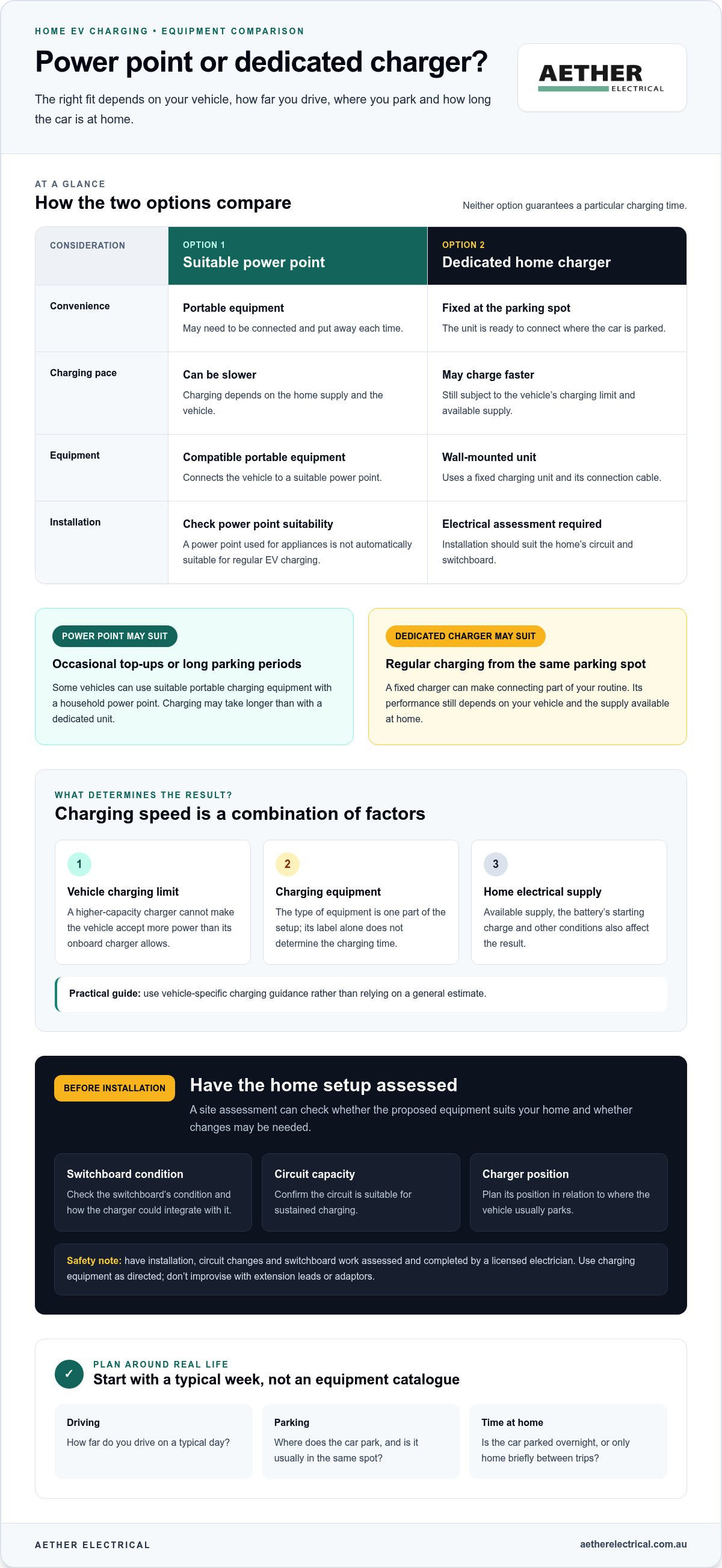
A suitable power point can be a practical starting point for some households. A dedicated wall-mounted charger may suit regular charging and a fixed parking spot. Neither option guarantees a particular charging time. The result depends on the equipment, your home’s electrical supply and the vehicle’s onboard AC charging limit.
| Consideration | Suitable power point | Dedicated home charger |
|---|---|---|
| Convenience | Portable equipment may need to be connected and put away each time. | A fixed unit is ready at the parking spot. |
| Charging pace | Can be slower, depending on the supply and vehicle. | May provide faster charging, subject to vehicle and supply limits. |
| Equipment | Uses compatible portable charging equipment. | Uses a wall-mounted charging unit and its connection cable. |
| Installation | Power point suitability still matters. | Requires an electrical assessment and installation suited to the home. |
Charging time is a combination of factors, not just a number on a charger’s label. A higher-capacity unit can’t make a vehicle accept more power than its onboard charger allows. The battery’s starting charge and other conditions also affect the result, so use vehicle-specific guidance rather than relying on a general estimate.
Can you charge an EV from a standard power point?
Some vehicles can use suitable portable charging equipment with a household power point. This may work for occasional top-ups or when the car is parked for long periods, but charging can take longer than with a dedicated unit. Use equipment as intended, and don’t improvise with extension leads or adaptors. If you’re unsure whether a power point or circuit is suitable, have it assessed before relying on it for regular charging.
When might a dedicated home charger suit you better?
If you charge regularly and park in the same spot, a dedicated charger can make connecting part of your routine. Its performance still depends on your vehicle’s charging capability and the available supply. Before installation or circuit changes, a qualified electrical assessment can consider circuit capacity and switchboard integration. Aether Electrical installs residential EV chargers, with the setup planned around the home. Explore EV charger installation as a practical next step.
Is home EV charging safe? Understand the electrical checks
Home EV charging can be safe when the equipment suits the vehicle and the installation is properly assessed. A dedicated charger draws power over sustained periods, so the circuit and switchboard need to be suitable. A power point that works for everyday appliances isn’t automatically suitable for regular vehicle charging.
Using charging equipment as directed is also important. Installing a dedicated charger, changing a circuit or altering switchboard connections is electrical work. Have that work assessed and completed by a licensed electrician. You can connect and unplug the vehicle during normal use, following the instructions for your car and charging equipment.
What should an electrician assess before installation?
A site assessment helps determine whether the proposed setup suits your home. It should consider the switchboard’s condition, available circuit capacity and the charger’s proposed position in relation to your parking spot. These details show whether the existing setup is suitable or whether changes may be needed. Related electrical work, including a switchboard upgrade, can also be considered where appropriate.
For homes in the Gold Coast, Tweed, Tweed Heads and Northern Rivers, Aether Electrical plans residential EV charger installations around circuit capacity and switchboard integration. The assessment takes the property and parking arrangement into account, rather than treating an empty patch of wall as the only consideration.
What should you avoid when charging at home?
Keep the setup simple and use equipment only as directed. Don’t try to solve a reach or connection problem with improvised wiring or unsuitable extension leads. Check cables and connectors for visible damage, and follow the operating instructions from your vehicle and equipment manufacturers.
- Stop using damaged equipment. Don’t handle exposed wiring or attempt a repair yourself.
- Pay attention to unusual heat. Stop charging if a plug, cable or connection becomes unusually hot.
- Take repeated interruptions seriously. If charging repeatedly stops or trips a circuit, pause use and seek professional advice.
These signs don’t identify the exact fault, but they’re a reason to stop charging rather than hope the issue clears. A qualified electrician can assess the equipment and your home’s electrical setup. For related household electrical work, domestic electrical services can address the wider setup alongside your charging needs.
How to prepare your home for an EV charger installation
A little preparation can make the site assessment more useful. Think about where you park, how you use the car and where a charging point would be convenient. This gives the electrician a clear starting point for planning an installation around your home and routine.
- Map your parking routine. Note where the vehicle usually parks and whether that spot changes. Include tight clearances or shared parking arrangements.
- Choose a possible mounting spot. Consider cable reach, convenient access and whether the area is exposed to weather or likely to be bumped by doors, bikes or stored items.
- Share the layout. Describe how you park and point out your preferred charger location during the electrical assessment. Photos can help explain areas that are difficult to access.
- Have the electrical setup assessed. The electrician can review the proposed cable route, switchboard and available circuit capacity on site. This helps determine a suitable charger and whether electrical changes may be needed.
- Review the installation and handover. Once the work is complete, ask for a walkthrough of the charger’s operation and any project-specific instructions. Testing and handover arrangements depend on the installation.
Choose a practical charger location
Start with the car’s usual position, not the nearest empty wall. The charging cable needs to reach comfortably without creating an awkward path across a walkway or driveway. Consider how exposed the spot is to sun and rain, and whether the charger could be knocked or obstructed. Explain these conditions during the assessment so the installation suits the actual site.
Plan the electrical assessment and installation
The site assessment connects your parking plan with your home’s electrical capacity. The electrician considers the switchboard and circuit alongside the proposed charger and cable route. Some homes may need electrical upgrades; others may not. An assessment determines what’s appropriate for the property rather than assuming every installation requires the same work.
For a local overview of the service, explore Gold Coast EV charger installation. Aether Electrical installs residential chargers across the Gold Coast, Tweed, Tweed Heads and Northern Rivers, with installation planned around circuit capacity and switchboard integration.
Once the charger is installed, take time to understand its controls and your vehicle’s instructions before making charging part of your routine. A clear plan for where you park and connect makes it easier to charge an EV at home safely and conveniently.
Make home EV charging work with solar and local electrical support
Solar can contribute to EV charging when your system is generating power and the car is plugged in. The closer those times align, the more solar generation may be available for charging. If your vehicle is away during the day and only home at night, your charging pattern may rely more on other available electricity. The result depends on your solar system, household demand and charging times.
Can solar panels help charge an EV at home?
Consider your household’s energy use across the day. If the car is parked at home while your panels are generating, some solar power may be available for charging after other household demand is met. If you’re exploring a solar system, a solar panel installation guide can help you consider how generation might fit your routine. A battery may also be part of broader home energy planning, depending on your household’s needs.
Charging with solar doesn’t automatically mean every charge is powered by the sun or comes at no cost. Generation timing, other household use and your vehicle’s charging needs all affect the result. Start with when the car is usually home, not just the system’s capacity.
What are the next steps for homeowners in the Gold Coast and Northern Rivers?
Bring the key decisions together before arranging installation:
- Vehicle: Understand its charging capability and connection requirements.
- Routine: Note how far you drive and when the car is usually parked at home.
- Location: Identify the regular parking spot and a practical place for the charger.
- Electrical setup: Arrange an assessment of circuit capacity, the cable route and switchboard integration.
This gives the installation plan a solid starting point and helps connect EV charging with existing or planned solar and battery systems. Aether Electrical installs solar systems and battery storage as well as residential EV chargers, making it possible to consider these parts of your home’s energy setup together.
Aether Electrical installs residential EV chargers across the Gold Coast, Tweed, Tweed Heads, Northern Rivers, Ocean Shores and Byron Bay. If you’re ready to plan a charger around your home and vehicle, talk to Aether Electrical about home EV charger installation.
Make your home charging plan work for you
The right setup starts with your routine. Consider where your vehicle parks, how its charging capability matches your needs, and whether a suitable power point or dedicated charger makes sense. Before installation, an electrical assessment can show how the circuit, cable route and switchboard fit together.
Solar may contribute to charging when your car is home while your system is generating, but the outcome depends on household demand and timing. A well-planned setup brings these factors together to make it easier to charge an EV at home safely and conveniently.
Aether Electrical installs residential EV chargers across the Gold Coast, Tweed, Tweed Heads, Northern Rivers, Ocean Shores and Byron Bay, alongside electrical, solar and battery installations. With your parking routine and electrical setup in mind, talk to Aether Electrical about home EV charger installation.
With a clear plan and a suitable electrical setup, home charging can become a simple part of your everyday routine.
Frequently Asked Questions
Can I charge an EV at home from a normal power point?
Some EVs can be charged using suitable portable equipment connected to a household power point, but charging is generally slower than with a dedicated charger. Whether it suits your household depends on your vehicle, equipment, circuit condition and charging routine. Don’t use extension leads or improvised connections. If you’re unsure whether the circuit is suitable, arrange an assessment by a licensed electrician before relying on it for regular charging.
How long does it take to charge an EV at home?
There’s no single charging time for every EV. It depends on how much energy the vehicle needs, the equipment’s output, the home’s available supply and the vehicle’s onboard charger. A dedicated charger can’t exceed the vehicle’s own charging limit. Check your vehicle and charger specifications for an estimate. Treat online charging-time examples as guides, not guarantees, because the starting charge and installation setup can affect the result.
Do I need a dedicated EV charger at home?
Not necessarily. A suitable power point may work for some vehicles and charging patterns, while a dedicated charger can make regular home charging more convenient. Consider how far you drive, how long the car is parked and where it usually sits. Your home’s electrical system also matters. An electrician can assess the circuit, switchboard and proposed charger location to help you understand which setup suits your household before you choose equipment.
Is it safe to charge an electric car at home overnight?
Home charging can fit into a normal overnight routine when you use suitable equipment as directed and the electrical installation is appropriate. Keep cables and connectors in good condition, follow the manufacturer’s instructions and avoid makeshift connections. For a dedicated charger, have the circuit and switchboard assessed by a licensed electrician. Stop using damaged equipment or equipment that becomes unusually hot, and seek professional advice if charging repeatedly interrupts.
Can I charge my EV using solar panels?
Solar generation can contribute to charging when your system is producing power and your vehicle is connected. How much solar energy reaches the car depends on generation, household demand, charging settings and when the vehicle is parked. Solar won’t necessarily power every charge entirely. If you’re planning a charger alongside solar or battery storage, consider your household’s energy use and daily routine so the systems work together appropriately.
Does my switchboard need an upgrade for a home EV charger?
Not always. It depends on the switchboard’s condition, available electrical capacity, existing household loads and the charger being considered. An on-site assessment can show whether the current setup is suitable or needs changes. Don’t assume an upgrade is required before the home has been assessed, and don’t attempt switchboard work yourself. A licensed electrician can assess the setup and explain practical options for your property.
Can I install an EV charger myself in Australia?
A dedicated EV charger installation should be handled by a licensed electrician. The work needs to suit the property’s electrical supply, switchboard and charger location, with applicable requirements considered for your state or territory. You can prepare by noting your parking arrangements and charging needs, but leave wiring and switchboard changes to a professional. Aether Electrical installs residential EV chargers across the Gold Coast, Tweed, Tweed Heads, Northern Rivers, Ocean Shores and Byron Bay.


