

If you’re searching for “how to test smoke alarm”, start with the test button and the manufacturer’s instructions. A loud beep is useful, but it doesn’t tell you everything about the alarm’s condition or smoke sensor.
A quiet test, intermittent chirping or uncertainty about the sensor can leave you wondering whether your household is protected. This guide explains how to test smoke alarms safely, what the results mean and when to arrange professional help.
You’ll learn how to use the test button, what to check on an interconnected system and why a button test isn’t the same as testing the smoke sensor itself. We’ll also cover common warning signs and when an alarm may need attention or replacement. Aether Electrical provides smoke alarm testing, installation and compliance safety reports across the Gold Coast, Tweed and Northern Rivers, including Tweed Heads, Ocean Shores and Byron Bay.
Key Takeaways
- Follow the manufacturer’s instructions and use a stable, safe reach when testing a smoke alarm.
- Know what a clear, weak or absent alarm sound may indicate, and when a result needs follow-up.
- Use the alarm’s instructions to address simple indicators, but don’t open, rewire or modify the unit yourself.
- Build testing and cleaning into a household reminder, then record the date, alarm location and any action needed.
- Understand when smoke alarm testing, installation or a compliance safety report from an electrician can help.
How to test a smoke alarm and what the test tells you
Testing a smoke alarm is straightforward when you follow the manufacturer’s instructions. A working alarm gives your household an important early warning, and regular checks can help you spot a problem. In Queensland, interconnected alarms can sound together, helping alert people in different parts of a home.
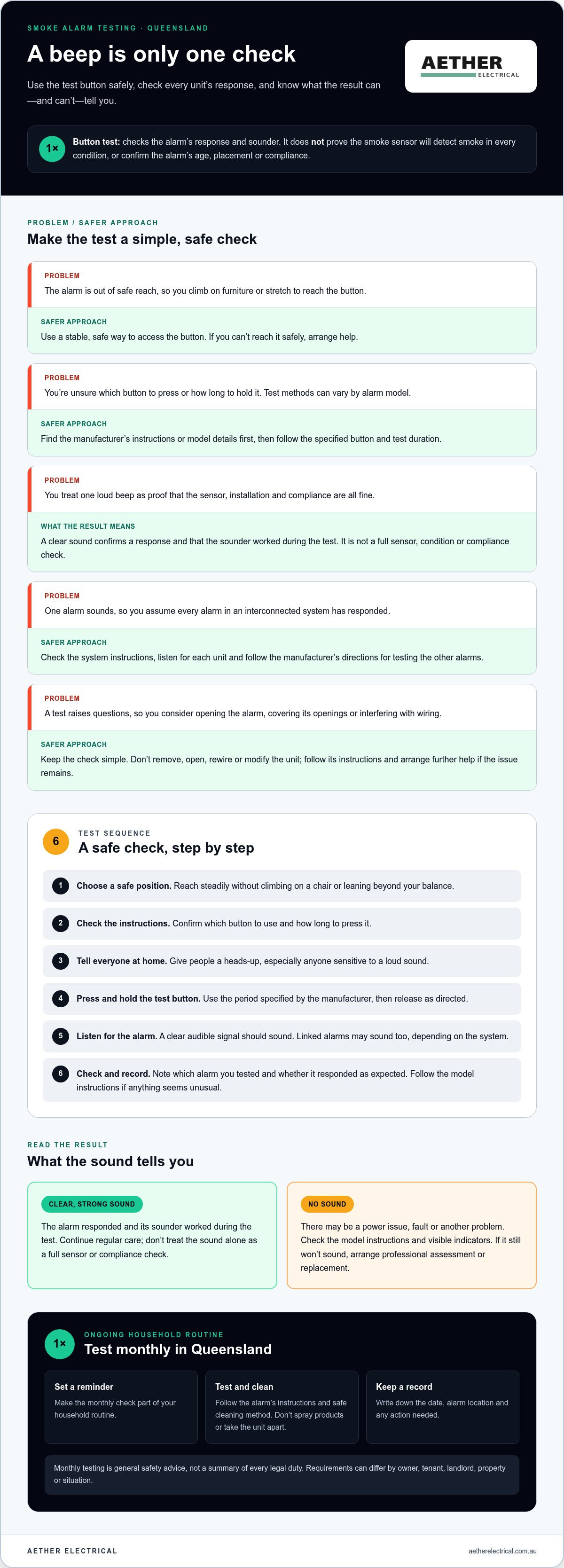
It’s useful to understand what a button test can and can’t tell you. The test button checks the alarm’s response and sounder. It doesn’t prove the smoke sensor will detect smoke in every condition, or confirm the alarm’s age, placement or compliance. For a broader introduction to how smoke detectors work, see this overview of common alarm types and their operation.
What does the smoke alarm test button check?
When pressed as directed, the button should trigger the alarm’s audible signal. On an interconnected system, other linked alarms should respond according to the system’s instructions. A clear sound is reassuring, but it’s only one part of checking your home’s smoke protection.
Routine functional testing is a household check. A professional inspection or compliance assessment can look beyond the button response, including the alarm setup and whether it meets relevant requirements. These checks serve different purposes.
How often should you test a smoke alarm in Queensland?
Queensland fire safety guidance recommends testing smoke alarms monthly. Follow the instructions for your specific alarm, as the test method can vary. Cleaning is also part of regular care. Use the manufacturer’s safe cleaning method rather than spraying products or taking the unit apart.
Monthly testing is general safety advice, not a summary of every legal duty. Requirements can differ for owners, tenants and landlords, and may depend on the property or situation. For current details, read the Queensland smoke alarm rules and compliance guide.
Make the routine easy to follow: set a monthly reminder, test each alarm as directed and record any unit that doesn’t respond as expected. A button test shows that the alarm responds and sounds during the test. It can’t replace checks of the alarm’s condition or a professional assessment when something remains uncertain.
How to test a smoke alarm safely, step by step
A careful test takes only a few steps. Read the instructions for your alarm model first, as button operation and test duration can vary. If the unit is out of safe reach, don’t climb on furniture or stretch to reach it. Use a safe way to access the button or arrange help.
Before pressing the test button
Identify the alarm and find its manufacturer instructions or model details. Tell everyone at home that you’re about to test, especially anyone who may be sensitive to a loud sound. Don’t remove the alarm, cover its openings or interfere with wiring. A test should be a simple check, not a reason to take the unit apart.
Follow these steps
- Choose a safe position. Stand where you can reach the button steadily, without climbing on a chair or leaning beyond your balance.
- Check the instructions. Confirm which button to use and how long to press it for your model.
- Press and hold the test button. Hold it for the period specified by the manufacturer, then release it as directed.
- Listen for the alarm. You should hear a clear audible signal. If the alarm is interconnected, linked units may sound too.
- Check each unit’s response. Follow the manufacturer’s directions for testing the other alarms. Don’t assume one sounding unit proves every alarm has responded.
- Note anything unexpected. Record which alarm you tested and whether its response seemed normal. If it doesn’t respond as expected, follow the instructions for that model and arrange further help if the issue remains.
Testing interconnected smoke alarms
Interconnected alarms are designed to communicate, so testing one may activate linked units elsewhere in the home. The exact response depends on the system. Check the instructions to learn what should happen, and listen for each unit rather than relying on the alarm closest to you. If one unit stays quiet or the system behaves unexpectedly, note its location and follow the manufacturer’s guidance before treating the test as complete.
If an alarm still doesn’t respond after you’ve followed its instructions, don’t open, rewire or modify it. Queensland Fire and Emergency Services provides guidance on a failed smoke alarm test in Queensland. Aether Electrical provides smoke alarm testing and installation, with compliance safety reports for homeowners and landlords. Find out more about smoke alarm testing services.
Does the alarm beep mean your smoke alarm is working properly?
A clear sound during a test is a good sign, but it doesn’t confirm the alarm’s entire condition. The test button checks the response and sounder. It doesn’t prove the sensor will detect smoke in every situation, or that the unit is correctly installed, within its service life or compliant with current requirements.
A beep confirms a response, not the alarm’s entire condition. Treat it as one useful check, then follow the manufacturer’s guidance for other indicators and ongoing care.
| What you notice | What it may mean | What to do next |
|---|---|---|
| Clear, strong alarm during the test | The alarm has responded and its sounder is working during the test. | Follow the regular care instructions. Don’t treat the sound alone as a full sensor or compliance check. |
| No sound | The unit may have a power issue, fault or other problem. | Check the model instructions and any visible indicators. If it still won’t sound, arrange professional assessment or replacement. |
| Weak or unusual sound | The response may not match the manufacturer’s expected test signal. | Consult the instructions. If the result remains unclear or weak, don’t rely on the alarm until the issue is resolved. |
| Repeated chirping between tests | This may indicate a low battery, fault or end-of-life signal. Patterns vary by model. | Identify the signal using the instructions for that exact alarm, then follow the stated steps. |
What if the smoke alarm doesn’t sound during the test?
Repeat the test only as the manufacturer directs. Pressing the button over and over won’t help if the unit isn’t responding. Check the instructions for user-level indicators, such as a power warning, battery message or fault signal. Don’t open the casing or attempt electrical work.
If the alarm still fails to sound, arrange professional assessment or replacement rather than assuming it will protect the household. Aether Electrical provides smoke alarm testing and installation to help identify when a unit needs attention.
Is a chirping smoke alarm the same as a successful test?
No. A test alarm is the response triggered by the test button. A chirp is a separate signal that may point to a battery issue, fault or end-of-life warning. The pattern and meaning can vary between alarm models, so check the instructions for that exact alarm instead of guessing from the sound alone.
Don’t disable the alarm or remove its power source without a safe resolution. If the instructions don’t resolve the chirping, or the alarm also fails its test, arrange help. Knowing how to test smoke alarm units is useful, but it’s just as important to understand what the result doesn’t prove.
What to do after a failed smoke alarm test in Queensland
A smoke alarm that stays silent needs prompt attention. Stay calm, but don’t treat the unit as working until the issue is resolved. A working alarm is especially important when someone in the home relies on it for an early warning.
Take a simple, safe approach: check the instructions, follow any user-level steps for the alarm’s indicator or power source, then arrange qualified help if it still fails. Don’t open the alarm, rewire it or modify it yourself. If you’re unsure about your obligations, check current Queensland requirements for your property type.
Safe checks you can make without dismantling the alarm
- Check the model instructions. Look up the alarm’s indicator lights, battery guidance and fault signals. Follow only the steps intended for household use.
- Look for visible dust or obstruction. Clean the unit only as the manufacturer permits. Don’t use water, cleaning chemicals, compressed air or unapproved test products.
- Retest only as directed. If the instructions recommend a further test after a user-level step, follow them. Don’t keep pressing the button or remove the alarm to investigate.
If there’s no safe user-level step, or the alarm remains silent, stop there. Guesswork can damage the unit or leave the household without a working warning.
When to arrange professional smoke alarm testing
Arrange professional help if the alarm won’t sound, a fault indicator remains or persistent chirping continues after you’ve followed the manufacturer’s instructions. A missing alarm also needs attention. If it’s part of an interconnected system, one unresponsive unit may affect the protection you expect across the home.
Aether Electrical provides smoke alarm testing and installation, as well as compliance safety reports for homeowners and landlords across the Gold Coast, Tweed and Northern Rivers, including Tweed Heads, Ocean Shores and Byron Bay. For related electrical work at home, see the Gold Coast home electrical services guide.
For an alarm that fails a test or raises concerns, read about professional smoke alarm testing. An assessment can help identify whether the unit needs attention, replacement or a compliance check.
Keep smoke alarms ready with a simple Queensland home routine
A regular reminder makes smoke alarm care easier to keep up with. Set a recurring household reminder to test and clean each alarm according to the manufacturer’s instructions. Queensland fire safety advice recommends monthly testing and cleaning. Use the instructions for your specific model, especially for cleaning, so you don’t block openings or damage the unit.
Include alarm age in your routine too. Check the date or model information and follow the manufacturer’s replacement guidance. Smoke alarms are generally replaced every 10 years, even if they still sound during a test. If the unit’s age is unclear, or it shows a fault, note it for follow-up rather than relying on the test beep alone.
A simple smoke alarm check record
A basic record helps you spot missed checks and track issues, whether you own your home or manage a rental property. Keep it somewhere household members or property managers can find it, such as a shared digital note or home maintenance folder.
- Date: Record when you tested and cleaned the alarms.
- Location: List each alarm by room or area, such as hallway or bedroom corridor.
- Result: Note whether each unit sounded and, for interconnected systems, whether linked alarms responded as expected.
- Follow-up: Record chirping, fault indicators, cleaning or replacement concerns, and the action taken.
This record won’t replace a professional assessment, but it gives you a clear history. If a concern returns, you’ll know which alarm was affected and what you’ve already tried.
Get help with smoke alarm testing on the Gold Coast
Knowing how to test smoke alarm units is a useful part of home care. If a test identifies a fault, an alarm needs replacing or you need a compliance safety report, professional support can help clarify the next step. Aether Electrical provides smoke alarm testing, installation and reports for homeowners and landlords across the Gold Coast, Tweed and Northern Rivers, including Tweed Heads, Ocean Shores and Byron Bay.
Learn about Aether Electrical’s smoke alarm testing and installation.
Make smoke alarm checks part of your home routine
Knowing how to test smoke alarm units gives you a straightforward way to check that they respond and sound as expected. Follow the manufacturer’s instructions, use a safe reach and test each alarm rather than assuming one beep confirms the whole system is working.
A clear test is reassuring, but it doesn’t prove the sensor, condition or compliance status has been fully checked. Keep a simple record of test results and follow up on persistent chirping, faults or an alarm that stays silent. Regular testing and cleaning, guided by the manufacturer, make smoke alarm care easier to manage.
If a household check raises concerns, Aether Electrical provides smoke alarm testing, installation and compliance safety reports for homeowners and landlords across the Gold Coast, Tweed and Northern Rivers, including Tweed Heads, Ocean Shores and Byron Bay.
Arrange smoke alarm testing with Aether Electrical for practical support with your home’s alarms.
Frequently Asked Questions
How often should I test my smoke alarm in Queensland?
Test your smoke alarms monthly, following the manufacturer’s instructions. Regular checks help you notice a unit that doesn’t sound or an unexpected fault signal. Cleaning is also recommended monthly, using the method specified for your alarm. These are general safety steps; duties can differ for tenants and landlords. For a rental property or questions about compliance, check current Queensland guidance for your situation.
Can I test a smoke alarm by pressing the button?
Yes. The test button is the usual way to check that an alarm responds and produces its audible signal. Follow the instructions for your model, including how long to press the button. A clear sound is reassuring, but it doesn’t confirm the sensor will detect smoke in every condition or prove the alarm’s age, placement or compliance. To learn how to test smoke alarm units safely, don’t dismantle the alarm or interfere with wiring.
What should I do if my smoke alarm does not beep during a test?
Check the manufacturer’s instructions for the alarm’s power, battery or fault indicators, then follow any household steps provided. Repeat the test only if and as directed. Don’t open the alarm, rewire it or keep pressing the button in the hope it will work. If it remains silent, arrange professional assessment or replacement. Until the fault is resolved, don’t rely on that alarm to provide a warning.
Why does my smoke alarm chirp after I test it?
A chirp after testing may signal a low battery, a fault or an end-of-life warning. The meaning and sound pattern vary between models, so check the instructions for that exact alarm rather than assuming it’s a normal test sound. Follow only the stated user-level steps. Don’t silence the problem by disabling the alarm or removing its power source without a safe resolution. If chirping continues, arrange professional help.
Do interconnected smoke alarms all sound when I test one?
In an interconnected system, testing one alarm may activate the linked alarms, but the response depends on the model and system. Check the manufacturer’s instructions to confirm what should happen. Listen for each unit and don’t assume that one sounding alarm proves every linked alarm has responded. If a unit stays quiet or the system behaves unexpectedly, note its location and arrange further checks if the instructions don’t resolve the issue.
Does a smoke alarm test button check the smoke sensor?
No. The test button checks the alarm’s response and sounder, but it doesn’t prove the sensor will detect smoke in every condition. It’s a useful routine functional check, not a full assessment of the alarm’s condition or compliance. Follow the manufacturer’s care instructions, including cleaning and replacement guidance. If you have concerns about the sensor, alarm condition or installation, arrange professional smoke alarm testing.
Can I test a smoke alarm with a candle or an open flame?
No. Don’t use a candle, match or other open flame to test a smoke alarm. It creates an unnecessary fire risk and isn’t a substitute for the manufacturer’s test procedure. Use the test button as directed. Avoid smoke, sprays or other test products unless the alarm manufacturer specifically approves their use and provides instructions. If the alarm doesn’t respond to its button test, follow the fault guidance or arrange professional assessment.


