
Could your home be close to Queensland’s smoke alarm deadline even if its alarms still work? For qld smoke alarms, functioning units aren’t enough: alarm type, interconnection, placement and property use all affect compliance. From 1 January 2027, all Queensland homes must meet the interconnected photoelectric standard. Rental homes, properties for sale and new builds already have requirements tied to their circumstances.
It’s understandable to be unsure which rules apply, especially when deadlines differ by property type. Start by checking the alarm type, locations, interconnection and how the property is used.
This guide explains the key Queensland requirements for owner-occupied homes, rentals, sales and new builds, and how alarm standards and placement fit together. Aether Electrical installs interconnected photoelectric smoke alarms and provides compliance safety reports for homeowners and landlords across the Gold Coast, Tweed, Tweed Heads, Northern Rivers, Ocean Shores and Byron Bay. An assessment, installation and report can turn the requirements into a clear plan for your property.
Key Takeaways
- Learn what a compliant qld smoke alarms setup involves, including photoelectric detection and interconnection.
- Compare requirements for owner-occupied homes, rentals, new builds and properties being sold to identify which timeline applies.
- Understand the owner’s responsibilities and how to coordinate access with tenants or a body corporate.
- Use a simple property review to record alarm locations, visible dates and known interconnection status.
- See how assessment, installation and compliance reporting can turn your next step into a clear plan.
QLD smoke alarms explained: what the rules are designed to achieve
A compliant Queensland smoke alarm setup uses photoelectric alarms that meet the required standard, are interconnected and are installed in the required locations. The aim is to provide an early warning throughout the home, including near sleeping areas, so occupants have time to respond.
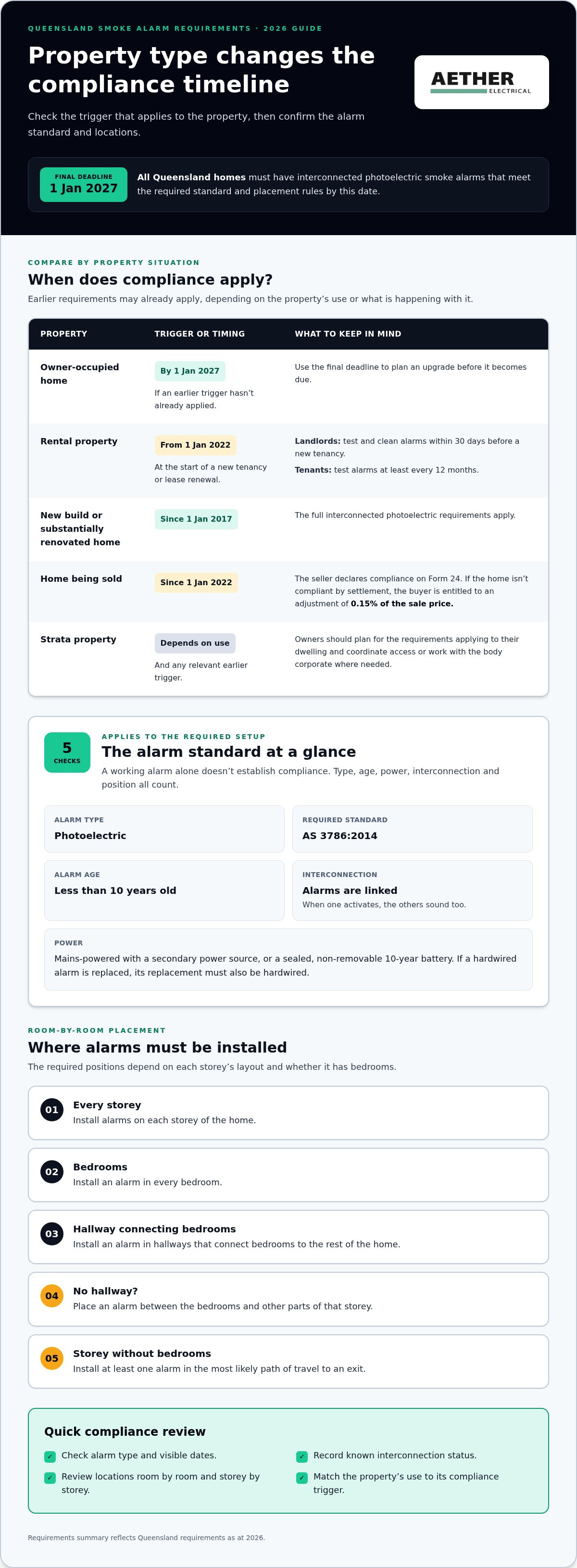
Compliance means approved photoelectric alarms that are less than 10 years old, interconnected, correctly powered and positioned as required for the home. Queensland’s requirements specify alarms that comply with AS 3786:2014. They must be mains-powered with a secondary power source, or use a sealed, non-removable 10-year battery. If a hardwired alarm is replaced, its replacement must also be hardwired.
What does an interconnected photoelectric smoke alarm do?
A photoelectric alarm detects smoke using a light-sensing method. Read a foundational explanation of photoelectric smoke alarms and how this detection method works. Interconnection means that when one linked alarm activates, the others sound too. This helps a warning from one part of the home reach people elsewhere, including in bedrooms.
That added reach matters when people are asleep or away from where smoke first appears. Alarms support an escape plan, but don’t replace one. Make sure everyone at home knows how to get out and where to meet outside.
Why does Queensland specify alarm type and placement?
The right model in the wrong spot can leave a gap in the warning system. Queensland rules require alarms on each storey, in every bedroom and in hallways connecting bedrooms to the rest of the home. If there’s no hallway, an alarm must be between the bedrooms and other parts of that storey. On a storey without bedrooms, at least one alarm must be in the most likely path of travel to an exit.
Owning an alarm, or seeing a light on a working unit, doesn’t by itself establish compliance. Alarm type, age, power source, interconnection and position all count. Property layout matters too, so a room-by-room review is more useful than simply counting alarms.
For official safety information and guidance, refer to the Queensland Fire Department. The requirements provide a clear framework; applying them to your home starts with its layout and existing alarms.
What QLD smoke alarm requirements apply to your property in 2026?
The deadline depends on how the property is used and what’s happening with it. A rental, a home being sold and an owner-occupied home can each have a different compliance trigger. The summary below reflects Queensland requirements as at 2026. For the official rules, see the Queensland Fire Department’s QLD smoke alarm requirements.
By 1 January 2027, all Queensland homes must have interconnected photoelectric smoke alarms that meet the required standard and placement rules.
| Property situation | When compliance applies | What to keep in mind |
|---|---|---|
| Owner-occupied home | By 1 January 2027, if an earlier trigger hasn’t already applied. | Use the final deadline to plan an upgrade before it becomes due. |
| Rental property | From 1 January 2022, at the start of a new tenancy or lease renewal. | Landlords must test and clean alarms within 30 days before a new tenancy. Tenants must test them at least every 12 months. |
| New build or substantially renovated home | Since 1 January 2017. | The full interconnected photoelectric requirements apply. |
| Home being sold | Since 1 January 2022. | The seller declares compliance on Form 24. If the home isn’t compliant by settlement, the buyer is entitled to an adjustment of 0.15% of the sale price. |
| Strata property | Depends on the dwelling’s use and any relevant earlier trigger. | Owners should plan for the requirements applying to their dwelling and coordinate access or work with the body corporate where needed. |
How do requirements differ for owners, landlords and property transactions?
For an owner-occupier, the key planning date is 1 January 2027 unless an earlier requirement has already applied, such as after a substantial renovation. Rental obligations are tied to tenancy events, with separate testing responsibilities for landlords and tenants. A sale has its own declaration and settlement considerations. Landlords can refer to our detailed guide to Gold Coast rental smoke alarm rules for more on tenancy responsibilities.
What alarm locations and standards should a QLD home meet?
Required alarms must be photoelectric, comply with AS 3786:2014, be less than 10 years old and be interconnected. Install them on each storey, in every bedroom and in hallways connecting bedrooms to the rest of the home. If there’s no hallway, place an alarm between the bedrooms and other parts of that storey. On a storey without bedrooms, install at least one alarm in the most likely path of travel to an exit.
Layout affects the practical plan, particularly when bedrooms open onto different areas or a home has multiple storeys. A room-by-room assessment can turn the requirements into clear installation and reporting steps. Arrange a smoke alarm assessment with Aether Electrical.
Which QLD smoke alarm rules apply to rentals, sales and strata homes?
Start with the property’s situation, not just the alarm on the ceiling. Is it owner-occupied, rented, being sold or part of a strata scheme? Different events can trigger different obligations, so one date or responsibility won’t fit every home.
What should landlords and tenants understand about smoke alarm responsibilities?
For rental homes, the key trigger is a new tenancy or lease renewal. Since 1 January 2022, the required standard has applied at the start of either event. Landlords must test and clean each alarm within 30 days before a new tenancy begins. Tenants must test alarms at least once every 12 months. The Residential Tenancies Authority’s QLD smoke alarm rules apply to rentals guidance sets out these responsibilities in more detail.
Testing isn’t the same as installation or repair. Tenants should report a fault to the landlord or property manager rather than attempting electrical work themselves. Landlords can arrange the appropriate inspection, repair or replacement and keep a clear record of the work. For a step-by-step rental overview, see our detailed guide to smoke alarm rules for Gold Coast landlords.
A home being sold has a separate compliance point. The seller must declare smoke alarm compliance on Form 24, the Property Information (Transfer) form. If the home is not compliant by settlement, the buyer is entitled to an adjustment of 0.15% of the sale price. This sale-related requirement is distinct from the obligations triggered by a tenancy.
How can owners and body corporates handle strata properties?
For a strata home, first identify the lot’s layout and alarm locations. A unit’s bedrooms and internal hallways may need a different installation plan from a shared corridor or other common area. Coordinating work in common areas doesn’t replace reviewing the alarms required within the dwelling.
Access and work can involve the lot owner, tenant, property manager and body corporate. Before work begins, clarify which alarms are in the lot, whether common areas are involved, who will arrange access and where the final compliance records will be kept.
For qld smoke alarms, match the rules to the property’s use, then document the decisions. This helps keep tenancy duties, sale paperwork and strata coordination from being treated as one catch-all requirement.
How to review QLD smoke alarms and plan the next compliance step
A quick review can show what you know, what’s unclear and what needs attention. Start with the property’s use and layout. A rental, owner-occupied home, new build or strata property may have different compliance triggers or coordination needs.
What information should you gather before arranging an assessment?
Make a simple record before arranging work. You don’t need to diagnose faults or remove alarms. Note what you can see and leave electrical checks to an electrician.
- 1. Identify the property type. Record whether it’s owner-occupied, rented, newly built or strata-managed. Note any upcoming lease change, sale or renovation.
- 2. Sketch the layout. Mark each storey, bedroom, connecting hallway and existing alarm position. Include areas without bedrooms and any unusual room arrangement.
- 3. Note visible alarm details. Record dates or labels you can read on each unit. If a date isn’t visible, mark it as unknown rather than guessing.
- 4. Record what you know about interconnection. Note whether the alarms sound together during a test. Follow the alarm’s instructions, and don’t attempt electrical work or remove units to investigate.
- 5. List anything that needs coordination. For a rental or strata property, note who manages access and where installation or compliance records should be kept.
Ready to turn your notes into a practical plan? Arrange a smoke alarm assessment with Aether Electrical.
When is professional smoke alarm installation or reporting useful?
An electrician’s assessment can clarify whether alarm locations suit the property layout, how existing alarms are connected and what installation work is needed. It’s useful when alarm dates are unclear, the layout has changed, alarms don’t sound together during a test, or you’re preparing for a tenancy or property transaction.
For qld smoke alarms, a clear record matters alongside the installation. Keep a note of the work completed and alarm locations. A compliance safety report gives homeowners and landlords documentation of the testing and compliance work, and can make future reviews easier if the property’s use or management changes.
If the assessment identifies wider electrical work around the home, the Gold Coast home electrical services guide offers a broader overview. Keep the next step simple: gather the property details, assess the layout, then organise the installation and reporting needed for your situation.
Arrange QLD smoke alarm installation and compliance reporting with Aether Electrical
Once you know what your property needs, turn the requirements into a clear installation plan. Aether Electrical installs interconnected photoelectric smoke alarms and provides testing and compliance safety reports for homeowners and landlords across the Gold Coast, Tweed, Tweed Heads, Northern Rivers, Ocean Shores and Byron Bay.
What happens during a smoke alarm installation visit?
The process starts with the property. Its use, storeys, bedrooms and connecting hallways help shape alarm locations and the installation plan. Existing alarms matter too, including their position, visible age and whether they’re already interconnected. Sharing what you know about the home helps focus the assessment.
Aether Electrical can then install interconnected photoelectric alarms and test the system. Testing checks how the alarms respond together, so the work involves more than fitting units in place. It checks the setup as an interconnected system in the home.
For homeowners and landlords, a compliance safety report provides a record of testing and compliance work. Keep it with the property’s other important documents to make future checks, tenancy changes or property transactions easier to manage.
How can local property owners take the next step?
Keep the first conversation simple. Explain whether the property is owner-occupied, rented or strata-managed, and what prompted the review. It might be an upcoming lease, an unclear alarm date, a layout change or uncertainty about interconnection. A floor plan or a short list of existing alarm locations can help describe the setup.
The work follows a practical sequence: discuss the property’s needs, assess the layout, install the required alarms, then test and document the work. If the property has shared areas or access arrangements, mention them early so the work can be planned clearly. You don’t need to have every answer before getting started.
For qld smoke alarms, a professional assessment can replace guesswork with a property-specific plan. Aether Electrical supports local homeowners and landlords with installation and reporting across the Gold Coast, Tweed, Tweed Heads, Northern Rivers, Ocean Shores and Byron Bay.
Arrange smoke alarm installation and compliance support with Aether Electrical.
Make your next smoke alarm check straightforward
Queensland smoke alarm compliance involves more than having a working alarm. Alarm type, interconnection and placement all matter, and the rules can depend on whether your property is owner-occupied, rented, being sold or part of a strata scheme.
Start by noting how the property is used, where alarms are located, any visible dates and whether the units sound together. This simple review can help pinpoint what needs attention and clarify the next step.
Aether Electrical installs interconnected photoelectric smoke alarms and provides testing and compliance safety reports for homeowners and landlords across the Gold Coast, Tweed, Tweed Heads, Northern Rivers, Ocean Shores and Byron Bay. For qld smoke alarms, installation and reporting can follow one practical pathway, from assessing the layout to documenting the work.
Arrange smoke alarm installation and compliance support with Aether Electrical, and take the next step with a clear plan for your property.
Frequently Asked Questions
Are interconnected smoke alarms compulsory in Queensland?
Yes. Queensland’s requirements call for required smoke alarms in a home to be interconnected. When one alarm detects smoke and sounds, the linked alarms sound too, extending the warning through the dwelling. The deadline depends on the property’s circumstances. Rental, sale and new-build requirements have applied since earlier dates, while the final deadline for all homes is 1 January 2027. Check which trigger applies to your property.
By when do Queensland homes need compliant smoke alarms?
All Queensland homes must meet the interconnected photoelectric smoke alarm requirements by 1 January 2027. Some properties already have earlier compliance triggers. New builds and substantially renovated homes have been subject to the full requirements since 1 January 2017. Rental properties and homes being sold have had requirements since 1 January 2022. For rentals, the start of a new tenancy or lease renewal is a key trigger.
Where do smoke alarms need to be installed in a Queensland home?
Alarms are required on each storey, in every bedroom and in hallways connecting bedrooms to the rest of the home. If there’s no hallway, an alarm must be installed between the bedrooms and other parts of that storey. On a storey without bedrooms, at least one alarm must be in the most likely path of travel to an exit. The floor plan helps determine the right arrangement.
Do rental properties have different smoke alarm rules in QLD?
Yes. Rental properties have specific responsibilities tied to tenancy events. The required standard applies at the start of a new tenancy or lease renewal. Landlords must test and clean each alarm within 30 days before a new tenancy begins, while tenants must test alarms at least every 12 months. Tenants should report faults to the landlord or property manager, not attempt electrical installation or repairs themselves.
Do smoke alarms in Queensland need to be photoelectric?
Yes. Required alarms must be photoelectric, comply with Australian Standard AS 3786:2014 and be less than 10 years old. They must also be interconnected. Permitted power options are mains power with a secondary power source, or a sealed, non-removable 10-year battery. If a hardwired alarm is replaced, the replacement must also be hardwired. Check the alarm’s markings and installation details as part of a compliance review.
Can I install or replace a QLD smoke alarm myself?
It depends on the alarm and the work involved. A hardwired alarm replacement must also be hardwired, so arrange this electrical work through an electrician. Correct placement, interconnection and compliance with the required standard still matter for any alarm. A new unit alone doesn’t make the home compliant. If you’re unsure about the existing setup, an electrician can assess the layout and installation needs.
How do I know whether my Queensland smoke alarms are compliant?
Check the alarm type, visible date, power source, location and whether linked alarms sound together when tested according to their instructions. Required alarms must be photoelectric, less than 10 years old, interconnected and placed in the required rooms and storeys. A working alarm alone doesn’t confirm compliance. Aether Electrical installs, tests and reports on smoke alarms for local homeowners and landlords across the Gold Coast, Tweed, Tweed Heads, Northern Rivers, Ocean Shores and Byron Bay.


