
What if the lowest solar battery price isn’t the best-value option for your home? A headline figure can leave out important differences, from usable storage and inverter compatibility to switchboard work and backup capability. That makes quotes difficult to compare at a glance.
Before investing, it helps to understand whether your existing solar system can support a battery and whether the storage will suit your household’s energy use. The right option depends on more than the battery itself.
This guide explains what a battery quote can include and how to compare options on a like-for-like basis. You’ll learn what usable capacity means, what can affect installation scope and what to consider if you want backup power. We’ll also cover the property details to gather before planning a tailored installation for your Gold Coast, Tweed or Northern Rivers home.
Key Takeaways
- Compare the equipment, electrical work and commissioning included, not just the headline solar battery price.
- Check usable capacity, power output and inverter compatibility to see how well each option suits your home.
- Battery value depends on your household’s solar use, evening energy needs, electricity plan and installation scope.
- Gather details about your existing solar system, switchboard, preferred battery location and backup priorities before comparing quotes.
- Aether Electrical considers solar, battery and switchboard requirements together for properties across the Gold Coast, Tweed and Northern Rivers.
Solar battery price: what does a battery quote actually include?
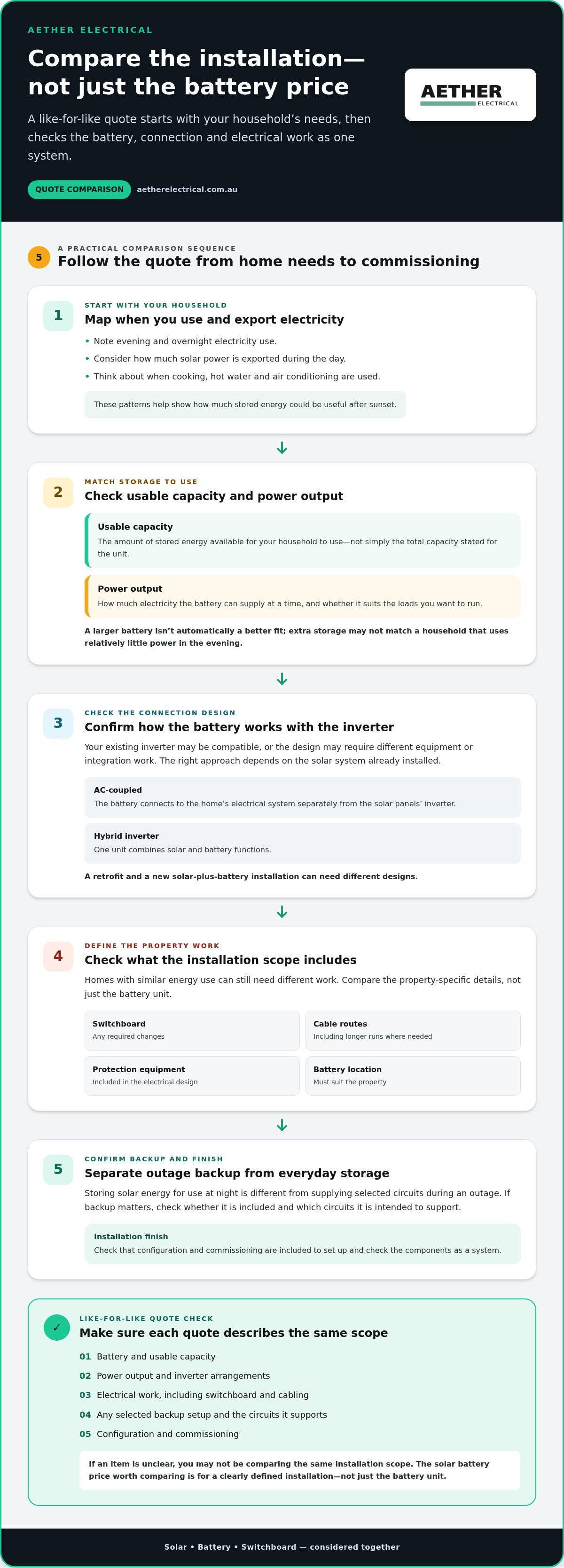
A listed battery price may cover equipment alone. An installed quote should describe the battery and the work needed to connect it safely with your solar and household electrical system. This can include inverter integration, switchboard work, cabling, system configuration and commissioning.
So the solar battery price worth comparing is for a clearly defined installation scope, not just a battery unit. A battery energy storage system stores electricity for later use; see this overview of a battery energy storage system for more background.
Which parts of an installed battery quote affect the total?
The battery is only one part of the picture. Its usable capacity is the amount of stored energy available for your home to use, rather than simply the total capacity stated for the unit. Check that the quote identifies the usable capacity.
Next, consider how the battery will connect to your solar system. Your existing inverter may be compatible, or the design may require different equipment or integration work. The right approach depends on the system already installed.
Electrical work can also affect the scope. Switchboard changes, cable routes, protection equipment and battery location all need to suit the property. Configuration and commissioning complete the installation by setting up and checking the components as a system.
Why can two solar battery quotes differ?
Two homes with similar energy use can need different installation work. One may have a compatible solar setup and a straightforward battery location. Another may need switchboard changes, longer cable runs or a different connection design. A site-specific electrical assessment helps identify these differences.
Backup capability can also change the design. Supplying selected circuits during an outage is different from storing solar energy for use at night. Be clear about whether backup matters to you and which parts of the home you want it to support.
Compare inclusions, not just the bottom line. Check that each quote describes the battery and usable capacity, inverter arrangements, electrical work, any selected backup setup, configuration and commissioning. If an item is unclear, you may not be comparing the same installation scope. Aether Electrical considers solar, battery and switchboard requirements together, whether you’re adding storage to an existing system or planning solar and a battery as one project.
Compare solar battery options by capacity, inverter and backup needs
Start by comparing what each battery can do in your home, not just its headline capacity. Stored energy capacity describes how much electricity a battery can hold; power output describes how quickly it can supply that electricity. Both matter if you want to run several appliances at once or support selected circuits during an outage.
A larger battery isn’t automatically a better fit. If your household uses relatively little power in the evening, extra storage may not match your needs. Compare the system design and installation scope alongside capacity. General research, such as the U.S. Department of Energy’s Cost projections for battery storage, looks at broader cost trends, but can’t determine which configuration suits your property.
| Compare | What to look for |
|---|---|
| Usable capacity | How much stored energy is available for your household to use. |
| Power output | How much electricity the battery can supply at a time, and whether it suits the loads you want to run. |
| Inverter setup | How the battery connects with your existing solar system, or the inverter planned for a new installation. |
| Backup | Whether backup is included in the design and which circuits it is intended to support. |
| Installation scope | Any switchboard, cabling, protection, configuration or commissioning work included. |
How much battery capacity does a household need?
Start with your evening and overnight electricity use. Then consider how much solar power your home exports during the day and when you typically use appliances such as cooking, hot water or air conditioning. Together, these patterns help indicate how much stored energy could be useful after sunset.
Usable capacity is the portion available to serve those needs. Assessing your household’s energy use is more helpful than choosing a battery by its capacity label alone. The right size depends on your solar generation, routines and priorities.
Does the inverter setup affect solar battery price?
Yes. An AC-coupled arrangement connects a battery to the home’s electrical system separately from the solar panels’ inverter. A hybrid inverter combines solar and battery functions in one unit. Either approach may suit a project, depending on the existing solar equipment and proposed configuration. A retrofit and a new solar-plus-battery installation can require different designs.
When comparing the solar battery price, check that each option states usable capacity, power output, inverter arrangement, backup design and installation inclusions. Aether Electrical assesses solar, battery and switchboard requirements together. Explore solar and battery installation for your property.
Will a solar battery pay off? Assess value, incentives and limitations
A battery’s value depends on when your household uses energy. The potential benefit comes from how well stored solar energy fits your daily pattern, not from storage capacity alone.
Look at your solar surplus during the day and how much electricity your household uses in the evening. A home that exports solar regularly and draws more power after sunset may have different storage needs from one where people are home and using energy during daylight hours. Occupancy, appliance use and household routines all shape the picture.
Your electricity plan matters too. Tariffs, export arrangements and retailer terms can affect the value of storing or exporting energy. These can change, so use current plan details when assessing an estimate. The economics of battery storage also depends on the wider energy market, but broad market analysis can’t predict the result for an individual home.
What changes a battery’s likely value at home?
Savings estimates rely on assumptions. Check what they use for solar generation, energy use, tariffs, export rates, battery operation and installation scope. If your routines or electricity plan change, the outcome may change too. Treat estimates as scenarios, not a promise of lower bills or a set payback period.
There may also be value beyond bill savings. A battery can help you use more of your own solar energy, while backup capability may offer added resilience during a power outage, depending on the system design. Consider these separately: energy independence and backup may matter to your household even if they don’t appear as direct bill savings.
What should you know about Australian battery incentives?
Before including an incentive in your calculations, check current national and Queensland eligibility information. Don’t assume a battery or installation qualifies. Eligibility and any calculation can depend on system and installation details, so confirm the rules that apply to your project before treating an incentive as part of its expected value.
For a grounded comparison, assess the solar battery price alongside installation scope, your usage pattern and your current electricity plan. A site-specific assessment brings those factors together. Aether Electrical considers solar, battery and switchboard requirements for residential battery storage installations across the Gold Coast, Tweed and Northern Rivers.
What should Gold Coast and Northern Rivers homeowners check before comparing quotes?
Preparing a few details makes it easier to compare battery options against your actual home rather than a generic estimate. Gather the information below before discussing a solar battery price. A licensed electrician’s site assessment can then clarify how a battery could integrate with your solar and switchboard, and what work the property needs.
What information helps clarify a battery quote?
- Existing solar system: Note the system’s age and size, and gather paperwork identifying its inverter. If you can’t find the details, a clear photo of the inverter label can help.
- Electricity use: Have recent bills handy. Note when people are usually home, which appliances run in the evening and whether your household’s routines change across the week.
- Switchboard: Take a clear photo and note any known electrical issues or recent upgrades. This gives the site assessment a useful starting point.
- Backup priorities: List the essential circuits you’d want powered during an outage, such as lighting or refrigeration. Backup needs can influence the system design.
- Possible battery location: Consider access, available space, ventilation and exposure to sun, rain or salt air. The location needs to suit the property and the battery’s installation requirements.
These details help clarify the project, but they don’t replace an on-site assessment. Switchboard condition, cable routes and compatibility with existing solar equipment need to be considered in the context of the property. For related switchboard and electrical work, see our Gold Coast home electrical services.
How can coastal conditions affect battery installation planning?
Coastal exposure is a practical factor when choosing equipment location and planning an installation. Properties across the Gold Coast, Tweed, Tweed Heads, Ocean Shores and Byron Bay can have different levels of exposure to weather and salt air, depending on their position and layout. That doesn’t mean every coastal home needs the same solution.
Battery placement should suit the property and the manufacturer’s installation requirements. A site assessment can consider shelter, access, ventilation and the route for connecting equipment to the home’s electrical system. Don’t assume a location or product is suitable based on a general coastal rule. Conditions at the property and equipment requirements matter.
Considering solar, battery and switchboard needs together helps clarify the installation scope before you compare options. Arrange a solar and battery assessment with Aether Electrical for your local property.
Get a solar battery price that matches your home and existing solar
A useful quote makes the proposed system and installation scope clear. Before deciding, compare the details side by side rather than focusing only on the headline figure.
- Equipment: Check which battery and related equipment are included.
- Usable capacity: Compare the energy available for your home to use, not only the battery’s stated capacity.
- Inverter integration: Make sure the quote explains how the battery connects with your existing solar system or planned setup.
- Backup: Check whether backup is part of the design and which circuits it is intended to support.
- Electrical work: Review any switchboard, cabling or protection work included, along with stated exclusions.
- Commissioning: Check that configuration and commissioning are part of the quoted scope.
If you’re comparing estimated savings, use the same household energy use, solar generation and electricity plan assumptions for each option. Otherwise, you may be comparing different scenarios rather than different systems. For a combined solar and battery project, the Gold Coast solar panel installation buying guide can also help you consider the wider system together.
What happens when you arrange a local battery installation?
Planning starts with your existing solar, energy use and priorities, including whether backup matters to you. A property assessment helps establish how the battery could integrate with your solar system and switchboard, and what installation work is needed.
The system is then planned around the property and its requirements. Installation and commissioning complete the work, with the equipment configured as a connected system. Aether Electrical tailors the scope to your home, whether you’re adding a battery to existing solar or planning a combined installation.
For a clear solar battery price shaped around your property, discuss battery storage installation with Aether Electrical. Local homeowners across the Gold Coast, Tweed and Northern Rivers can discuss a tailored battery installation.
Make your next battery decision with confidence
A useful solar battery price reflects more than the battery itself. Compare usable capacity, inverter compatibility, backup needs and included electrical work, then consider how the system fits your household’s energy use. Savings estimates depend on their assumptions, so treat them as a guide rather than a promise.
The right installation also depends on your existing solar and switchboard. A site-specific assessment helps bring those requirements together and clarify the work your home needs. Aether Electrical installs solar and battery systems across the Gold Coast, Tweed and Northern Rivers, with electrical services that include switchboard upgrades and solar system servicing.
Ready to explore a battery for your home? Talk with Aether Electrical about a solar battery for your home. A clear, tailored plan is a practical first step towards choosing with confidence.
Frequently Asked Questions
How much does a solar battery cost in Australia in 2026?
There’s no single solar battery price that applies to every home. The installed cost depends on the battery and any inverter, electrical and switchboard work, backup requirements, and the time needed to integrate and commission the system. A site-specific quote gives a more useful figure than a battery-only listing. Aether Electrical tailors battery installation scope to the property and its existing solar setup.
What affects the price of a solar battery installation?
Battery equipment is only one part of an installation quote. Usable capacity, compatibility with your solar inverter, battery location and cable routes can all affect the work involved. Switchboard changes, electrical protection and backup circuits may also shape the design. Compare what each quote includes, including configuration and commissioning, and note exclusions to see whether the proposed installations have the same scope.
Is a solar battery worth it in Queensland?
It depends on your household’s solar surplus, evening electricity use, electricity plan and installation scope. A battery may help you use more of your own solar power, but savings estimates rely on assumptions and aren’t guaranteed. Backup or greater energy independence may also matter to your household, separately from bill savings. Check current Queensland and national incentive eligibility before including any incentive in your calculations.
Can I add a battery to my existing solar system?
A battery can often be added to an existing solar system, but the design depends on your current inverter, solar equipment and electrical setup. Some systems may suit an AC-coupled battery, while others may need a different integration approach. A site assessment can clarify compatibility, switchboard requirements and installation scope. Aether Electrical installs and services solar and battery systems across the Gold Coast and Northern Rivers region.
How do I compare solar battery quotes?
Compare the same details in each quote: battery equipment, usable capacity, inverter arrangement, backup circuits, electrical work and commissioning. Check exclusions as well as inclusions. If quotes show estimated savings, compare them using the same assumptions for household use, solar generation and electricity plan. This lets you compare the installation and its stated benefits on a like-for-like basis, rather than relying on the headline figure alone.
Do I need a new inverter to install a solar battery?
Not always. Whether your existing inverter can work with a battery depends on its compatibility and the proposed system configuration. An AC-coupled arrangement connects the battery separately to the home’s electrical system, while a hybrid inverter combines solar and battery functions. Neither option suits every home by default. Assessing your existing solar equipment helps establish the appropriate integration and any inverter work required.
Can a solar battery power my home during a blackout?
It can if the system is designed and configured for backup operation. A battery installation intended mainly to store solar energy may not automatically power the home during an outage. Backup design can depend on compatible equipment, system configuration and which circuits you want supplied. Identify essential loads, such as refrigeration or selected lighting, and have the installation plan set out what the backup system is designed to support.


