

A bigger battery isn't automatically the better fit. To work out how to choose a solar battery in the Northern Rivers, start with your after-dark electricity use and winter solar generation: a household using 20 kWh a day typically uses 10 to 12 kWh after dark, while a Northern Rivers winter day generates roughly 30 per cent less solar electricity than the yearly daily average. Then compare usable storage, power output and whether the system is configured to provide backup during an outage.
It makes sense to want enough stored energy for the evening and backup power when the grid goes down. But capacity is only part of the decision. Your appliances, solar system and the circuits you want to keep running all affect what a battery can do.
This guide explains how to estimate your household’s storage needs, compare battery capacity and output, and plan blackout backup around essential circuits. You’ll also learn what to consider when reviewing battery lifespan and warranty coverage, helping you assess what may suit your Northern Rivers home.
Key Takeaways
- Choose a battery configured for blackout backup, then identify the essential circuits you want it to power.
- Compare usable storage and power output, not just the battery’s headline capacity.
- Use your after-dark electricity use to estimate storage needs; a Northern Rivers household using 20 kWh daily typically uses 10 to 12 kWh after dark.
- Allow for seasonal changes: a Northern Rivers winter day generates roughly 30 per cent less solar electricity than the yearly daily average.
- Compare warranty terms, expected lifespan and remaining capacity to understand how a battery may perform over time.
1. Blackout backup capacity and essential circuits
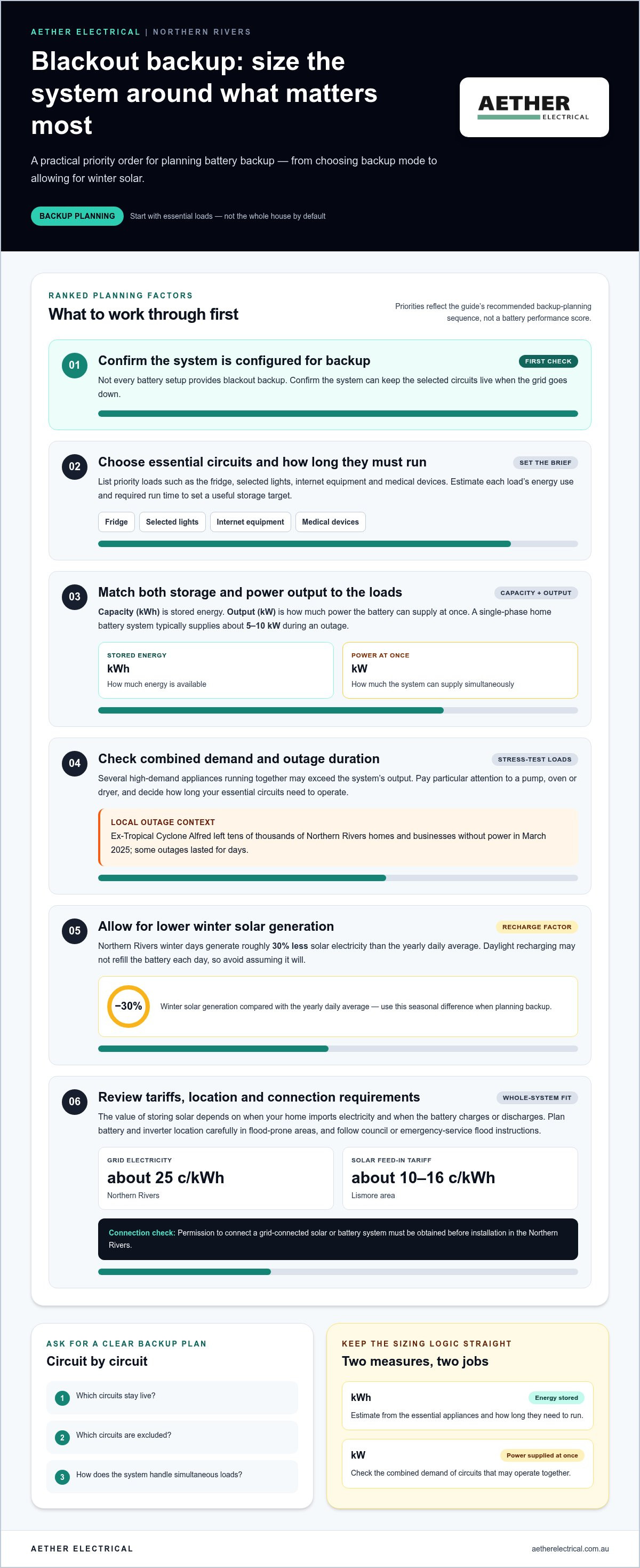
For blackout planning, size the battery around the essential circuits you want to power and how long they need to run. The system must be configured for backup, as not every battery setup provides it. Start by listing priority circuits, such as the fridge, selected lights, internet equipment and medical devices, then estimate their required run time. This gives you a more useful target for usable capacity than assuming you can run every appliance as usual.
Local tariffs affect the savings from storing solar power. Grid electricity in the Northern Rivers costs about 25 c/kWh, while solar feed-in tariffs in the Lismore area are about 10–16 c/kWh. A battery can improve payback by storing solar energy for use later, rather than exporting it for a lower credit. Time-of-use rates can also influence the value: savings depend on when your home imports electricity and when the battery charges or discharges.
Separate capacity from output. Capacity, measured in kWh, indicates stored energy; output, measured in kW, indicates how much power the battery can supply at once. A single-phase home battery system typically supplies about 5 to 10 kW during an outage. That output can support essential loads, but running several high-demand appliances together may exceed the system’s limit. Check the combined demand of the circuits you want backed up, especially if they include a pump, oven or dryer.
Size backup for the loads and outage duration you’re preparing for, not the whole house by default. Ex-Tropical Cyclone Alfred left tens of thousands of Northern Rivers homes and businesses without power in March 2025, with some outages lasting for days. Estimate each essential appliance’s energy use and add the hours it must run. Then consider whether solar can recharge the battery during daylight. Winter solar generation is roughly 30 per cent lower than the yearly daily average, so don’t assume each day will refill storage.
Ask for a circuit-by-circuit backup plan: which circuits stay live, which are excluded, and how the system handles simultaneous loads. In flood-prone areas, include the battery and inverter location in the plan. Follow council or emergency-service flood instructions rather than relying on household backup power. Some systems can use grid power as backup and export excess energy when the grid is available. In the Northern Rivers, permission to connect a grid-connected solar or battery system must be obtained before installation.
2. What Types of Solar and Battery Systems Are Popular in the Northern Rivers?
Northern Rivers homeowners commonly compare grid-connected and off-grid systems. A grid-connected solar system can export excess electricity when generation exceeds household use, while a battery stores energy for later. Off-grid systems operate without a regular grid connection, so solar generation, battery storage and backup arrangements must support the home’s energy needs. The right design depends on daily use, the roof and connection requirements.
Lismore provides a useful local guide to solar generation. A 3 kW solar system is estimated to generate about 12 kWh per day on an annual average; a 5 kW system, about 20 kWh. Estimates rise to 28 kWh for 7 kW and 40 kWh for 10 kW. These figures assume 80 per cent system efficiency and north-facing panels tilted at 30 degrees. Roof direction and seasonal conditions affect actual output.
Battery systems differ in capacity, output and how they connect with solar panels and inverters. Sonnen and Skybox are names homeowners may encounter while comparing systems. Assess each option by its usable storage, power output and backup capability, not brand name alone. Also consider whether it suits your existing solar system and the household circuits you want to support during an outage.
Adding storage to existing solar commonly uses AC coupling in Australia. The battery connects through its own inverter, which can make this approach suitable for an established solar system. A new solar system and battery can instead be planned together. Compare the options against your current inverter, solar generation and likely future electricity use, so the design fits your home rather than relying on a single capacity figure.
In the Northern Rivers, permission to connect a grid-connected solar or battery system must be obtained before installation. Essential Energy owns or operates the local poles and wires. Approval requirements can depend on the proposed installation, so check what applies before proceeding. The federal battery rebate requires an eligible battery on the Clean Energy Council approved list. On-grid systems also need virtual power plant capability under the Cheaper Home Batteries Program.
A battery installer should be registered or licensed and accredited for battery installation. For a practical comparison, assess solar generation, connection type and storage together; solar and battery system planning can help bring those decisions into one design.
3. Assessing household energy use and daily battery capacity
Start with your electricity use, not a battery size in a brochure. Check your bills for daily consumption, then note which appliances run after sunset. Separate steady loads, such as refrigeration, from occasional high-demand appliances. This helps show whether storage should cover evening basics, regular overnight use or a broader share of household demand. If you already have solar, compare daytime generation with the energy you still draw from the grid.
Household batteries in Australia typically have a capacity of 4 to 14 kWh, while most Northern Rivers homes use systems between 9 and 27 kWh. Treat those ranges as context, not a sizing formula. Your evening use, solar surplus and backup needs determine the useful capacity. A battery that’s too small may run out early; excess capacity can sit unused if daily consumption and charging opportunities are low.
Separate nominal capacity from usable capacity. For lithium-ion batteries, usable capacity is typically 5% to 10% less than actual capacity. A 20 kWh battery supplying a home using an average of 4 kW can run it for roughly five hours, before minor transfer losses. That example shows why both stored energy and appliance demand matter. Check whether the quoted capacity is nominal or usable before comparing systems.
Power output is a different measure from capacity. Kilowatt-hours describe stored energy; kilowatts describe how much power the battery can deliver at once. A high-capacity battery may still struggle with multiple appliances if its inverter output is limited. Compare inverter output with the combined demand of the appliances likely to run together. A 5 kW inverter, for example, cannot supply a simultaneous 7 kW load from a 3 kW oven and 4 kW dryer.
Match solar generation and storage to the energy available to charge the battery. More storage won’t help if your solar system rarely produces enough surplus to fill it. If generation is the constraint, adding panels may be more useful than enlarging storage. For existing solar, review inverter capacity and compatibility before planning a battery expansion. If you want the option to expand later, make sure the proposed design explains how additional storage would connect.
Compare capacity, usable energy, power output, efficiency and warranty together. Lithium home batteries should usually be more than 90% efficient, and residential warranties commonly run for 10 years, often tied to cycle numbers or energy throughput. Read the warranty’s capacity-retention terms alongside the usable-energy figure. This gives households a more practical comparison than headline capacity alone, and helps identify whether a cheaper system meets the same daily needs.
4. Warranty coverage and expected battery lifespan
A warranty gives one measure of a battery’s expected service life, but the headline term isn’t the whole story. Residential solar batteries in Australia often have 10-year warranties or guarantees tied to cycle numbers or energy throughput. Compare the coverage conditions alongside usable capacity and expected daily use. A system reaching its throughput limit before the stated term may be treated differently from one used less intensively.
Read the battery warranty for its covered period, capacity-retention terms and any cycle or energy-throughput limits. These details show what performance the manufacturer expects over time. A typical lithium home battery may retain about 60–80% of its original capacity at the end of its expected life. That reduced storage can still serve household appliances, but it may not meet the same overnight needs as a new battery.
Expected lifespan depends on battery type and operating conditions. Home batteries should be able to last 10 years or more under normal usage when they aren’t exposed to extreme temperatures. A well-chosen solar battery can provide reliable performance for 10 to 15 years or more under typical usage. Lithium-ion batteries can last up to 15 years, while lead-acid batteries are estimated to last 5 to 7 years.
Check how the battery responds to prolonged periods at low charge. Battery chemistry can affect how systems respond to low charge levels, so check the guidance for the model you are considering. This can matter when solar generation falls or household use leaves little energy in storage. Compare battery chemistry and warranty terms with how you expect to use the system, rather than assuming all batteries have the same lifespan.
Compare warranties across the whole solar system, not just the battery. The standard solar panel performance warranty is 25 years, while inverter warranties range from 5 to 10 years, depending on the brand and offer. Those different timeframes mean panels, batteries and inverters may need attention at different stages. Keep the warranty documents together and note which component each one covers.
Installation and placement also matter for a safe, durable system. Choose an installer who is registered or licensed and accredited for battery installation. In flood-prone parts of the Northern Rivers, solar inverters and batteries should be mounted as high as practically possible. Consider exposure to heat and flooding, and compare the proposed location with the manufacturer’s installation instructions. A suitable battery and clear warranty terms are only part of the decision; correct installation helps the system meet its intended use.
5. Battery sizing from household electricity use and winter solar generation
Knowing how to choose a solar battery in the Northern Rivers starts with matching storage to after-dark electricity use, then allowing for backup needs. A household using 20 kWh daily typically consumes 10 to 12 kWh after dark. That gives you a useful starting point, not an automatic battery specification. Compare that requirement with usable capacity, since lithium batteries can typically be safely discharged to about 80–90% of nominal capacity. Keep stored energy and power output distinct: kilowatt-hours describe energy, while kilowatts describe delivery rate.
Winter changes the charging picture. The Northern Rivers receives about 5 peak sun hours per day on average across the year, but a winter day generates roughly 30 per cent less solar electricity than the yearly daily average. A battery sized only around summer surplus may not recharge fully during cloudy winter periods. Check your solar system’s seasonal production against household use before adding storage. More solar panels can help provide power in cloudy weather, rather than relying only on a larger battery.
Use your household’s energy profile to refine the target. Review evening and overnight consumption in your electricity data, then identify appliances that must run during an outage. Separate essential loads from optional ones, such as a clothes dryer or oven. Estimate how long essential appliances need power, and include the energy required to recharge devices. This ties capacity to actual use instead of choosing a battery based on household size alone.
Plan charging around daylight as well as storage. Running appliances while solar panels are generating lets you use more electricity directly, reducing the amount needed from the battery overnight. Energy-efficient appliances can also reduce storage needs. For backup, reserve some capacity for essential circuits rather than planning to use every kilowatt-hour for routine evening consumption. The right balance depends on your outage priorities and available winter solar generation.
Compare savings against the complete system: solar panels, battery, inverter and household consumption. A larger battery won’t generate extra electricity; it only stores available surplus. A smaller battery may suit a home that shifts appliance use into daylight. Check whether the inverter can charge and discharge at the rate your home needs, and whether the battery can be expanded if future electricity use changes. Seasonal performance is an important part of how to choose a solar battery in the Northern Rivers.
To set a capacity target, bring together daily use, after-dark consumption, winter solar output and backup priorities. Arrange solar and battery installation to plan a system around those household figures.
Aether Electrical: Domestic Electrical Services
Aether Electrical provides Battery Storage Installation and Solar Installation & Servicing for Northern Rivers homes. If you’re weighing storage capacity, solar generation and blackout backup, Aether can provide a free design and quote for a solar and battery project. The team also provides Domestic Electrical Services for household electrical needs.
Turn to Aether Electrical when you’re ready to plan a battery system, add storage to existing solar, or review how solar and battery components work together. The right setup depends on your household’s electricity use, backup priorities and current solar system. Clear requirements make it easier to shape the work around your home.
Contact Aether Electrical to discuss your solar and battery installation.
Turn your battery shortlist into a clear plan
The best next step is to turn your priorities into a practical system brief. Note which appliances matter during an outage, how you expect to use electricity at home and whether your plans may change. This gives the design conversation a useful starting point instead of leaving the decision to a capacity figure alone.
If you’re still weighing how to choose a solar battery in the Northern Rivers, focus on how the system should work for your household day to day. Aether Electrical offers Domestic Electrical Services, Solar Installation & Servicing, and Battery Storage Installation, including a free design and quote for solar and battery projects. Contact Aether to discuss your home’s electrical needs and solar plans.
Take the next step at your pace. Contact Aether Electrical today to discuss your solar and battery plans. A considered design can make the decision feel simpler and help you move forward with confidence.
Frequently Asked Questions
What about batteries?
A battery stores electricity for use after your solar panels stop generating or when the grid is unavailable. For example, a household can store daytime solar energy to run selected appliances later. First decide what you want the battery to do: shift solar use into the evening, provide blackout backup or both. That purpose shapes the capacity, power output and system configuration to compare.
What Types of Solar and Battery Systems Are Popular in the Northern Rivers?
Grid-connected solar and battery systems are a common option for homes that remain connected to the electricity network. Off-grid systems suit properties designed to operate independently, with generation and storage planned around household demand. For existing solar, AC-coupled batteries are a common retrofit arrangement in Australia. Compare the system’s connection type, solar generation and backup function rather than choosing by its label alone.
Are home batteries a worthwhile investment?
A home battery may be worthwhile when the value of using stored solar electricity and having backup power matches your priorities. Its financial value depends on how much solar energy would otherwise be exported, how much grid electricity you use later and the applicable tariffs. Backup also has practical value during outages, although electricity savings alone don’t capture it. Compare expected use with the system’s full installed cost.
How do home solar batteries work?
Solar panels generate electricity during daylight, and household appliances use available power first. If generation exceeds immediate use, the system can charge the battery. Later, stored energy can supply the home when solar production falls. An inverter manages the flow between the solar panels, battery and household circuits. If the grid fails, only a system configured for backup can supply selected circuits; ordinary grid-connected operation does not guarantee power during an outage.
Is the federal battery rebate still available, and when does it step down?
The Cheaper Home Batteries Program provides an upfront discount for eligible small-scale battery installations. The rebate factor is 6.8 for installations through 31 December 2026, then 5.7 from 1 January 2027 and 5.2 from 1 July 2027. To qualify, the installation must be on or after 1 July 2025, and the battery must meet the program’s eligibility requirements.
Which solar batteries are best suited to Northern Rivers homes and climate?
There isn’t one battery that suits every Northern Rivers home. Compare usable capacity, output, backup configuration and expansion options against your household’s needs. Examples in the market include Sungrow SBR systems with 9.6–25.6 kWh capacity, Sigenergy SigenStor systems with 5–40 kWh or more, and Pylontech Pelio units at approximately 10.65 kWh each. In flood-prone areas, installation location also matters.
What are the current NSW and Australian rebates or incentives for home batteries?
Australia’s Cheaper Home Batteries Program offers an upfront discount on eligible battery installation costs. Eligible systems have nominal capacity of 5–100 kWh, with support applied to the first 50 kWh of usable capacity; on-grid systems need virtual power plant capability. The NSW Government says eligible homeowners with combined taxable household income of $210,000 or less can apply for a 0% interest Home Energy Saver loan of up to $15,000 for solar and batteries, over up to 10 years.
How can I estimate solar battery savings and payback for my electricity usage?
Start with your electricity bills and identify how much power you buy after solar generation falls. Estimate how much of that use a battery could cover, then compare the avoided grid charges with the feed-in credit you give up by storing electricity instead of exporting it. For a simple payback estimate, divide the net system cost by estimated annual savings. Use your own tariffs and usage patterns in the calculation.


