

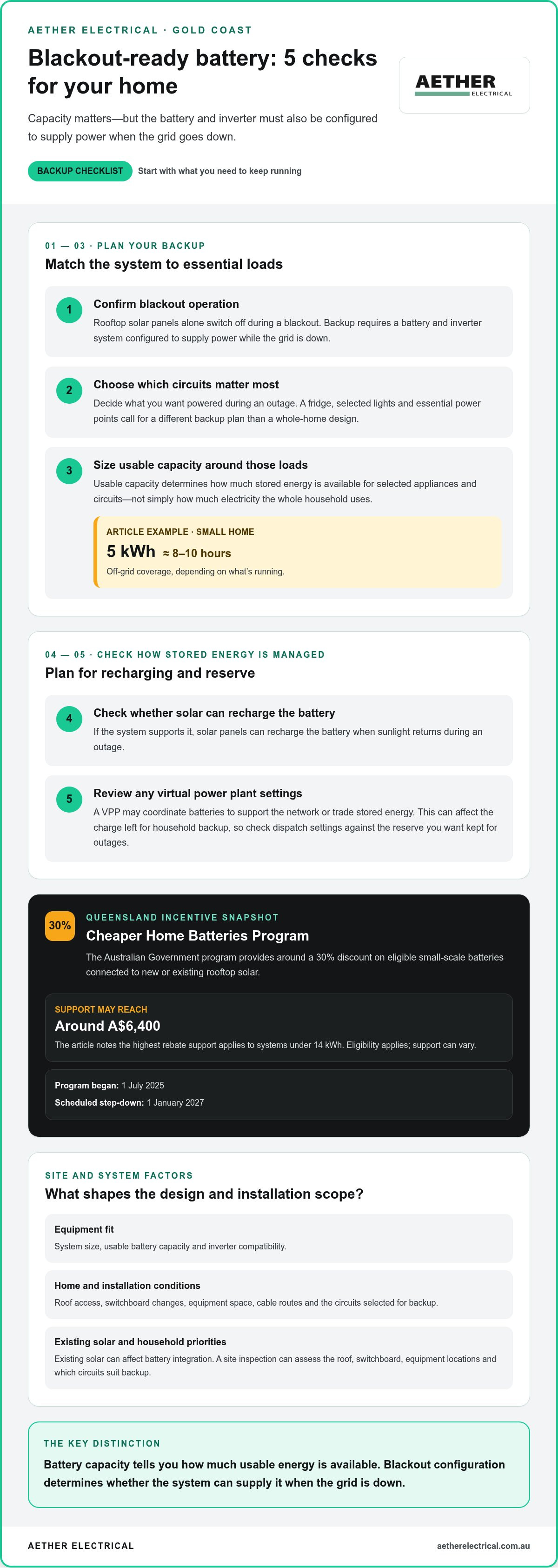
A solar battery’s usable capacity sets how much stored energy your home can draw on during a blackout. As a guide, a 5 kWh battery can provide around 8-10 hours of off-grid coverage for a small home, depending on what’s running. For a solar battery for blackout protection on the Gold Coast, capacity matters, but so does having a system configured to supply power when the grid goes down.
It’s easy to assume rooftop solar will keep the lights on during an outage. But solar panels alone switch off during a blackout. Backup depends on the battery and inverter setup, as well as which circuits you want to keep powered.
This guide explains how battery capacity relates to household electricity use, what affects backup time and how rebates may apply in Queensland. You’ll also learn how a solar and battery system can support essential appliances during an outage, and what to consider when planning a setup for your home.
Key Takeaways
- Size battery capacity around the appliances and circuits you want to run, not just your household’s total electricity use.
- A 5 kWh battery can provide around 8-10 hours of off-grid coverage for a small home, depending on what’s running.
- Rooftop solar alone switches off during a blackout; backup depends on a battery and inverter system configured to supply power when the grid is down.
- The Australian Government’s Cheaper Home Batteries Program provides around a 30% discount on eligible small-scale battery systems connected to new or existing rooftop solar.
- Compare usable capacity, backup configuration and rebate eligibility to understand how a battery could suit your home.
Is there a solar battery rebate available in Gold Coast?
Yes. Gold Coast households may be eligible for Australian Government and Queensland battery incentives. According to the Australian Government, the Cheaper Home Batteries Program provides around a 30% discount on eligible small-scale batteries connected to new or existing rooftop solar.
The federal program began on 1 July 2025. Eligible Queensland homeowners may be able to access support towards a new solar battery system. Support can reach around A$6,400, with the highest rebate support applying to systems under 14 kWh. The rebate is scheduled to step down again on 1 January 2027.
A solar battery stores surplus solar power for later use. During sunny hours, the solar system supplies household demand first, and excess generation charges the battery. When solar generation drops, such as after sunset or during cloudy weather, the battery sends stored energy through its inverter to help power the home. Usable capacity matters because it determines how much energy is available to run selected loads.
During a grid outage, ordinary rooftop solar panels switch off to prevent electricity flowing back into the grid and endangering line workers. A battery provides backup only if the inverter and system are configured for blackout operation. The system can then supply selected circuits from stored energy. If the setup supports it, solar panels can recharge the battery when sunlight returns.
Which solar batteries provide reliable blackout protection on the Gold Coast? Choose a battery and inverter system with blackout functionality, then match its usable capacity to the appliances and circuits you need to keep running. Battery capacity alone doesn’t establish backup capability: the system configuration does.
Stored energy can also reduce grid imports when solar generation is low. For example, a household can use daytime surplus after sunset instead of buying all its evening electricity from the grid. This can improve energy independence and support bill savings, though actual savings depend on household use, solar output and battery operation. Using stored solar power also makes better use of electricity generated at home.
Some battery owners join a virtual power plant (VPP), which links participating batteries so an operator can coordinate stored energy. Depending on the arrangement, a VPP may discharge some energy to support the network or trade it through the electricity market. This can create another value stream, but may affect the charge left for household backup. Check the VPP’s dispatch settings against the reserve you want kept for outages.
For a solar battery for blackout protection on the Gold Coast, consider backup settings alongside rebate eligibility. Compare usable capacity, the circuits that need backup, and how the battery will prioritise household use, VPP participation and solar charging. These choices shape both outage support and day-to-day savings.
Residential solar and battery installation across the Gold Coast
A residential installation brings solar panels, a battery and an inverter together in one system. As clean energy providers like Redefining Solar note, the right design starts with your home’s energy use, roof and backup priorities.
Installation Costs and Factors
Installation costs depend on system size, usable battery capacity and the work needed to integrate the equipment with your home. Roof access, switchboard changes, inverter compatibility and the circuits selected for backup can also affect the scope. These factors help shape the assessment and quote.
Battery size is only one part of the decision. For example, a Gold Coast installation featured 43 kW of solar, a 48 kWh battery and a 30 kW three-phase inverter. That example shows how system components can be matched as an integrated design, rather than chosen in isolation.
Accreditation and workmanship terms are separate considerations. Accreditation describes an installer’s recognised training or industry standing, while workmanship terms explain how installation work is covered. Read those terms separately from the battery and inverter manufacturers’ product warranties. This gives you a clearer understanding of equipment coverage and installation responsibilities.
Site Inspection and Installation Process
A site inspection helps establish where the panels, battery and inverter can be installed. The assessment can consider roof layout, available equipment space, switchboard condition and cable routes. It also helps identify which household circuits suit backup, so the proposed design reflects how you use your home.
After the design and order are confirmed, installation brings the solar system and battery together. The team fits the equipment, connects the components and checks system operation. A Gold Coast installation involving battery storage and an EV charger has an estimated lead time of 1-3 weeks after order confirmation. The site and equipment requirements shape the work involved.
Before installation, note the appliances you most want available during an outage. A fridge, selected lights and essential power points call for a different backup plan than a whole-home design. Sharing those priorities during the inspection helps determine circuit selection and battery capacity.
Planning a Gold Coast System
Gold Coast homes vary, so panel layout and equipment placement need to suit each property. Existing solar can also affect how a battery integrates, including whether the inverter arrangement needs attention. A clear proposal should show the system size, battery capacity, backup circuits and how the equipment will work together.
For a home planning solar and storage, solar and battery installation can bring generation, storage and electrical requirements into one coordinated design. Consider the inspection details alongside your household’s energy priorities before settling on a system.
Battery capacity and household electricity use
Battery capacity, measured in kilowatt-hours (kWh), indicates how much energy is stored for later use. For blackout planning, compare usable capacity with the electricity needed by essential appliances and circuits. A 5 kWh battery can provide 8-10 hours of off-grid coverage for a small home, depending on what’s running.
How do solar battery brands compare for backup power, warranty and lifespan on the Gold Coast? Compare usable capacity and blackout functionality first, then assess each model’s warranty duration, conditions and capacity-retention terms. Warranty details aren’t determined by the battery’s kWh rating.
Household use gives the sizing decision useful context. In the example available, over 60% of a typical Australian household’s electricity use occurs between sunset and sunrise. That evening demand can draw on stored solar energy, but the appliances running together affect how quickly capacity is used. A fridge, lights and selected power points create a different demand from several high-use appliances operating at once.
Use these steps to estimate the capacity your household needs:
- Review electricity use across daytime and evening periods.
- List the appliances and circuits you want supported during an outage.
- Consider how long those loads may need to run without grid power.
- Compare the resulting energy demand with a battery’s usable capacity.
Solar panels and household demand also affect how often a battery can recharge. Daytime generation first serves active household use, and surplus can then charge the battery. If evening consumption uses most of that stored energy, less remains for a later outage. Capacity planning should consider both normal daily use and backup priorities.
Queensland rebate thresholds provide another sizing consideration. Batteries from 5 kWh are eligible for the Queensland battery rebate, which supports up to 50 kWh of usable capacity. The highest rebate support applies to systems under 14 kWh. These thresholds don’t determine the right size for a home; compare rebate eligibility with the household’s actual energy and backup needs.
Named examples show the range of available system capacities. A Gold Coast installation example featured a 48 kWh Sigenergy battery. The Hinen B8900M has 8.9 kWh of usable capacity. These figures describe different storage scales, not identical backup duration: the energy drawn by connected loads determines how long a battery can supply them.
For a practical comparison, separate three figures: total capacity, usable capacity and the power required by the circuits selected for backup. Then compare warranty terms and rebate thresholds against your household’s priorities. This keeps your choice grounded in electricity use, not brand names alone.
Queensland home battery rebate eligibility and savings
Gold Coast homeowners may encounter federal and Queensland battery incentives. They are separate programs, so compare their eligibility rules, support amounts and timing before estimating the cost of battery storage. The Australian Government’s Cheaper Home Batteries Program provides around a 30% discount on eligible small-scale battery systems connected to new or existing rooftop solar.
For Queensland households, the battery rebate offers around A$250 per kWh towards a new solar battery system. Eligible batteries start at 5 kWh, and support covers up to 50 kWh of usable capacity. The maximum rebate support is around A$6,400, while the highest support applies to systems under 14 kWh. These thresholds make usable capacity central to an estimate.
The federal program’s estimated 2025 subsidy is around A$370 per kilowatt-hour of usable battery capacity. For example, a 10 kWh usable home battery was estimated to receive around A$3,700 under the federal rebate in 2025. Treat that as a program estimate, not an automatic amount for every household or system.
Queensland’s rebate is scheduled to step down again on 1 January 2027. That date makes timing relevant for homeowners comparing installation plans, but it doesn’t replace checking the specific program criteria. Queensland’s previous Battery Booster rebate is closed, so it should not be included in a new battery-savings estimate.
Use a simple comparison before deciding:
- Identify whether the battery will connect to new or existing rooftop solar.
- Compare the battery’s usable capacity with the Queensland thresholds.
- Separate the federal program estimate from Queensland rebate support.
- Account for the scheduled 1 January 2027 step-down when planning timing.
Assess likely household savings separately from the incentive. A battery can store excess solar energy for use when panels generate less, reducing reliance on grid electricity. The benefit depends on how much surplus solar your home produces, when you use electricity and how much stored energy remains available. This calculation helps you weigh energy independence against upfront expenditure.
Rebates lower eligible system costs, but don’t determine the right battery size. A household focused on backup may prioritise capacity for essential circuits, while another may target evening solar use. Both choices affect the estimate and the stored energy available. Compare the rebate calculation with your home’s usage pattern, not just the maximum advertised support.
For a clear estimate, list the proposed usable capacity, solar connection and relevant program. Keep each incentive as a separate line in the calculation, then compare the resulting outlay with expected solar use and backup priorities. This gives Queensland homeowners a more grounded view of incentives, savings and battery suitability.
How solar batteries provide blackout protection
Blackout protection depends on how the battery, inverter and selected circuits work together. A battery alone won’t keep every circuit in your home running.
Backup Power When the Grid Goes Down
Which solar batteries can provide backup power when the grid goes down? Batteries paired with an inverter and a system configured for blackout operation can supply selected household circuits. Check that backup functionality is part of the system design, not just the battery’s listed capacity.
During an outage, rooftop solar panels alone switch off to prevent power flowing into the grid and endangering line workers. A configured battery system can isolate the home from the grid and provide backup through its inverter. If the system supports it, solar panels can also generate power and charge the battery during daylight.
Powering Essential Appliances During an Outage
How long can a typical home battery power essential appliances during an outage? A 5 kWh battery can provide around 8-10 hours of off-grid coverage for a small home. Actual runtime depends on the appliances operating and their combined electricity use.
A fridge, some lights and selected power points draw energy at different rates. Running several high-use appliances together can use stored capacity faster than limiting backup to essential loads. How long those circuits can run also depends on the usable capacity remaining when the outage begins.
Prioritising Appliances on a Backup Circuit
Which appliances should be prioritised on a backup circuit during a blackout? Start with essentials such as refrigeration, selected lighting and power points for necessary devices. Then consider which circuits support your household’s needs and how much energy they draw.
Separating essential circuits from optional loads helps reserve stored energy. For example, you might prioritise the fridge and key lights while leaving non-essential appliances off during an outage. This gives the battery fewer demands to serve at once.
Before installation, list the appliances you need during a blackout and identify their circuits. Grouping priorities helps match battery capacity to your backup plan. It also clarifies whether you want essential-load coverage or broader household supply.
Solar generation changes through the day, so battery charge matters as much as capacity. If panels are generating while the grid is down, a system designed for this operation may use solar power to support loads and recharge storage. Overnight, the home relies on energy already stored.
For example, a household that reserves charge for evening essentials has a different backup plan from one that uses the battery for regular daily consumption. Set priorities around the appliances that matter most, then align inverter settings and backup circuits with that plan.
Plan blackout circuits and battery operation together. Arrange solar and battery installation to build backup priorities into the system design.
Aether Electrical: Domestic Electrical Services
Aether Electrical can help you plan solar generation, battery storage or electrical work for blackout backup. Its Solar Installation & Servicing and Battery Storage Installation services cover the system components behind household solar and backup power.
Bring your priorities to the discussion: which circuits matter during an outage, how your household uses electricity, and whether existing solar needs servicing. These details help shape a practical conversation about system requirements. Aether Electrical also provides Domestic Electrical Services and EV charger installation for related home electrical needs.
Contact Aether Electrical to discuss solar, battery storage or domestic electrical work for your home.
Make your backup plan work for your home
Choosing a solar battery for blackout protection on the Gold Coast is an opportunity to plan beyond the equipment. Think about how your household would operate during an outage: which rooms matter, what needs power first and how you’d manage if stored energy became limited. These priorities give the system design a practical purpose.
The right configuration depends on your home, existing electrical setup and backup goals. Aether Electrical offers Domestic Electrical Services, Solar Installation & Servicing and Battery Storage Installation to bring those requirements together. A clear conversation about your home’s needs is a useful next step, whether you’re adding storage to existing solar or planning a new system.
Contact Aether Electrical to discuss a backup plan that suits your household. With the right priorities in view, you can move forward with a clearer idea of how your home should be supported.
Frequently Asked Questions
How much energy does a battery store?
A battery’s stored energy is measured in kilowatt-hours (kWh), and usable capacity tells you how much is available to draw. For comparison, the Hinen B8900M has 8.9 kWh of usable capacity, while a Gold Coast example used a 48 kWh Sigenergy battery. These figures represent different storage sizes, not a set number of hours. Appliances running at the same time determine how quickly stored energy is used.
Why are solar batteries a smart addition to your solar power system?
Solar batteries let households use more of their own solar energy instead of exporting all surplus generation. For example, stored daytime solar can help supply evening electricity needs. A battery can also support selected circuits during an outage when its inverter and system are configured for backup. Consider everyday use and outage priorities before choosing a system, so the battery suits how your household uses electricity.
What size battery do you need?
Choose capacity by matching usable storage to your household’s energy pattern and backup priorities. Start with electricity use at different times of day, then list the appliances you’d want available during an outage. A home prioritising a fridge and selected lights has different needs from one seeking broader backup. Solar generation and the excess power available to charge storage also affect the right fit.
What are the benefits of installing a solar battery?
A battery can increase energy independence by storing excess solar energy for use when panels generate less. That may reduce grid electricity use, particularly when household demand continues after sunlight fades. Backup is another potential benefit, provided the inverter and system support blackout operation. Some owners also consider virtual power plant participation, where battery dispatch arrangements can affect how much stored energy remains for their home.
What is blackout protection?
Blackout protection means a solar inverter and battery system supplies selected home circuits while grid power is unavailable. The setup must isolate the home from the grid and be designed for backup operation. Solar panels alone switch off during an outage. If you’re planning backup, identify which circuits matter most, such as refrigeration, lighting or essential power points, and include those priorities in the system design.
What battery capacity is recommended for essential backup loads during a blackout?
There isn’t one capacity that suits every home. A 5 kWh battery can provide around 8-10 hours of off-grid coverage for a small home, depending on what’s running. For essential loads, identify the appliances you need and how long they must operate. Their combined energy use, the battery’s usable capacity and its remaining charge at outage start all shape the backup duration.
How much does solar battery backup installation cost on the Gold Coast?
Aether Electrical provides free design and quotes for solar and battery projects, including a recommended equipment description and price-versus-cost breakdown. The installation scope depends on battery capacity, inverter compatibility, switchboard work, site access and which circuits need backup. These details help you compare the proposed system design with the quoted work.
What rebates or incentives are available for home batteries in Queensland?
Queensland homeowners may be eligible for both federal and state support. The Australian Government’s Cheaper Home Batteries Program provides around a 30% discount on eligible small-scale batteries connected to new or existing rooftop solar. Queensland’s rebate offers eligible homeowners around A$250 per kWh, from 5 kWh to 50 kWh usable capacity, with support up to around A$6,400. Queensland support is scheduled to step down again on 1 January 2027.


