
Existing solar doesn’t rule you out. The Australian Government’s Cheaper Home Batteries Program provides around a 30% discount on eligible small-scale battery systems connected to new or existing rooftop solar, starting 1 July 2025. If you want to add a battery to existing solar on the Gold Coast, your current panels can be part of the setup.
It’s natural to ask whether you can add a battery to existing solar on the Gold Coast, and whether the rebate makes the upgrade worthwhile. Eligibility, system compatibility and savings are separate questions. A rebate can reduce the upfront cost, but your household’s energy use still matters.
This guide explains the rebate basics, what affects adding storage to existing solar, and how battery size and inverter compatibility shape the setup. You’ll also learn when storing more solar power for evening use may help, and when the numbers may not stack up for your household.
Key Takeaways
- Existing rooftop solar can be paired with an eligible battery under the federal Cheaper Home Batteries Program. Rebate rules and battery eligibility affect the discount.
- Before adding storage, consider whether your existing inverter is compatible and whether the battery suits your solar system’s output.
- Compare the value of using stored solar at home with the feed-in tariff you’d receive for exporting it. Evening electricity use can make a difference to whether a battery pays off.
- A battery doesn’t automatically provide backup during an outage. The system needs to be configured for backup power, and available power depends on the setup.
- Battery size, household energy habits and how much solar you export all help determine which storage option makes sense for your home.
Can I claim the battery rebate if I already have solar panels?
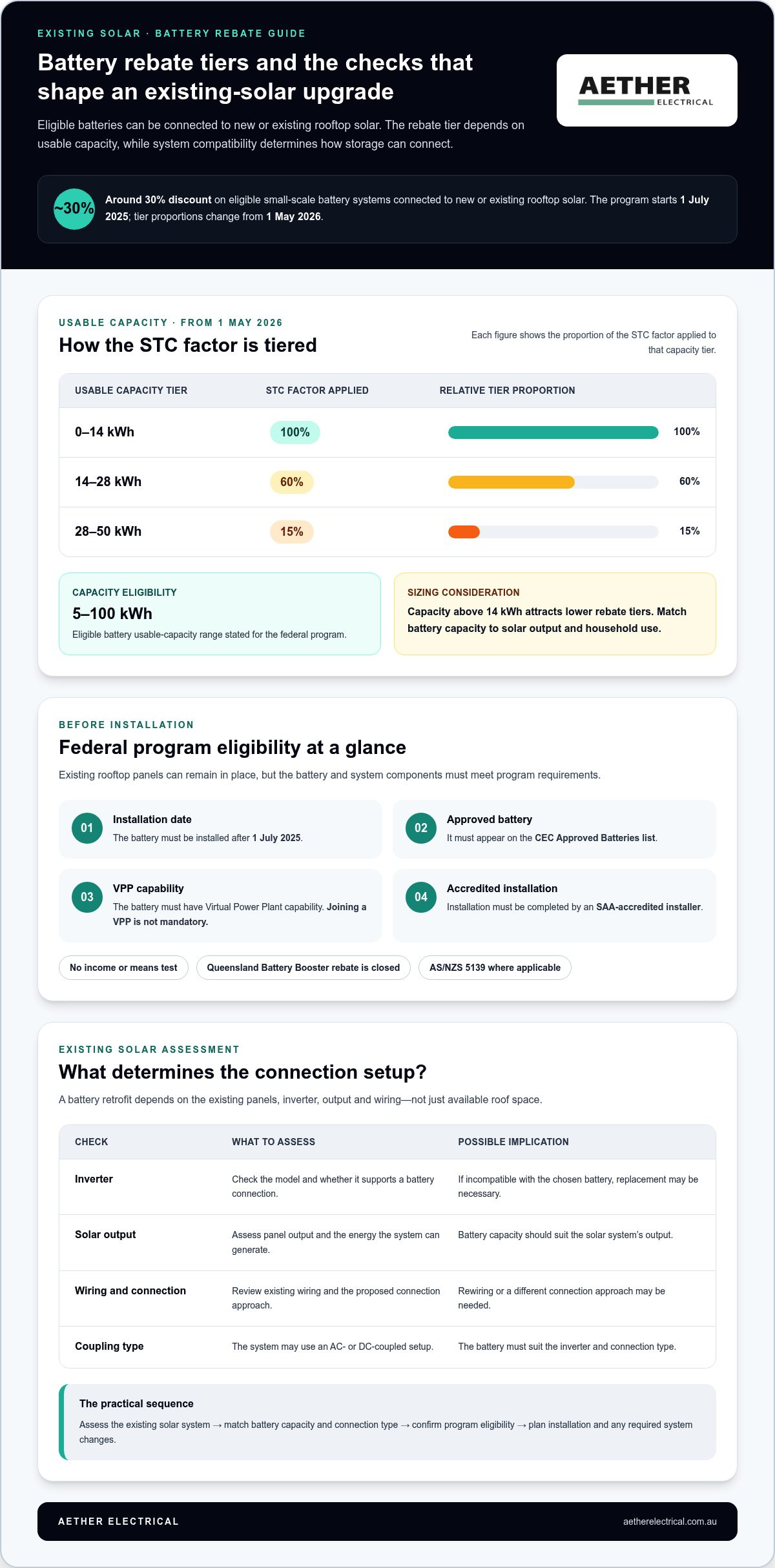
Yes. The Australian Government’s Cheaper Home Batteries Program provides around a 30% discount on eligible battery systems connected to new or existing rooftop solar, starting 1 July 2025. Your existing panels can remain in place, but the battery and the system’s electrical components need to meet the program’s eligibility requirements.
For households adding storage, the rebate is applied through the installation process rather than claimed as a separate payment afterwards. Eligibility depends on the battery, its usable capacity, installation date and installer. A battery must be installed after 1 July 2025, appear on the CEC Approved Batteries list and have Virtual Power Plant capability. Joining a Virtual Power Plant isn’t mandatory.
Assessing an Existing Solar System
Before choosing a battery, assess your existing solar panels, inverter, output and wiring. These details determine how the battery can connect and whether the system needs changes.
Start by checking the inverter model and whether it supports a battery connection. If it isn’t compatible, replacement may be necessary. The battery should also suit your panels’ output, so its capacity matches the energy your system can generate. Existing wiring and the proposed connection can determine whether rewiring is needed. These checks help establish a workable design before installation.
Adding Storage to Existing Solar
Adding storage involves connecting a compatible battery to store excess solar power for use when the sun isn’t shining. The system may use an AC- or DC-coupled setup, and the battery must suit the inverter and connection type.
For example, if your inverter can’t connect to the chosen battery, it may need replacing. A system with a different output arrangement may need another connection approach or panel rewiring. Your existing solar setup is therefore central to the battery decision, not just the available roof space. Matching components supports practical operation and helps identify a suitable rebate-eligible battery.
From 1 May 2026, the federal rebate tiers apply different proportions of the STC factor by usable capacity: 100% for the first 0-14 kWh, 60% from 14-28 kWh, and 15% from 28-50 kWh. Battery rebate eligibility depends on usable capacity and other program requirements. That makes usable capacity important: a larger battery may store more solar, but capacity above 14 kWh attracts lower rebate tiers.
Before purchase, compare the battery’s usable capacity with your solar output and household use. Rebate eligibility also requires installation by an SAA-accredited installer and compliance with applicable requirements, including AS/NZS 5139 where applicable. A battery can be added to an existing Gold Coast solar system, but the system assessment determines the connection work and suitable size.
Gold Coast Solar Battery Rebate Eligibility: Do You Qualify?
Queensland battery installations must meet applicable requirements, including AS/NZS 5139 where applicable. Grid connection design depends on how the battery integrates with your existing solar system and inverter.
For the federal Cheaper Home Batteries Program, the battery must be installed after 1 July 2025, have usable capacity between 5 kWh and 100 kWh, appear on the CEC Approved Batteries list and have Virtual Power Plant capability. Installation must be completed by an SAA-accredited installer. Joining a Virtual Power Plant isn’t mandatory.
There’s no income or means test for households applying for the federal rebate. Queensland’s previous Battery Booster rebate is closed, so eligible households rely on the federal program. The rebate applies to eligible batteries connected to new or existing rooftop solar.
From 1 May 2026, the rebate tiers apply 100% of the STC factor to the first 0-14 kWh of usable capacity, 60% from 14-28 kWh and 15% from 28-50 kWh. This tier structure means extra capacity above 14 kWh attracts a lower discount rate. Battery size should reflect both household use and the solar power your panels generate.
Battery installation pricing depends on capacity, inverter compatibility, wiring changes and the connection setup. The final price depends on your property and is provided after a quote request.
To understand the rebate and installation process, first match the proposed battery to your existing solar system. Then confirm that the battery appears on the CEC list and meets the capacity and VPP requirements. An SAA-accredited installer completes the installation, and the applicable rebate is tied to an eligible system. Your electricity tariff also affects the value of storing solar power instead of exporting it.
Retrofitting risks include incompatible equipment, wiring changes and a battery that doesn’t suit the solar system’s output. Safety requirements include AS/NZS 5139 where applicable; a typical battery warranty period is 10 years, so check the specific warranty terms and coverage before purchase.
For a system assessment and installation planning, explore battery storage installation for existing solar homes.
Household situations where a battery may not pay off
A battery’s value depends on when your household uses electricity, how much solar power it exports and the battery’s usable capacity. In Queensland, the incentive can reduce the upfront cost, but it doesn’t guarantee worthwhile savings.
Battery Capacity and Electricity Use
Battery capacity is the amount of stored electricity available for your household to use later. A battery larger than your evening demand may remain partly unused.
Compare typical daily use with the electricity you want to shift from daytime to night. For example, a household using 20 kWh daily needs to consider how much of that demand occurs after sunset, rather than choosing capacity based on total use alone. A smaller battery may suit a home with modest evening demand; a larger one needs enough regular use to make its extra storage valuable.
Solar Output and Household Demand
Solar output is the electricity your panels generate, while household demand is the power used throughout the day. Timing matters: a battery can store surplus daytime solar for later, but it can’t store energy the panels haven’t generated.
A typical Gold Coast home with a 6.6 kW solar system may generate 9,000-11,000 kWh per year. A 6.6 kW system with a 5 kW inverter produces around 27.7 kWh per day. Cloudy conditions and household use affect how much becomes surplus for storage.
Work patterns can shape the result. In 9-to-5 households, over 60% of electricity use occurs between sunset and sunrise. That evening demand creates a potential use for stored solar, but the battery must have enough charge from daytime generation to meet it. Homes that use more power while their panels are generating may have less excess to store.
Exporting solar also has a value. Queensland feed-in tariffs typically range from 1c to 10c per kWh, with no mandated minimum. Storing power may help avoid buying some grid electricity, but the saving depends on the household’s tariff and how much stored energy it actually uses.
For most Queensland homes with existing solar, estimated battery payback is roughly 5-7 years. A battery may take longer to pay off when evening use is low, solar surplus is limited, or exports already earn a useful tariff. A rebate can improve the calculation, but it doesn’t remove those household-specific factors.
Energy independence may matter even when bill savings are modest. You might value using more of your own solar power, while another household may prioritise a shorter payback. Compare expected savings with the battery’s role in your home, and size storage around regular demand rather than occasional high use.
Can you Add a Battery to your Existing Solar System?
Yes, you can add a battery to an existing Gold Coast solar system if its components work together. The main checks are backup needs, inverter compatibility and how surplus solar power will charge the battery.
Backup Power During Outages
Backup power means a battery supplies electricity to selected home circuits when grid power fails. A grid-connected battery won’t necessarily keep your whole home running during an outage.
Distinguish everyday storage from outage backup. A battery may charge from solar panels and discharge after sunset while still relying on the grid during a blackout. Backup operation needs to be part of the system design, including which circuits receive power. For example, you might prioritise essential lighting and refrigeration rather than every appliance. Battery capacity and available charge also affect how long those circuits can run.
Storing Excess Solar Power
A home battery stores surplus solar power for use when your panels aren’t generating. This shifts some daytime generation into the evening, when household demand may continue.
Solar panels generate direct current, while most home appliances use alternating current. The inverter manages this conversion and the battery’s charging and discharging. For an existing setup, the inverter’s AC or DC output type must suit the battery connection. If your current inverter isn’t compatible, it may need replacing. This affects the installation design and how stored energy moves through your home.
AC and DC Power Compatibility
AC and DC are the two forms of electricity used in a solar and battery system. Compatibility matters because the battery must connect correctly with the inverter and existing solar equipment.
An AC-coupled arrangement connects through the home’s AC side, while a DC connection links with the system’s direct-current side. The suitable approach depends on your existing inverter and its output type. For example, an older inverter that can’t work with a battery may need replacing. Matching the equipment helps the battery receive solar power and supply stored electricity for household use.
Virtual Power Plant capability is another rebate-related consideration. An eligible battery must be VPP-capable, but you don’t have to join a Virtual Power Plant to qualify. Capability means the system can support participation; joining is a separate choice. Consider this alongside backup needs, as VPP participation and outage backup serve different purposes.
To plan the likely setup, assess your inverter, the circuits that need backup and when your household uses electricity. Payback partly depends on how much stored solar power replaces grid electricity, but backup value may matter too. The design should account for both goals rather than assume one setup will deliver the same result for every home.
Battery storage options for Gold Coast homes
Battery storage works best when it matches your home’s solar surplus, evening demand and backup priorities. For homeowners on the Gold Coast, the useful comparison isn’t simply the biggest battery versus the smallest. Consider how much solar power your household can store and use regularly.
Without storage, a typical 6.6 kW Gold Coast solar system may export 30-50% of the electricity it generates. A correctly sized battery can increase household use of solar generation from 30-40% to 70-90%. These figures show the potential shift from exporting energy to using it at home, rather than guaranteeing the same result for every property.
Start by identifying what you want a home battery to do. Your priority may be using more solar after sunset, or you may value backup for selected circuits during outages. These needs can lead to different system designs, so define the intended use before comparing storage capacity.
- More self-use: Consider how much daytime solar is usually left over and how much electricity the household uses later.
- Backup priority: Identify the circuits you want supported during an outage, then factor that into the system design.
- Future changes: Account for planned changes in household electricity use, such as adding an EV charger.
Battery size should follow regular use, not an occasional peak. A 6.6 kW system may generate 9,000-11,000 kWh per year, but annual generation alone doesn’t show how much is available to store. Daytime demand, solar output and evening consumption all shape the surplus. A correctly sized system aims to store energy the household can use, rather than leaving capacity regularly unused.
The financial comparison depends on what stored electricity replaces. Shifting around 3,000 kWh of solar electricity each year from export to self-use can save a Gold Coast household A$600-A$900 annually at current electricity rates. The result depends on the home’s tariff and how much stored energy is used. Compare that potential saving with the battery’s expected role, rather than treating it as a guaranteed return.
For longevity, compare battery lifespan, cycle life and warranty terms. A typical battery warranty period is 10 years, but the specific coverage matters. Check what the warranty says about capacity over time and system use, then weigh that against your household’s likely storage needs.
Choose storage around the energy pattern you can see: daytime surplus, evening demand and backup priorities. Plan battery storage for your home around those practical needs.
Aether Electrical: Domestic Electrical Services
Aether Electrical helps homeowners across the Gold Coast, Tweed and Northern Rivers assess existing solar systems and plan battery storage to suit their property. Its Solar Installation & Servicing and Battery Storage Installation services address inverter compatibility, system upgrades and storage design. This is a practical next step when your panels are already installed and you want to understand how to add a battery.
For a wider household electrical project, Aether Electrical also provides Domestic Electrical Services and EV charger installation. Share details of your existing solar setup and what you want storage to do, such as shifting solar power into the evening or supporting selected circuits during an outage. A suitable design starts with the system you have and the outcome you want.
Contact Aether Electrical to discuss adding battery storage to your existing solar system.
Make your next solar decision with confidence
If you’re planning to add a battery to existing solar on the Gold Coast, consider more than the immediate upgrade. Think about how your household’s energy needs may change and what you want your solar system to support over time. This gives the decision a clearer purpose than simply adding equipment.
Aether Electrical can bring the electrical work together through Domestic Electrical Services, Solar Installation & Servicing, and Battery Storage Installation across the Gold Coast, Tweed Heads and Northern Rivers. Whether you’re planning storage now or aligning it with other home electrical work, discuss your existing system and the outcome you want with the team.
Contact Aether Electrical about your battery to talk through the next step. A well-planned upgrade can make your existing solar work harder for the way you live.
Frequently Asked Questions
What Does a Battery Actually Cost in 2026?
The 2026 cost depends on battery capacity, inverter compatibility and the installation work required. Existing systems may need wiring changes or different connection equipment, which affects the final scope. The price depends on the property and is provided after a quote request. Compare proposed capacity and installation details alongside the expected use, rather than judging a battery by its unit price alone.
What Does a Home Battery Actually Do?
A home battery stores electricity for later, so solar power generated during the day can help supply your home after sunset. The inverter manages energy moving between the panels, battery, home and grid. For example, stored power can run evening appliances instead of exporting all surplus generation. A battery can also be designed to support selected circuits during an outage.
Can I add a battery to my existing solar system on the Gold Coast?
Yes, Gold Coast homeowners can add eligible battery storage to an existing rooftop solar system. The federal Cheaper Home Batteries Program covers eligible batteries connected to new or existing solar, for installations from 1 July 2025. Your system’s inverter and wiring affect the connection design. Check that the battery meets program requirements and suits your existing equipment before proceeding with the installation.
How much does it cost to add a battery to existing solar in the Gold Coast?
The cost depends on the battery’s usable capacity, your existing inverter and any wiring or connection changes. A straightforward retrofit and a system requiring inverter replacement have different installation scopes. The final price depends on your property and is provided after a quote request. For a useful comparison, consider the installed system design, warranty coverage and expected household use, not battery capacity alone.
What battery size suits a typical Gold Coast household with existing solar panels?
Choose capacity based on your home’s regular evening demand and the surplus your panels can generate. A household that uses most solar power during the day has less excess to store than one that’s empty during those hours. Consider which appliances you want to run after sunset, seasonal changes in solar generation and whether backup power matters. These details help determine a practical size.
Is my existing solar inverter compatible with a home battery, or do I need a new inverter?
Your existing inverter may work with a battery, but compatibility depends on its model and AC or DC connection type. Find the inverter’s model information and installation records, then compare them with the proposed battery’s requirements. If the inverter can’t connect to that battery, replacement may be needed. The inverter’s output and system design also affect how solar power charges and supplies the battery.
What are the best AC-coupled and DC-coupled battery options for retrofitting solar?
The suitable option depends on your existing inverter and how your solar system is configured. AC-coupled storage connects through the system’s alternating-current side; DC-coupled storage connects on the direct-current side. Neither arrangement is automatically best for every retrofit. Compare how each proposed setup works with your existing equipment, battery charging and household use, including whether the design requires an inverter change.
What rebates or government incentives are available for home batteries in Queensland in 2026?
Queensland households may qualify for the federal Cheaper Home Batteries Program; the state’s previous Battery Booster rebate is closed. In 2026, the federal discount uses 100% of the STC factor for the first 0-14 kWh, 60% from 14-28 kWh and 15% from 28-50 kWh. Eligible installations must meet program requirements, including an approved battery and SAA-accredited installer. No income or means test applies.


