
The best Tesla Powerwall alternative isn’t automatically the cheapest battery. In Tweed Heads, compare options such as Sungrow, BYD, Alpha-ESS and LG Energy Solution against your household’s energy use, solar setup and backup needs. A Tesla Powerwall alternative in Tweed Heads should also suit your electricity tariff and any plans to join a virtual power plant.
Look beyond the battery’s headline capacity. How much power you use after sunset, what you earn for exported solar and whether you’re eligible for incentives all affect the value you get from storage.
This guide explains how to compare battery options for payback, tariffs, virtual power plant participation, rebates and finance in Tweed Heads. You’ll see what to weigh when comparing capacity and warranty, how incentives can affect upfront costs, and why a battery that suits one home may not suit another. The aim is to make the practical trade-offs clearer.
Key Takeaways
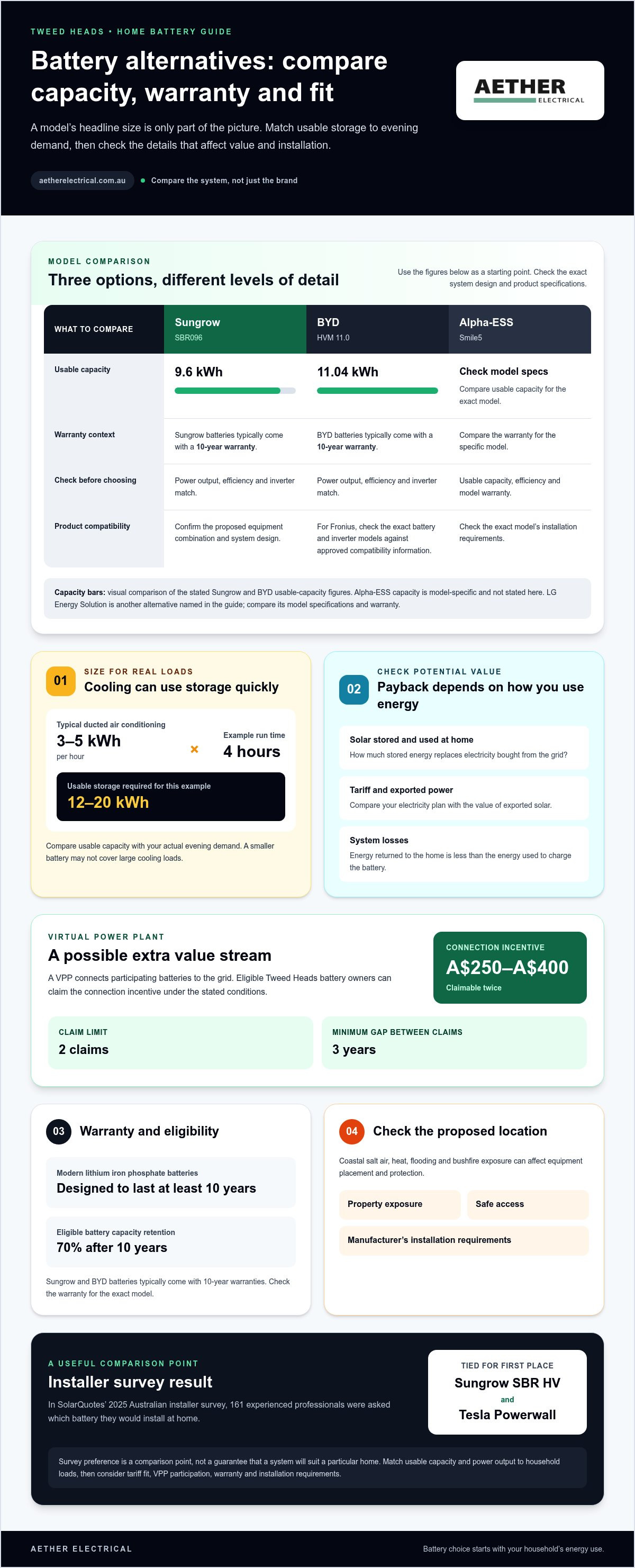
- Compare usable capacity with your evening demand, not just the battery’s headline size. Four hours of ducted air conditioning can require 12kWh to 20kWh of usable storage.
- Payback depends on how much solar power you store and use, the electricity you buy from the grid, and the value of your exported power.
- VPP participation can add an incentive for eligible Tweed Heads battery owners. The $250-$400 connection incentive can be claimed twice, with at least three years between claims.
- Check how rebates affect your options: eligible Tweed Heads households and businesses may receive an upfront NSW battery installation rebate of A$1,600-A$2,400, depending on battery size.
- Compare alternatives such as Sungrow, BYD, Alpha-ESS and LG Energy Solution by capacity, warranty, tariff fit and VPP capability before choosing a system.
Battery payback and Virtual Power Plant participation
Alternatives differ in usable capacity, power output, warranty and efficiency. The BYD HVM 11.0 provides 11.04kWh of usable capacity, while the Sungrow SBR096 provides 9.6kWh; compare each model’s power and efficiency specifications alongside its warranty.
For battery life, modern lithium iron phosphate batteries are designed to last at least 10 years. Sungrow and BYD batteries typically come with 10-year warranties, while an eligible battery must retain 70% capacity after 10 years.
Coastal salt air, heat, flooding and bushfire exposure can affect where equipment is located and how it is protected. Assess the proposed battery position in relation to the property’s exposure, safe access and the manufacturer’s installation requirements.
Payback depends on how much solar energy the battery stores for later use, your electricity tariff and the value of power exported. A VPP may provide another source of value by connecting participating batteries to the grid. Eligible Tweed Heads battery owners can claim the A$250-A$400 VPP connection incentive twice, with a minimum three-year gap between claims.
Size storage around actual loads, not a headline capacity. A typical ducted air conditioning system may draw 3kWh to 5kWh per hour. Four hours of operation therefore needs at least 12kWh to 20kWh of usable battery capacity. That example helps show why a smaller battery may not cover large cooling loads.
Australian installer preferences provide a useful point of comparison, not a guarantee of fit. According to SolarQuotes’ 2025 Australian installer survey, 161 experienced professionals were asked which battery they would install at home; Sungrow SBR HV and Tesla Powerwall tied for first place.
| Option | Usable capacity | Warranty context | Key comparison |
|---|---|---|---|
| Sungrow SBR096 | 9.6kWh | Sungrow batteries typically have 10-year warranties | Check power output and inverter match |
| BYD HVM 11.0 | 11.04kWh | BYD batteries typically have 10-year warranties | Check power output and inverter match |
| Alpha-ESS Smile5 | Compare model specifications | Compare the model warranty | Check usable capacity and efficiency |
To check BYD Battery-Box compatibility with Fronius inverters, match the exact battery and inverter models against their approved compatibility information. Product generation and system design matter: the brand names alone don’t confirm that the combination will work.
Installation quality matters as much as battery choice. Review the system design, equipment placement, commissioning records and electrical testing documentation. Choose a Tesla Powerwall alternative in Tweed Heads by matching usable capacity and power output to your household’s loads, then comparing tariff savings, virtual power plant participation, warranty and installation requirements.
Home energy storage and electricity tariffs
Battery storage changes when a household uses solar power, not how much it produces. In 2020, around 9% of Australia’s 110,000 completed solar installations included batteries. Today, storage systems can hold daytime generation for evening demand, when solar panels produce less. The benefit depends on how much stored power replaces electricity bought from the grid.
An average Australian home uses around 18kWh of electricity per day. That figure is a starting point, not a sizing rule. Compare it with your own daily usage, especially after sunset. A household that runs cooking appliances, hot water or cooling in the evening may use stored energy faster than one with lower overnight demand.
Your electricity tariff shapes the value of each stored kilowatt-hour. That example shows why using stored solar at home can be more valuable than exporting it, although actual tariffs and household use differ.
Map your usage against your electricity plan before choosing a battery system. Check when electricity is cheapest, when peak rates apply and what your retailer pays for exported solar. Charging from the grid during lower-priced periods may be worthwhile, but only if the battery system and plan support it. Compare the effect on your total bill, not one rate in isolation.
- List evening loads: note appliances and their usual running times.
- Review solar exports: identify how much excess generation leaves your home.
- Compare tariff periods: match battery charge and discharge patterns to your plan.
- Allow for system losses: stored energy returned to the home is less than the energy used to charge it.
For example, a Sungrow SBR096 provides 9.6kWh of usable capacity, while the BYD HVM 11.0 provides 11.04kWh. Compare usable storage with evening demand and consider whether an integrated system suits your existing solar setup. A larger battery may store more midday surplus, but unused capacity adds little value if household demand is low.
Battery Storage Installation can bring the battery, inverter and existing solar system together in a planned setup. A home with an older inverter may need a different design from one adding solar and storage at the same time. Before settling on a system, review how the equipment will charge, supply household loads and work with your tariff.
For a practical next step, explore battery storage installation alongside your usage and tariff review. That keeps the decision centred on the energy your household can store and use.
Government rebates and finance options
For Tweed Heads, check both the federal Cheaper Home Batteries Program and the NSW battery incentive before comparing the net investment. The federal program launched on 1 July 2025. The NSW Solar Battery Rebate began on 1 November 2024 for eligible households and businesses in Tweed Heads.
From May to December 2026, the federal program’s STC factor is 6.8. It applies the full factor to the first 14kWh of battery capacity. The factor drops to 5.7 on 1 January 2027. Federal support covers up to 50kWh, with the supported capacity tiered down.
Eligibility affects which battery you choose, not just the rebate amount. For the federal program, a battery must appear on the Clean Energy Council approved product list and be capable of participating in a virtual power plant. Compatibility is worth considering even if you don’t plan to join one straight away.
Eligible Tweed Heads households and businesses may also receive an upfront NSW battery installation rebate of A$1,600-A$2,400, depending on battery size. The NSW incentive criteria specify battery capacity from 2kWh to 28kWh. Consider how this range fits your household’s storage needs, then compare eligible options and the incentive available for each system.
- Confirm eligibility: compare the exact battery model with the Clean Energy Council approved product list.
- Check VPP capability: make sure the system meets the federal program requirement.
- Compare capacity: assess whether the battery fits the NSW incentive’s 2kWh to 28kWh range.
- Use the right date: account for the federal STC factor applying when the system is installed.
A hybrid inverter combines solar panels and battery functions in one system design. An AC-coupled battery connects to an existing solar setup through its own inverter. The right arrangement depends in part on whether you’re adding storage to existing panels or installing a combined system. Check the rebate criteria against the selected battery and system configuration, including warranty and virtual power plant capability.
Finance can spread the remaining investment, but compare the total repayment, interest and fees with the expected bill savings. Don’t treat a rebate as guaranteed savings each year: it reduces eligible upfront costs, while the battery’s ongoing value depends on how your household uses stored energy. The ACT Sustainable Household Scheme is separate from NSW, so its 3% loans and terms of up to 10 years don’t describe a Tweed Heads rebate or finance offer.
Reasons to consider alternatives to the Tesla Powerwall
A Tesla Powerwall isn’t the only route to home energy storage. Alternatives from Sungrow, BYD, Alpha-ESS, LG Energy Solution and Sigenergy give homeowners more systems to compare with their solar panels, inverter and energy use. The useful question isn’t which name is most familiar, but which system suits the home’s energy pattern and installation needs.
Start with the equipment already on your roof. If your solar system is operating, compare batteries that suit its inverter and connection setup. An AC-coupled battery uses its own inverter, while a DC-coupled setup connects through a compatible hybrid inverter. The right arrangement depends on the existing equipment and whether you’re adding storage or planning a new solar system.
Capacity is another reason to compare options. A household that uses most of its solar power during the day may need less storage than one with heavy evening consumption. List the loads that matter, such as cooking, hot water and cooling, then compare each battery’s usable capacity and power output. More capacity alone doesn’t guarantee better backup: check which household circuits the system can supply and how much power it can deliver.
Warranty terms can also separate options. Sungrow and BYD batteries typically come with 10-year warranties. Compare the warranty period and its capacity-retention conditions with the system’s expected use. A 10-year headline is only one part of the decision; read what the warranty covers and how it applies to the battery’s performance over time.
- Existing solar: match the battery and inverter to the panels already installed.
- Backup needs: identify essential circuits and compare the system’s stated backup capability.
- Daily use: compare usable storage with the household’s evening consumption.
- Long-term ownership: review warranty coverage and the records needed for a claim.
Installation planning matters as much as the product label. Ask for a written design showing the battery location, inverter arrangement, solar connection and any backup circuits. Keep the installation and commissioning records with the warranty documents. These details clarify how the system is configured and what equipment it includes.
For example, compare Sungrow, BYD and Sigenergy systems against the same household load profile. Record usable capacity, power output, inverter compatibility, warranty terms and backup coverage side by side. Then consider whether the proposed system meets your needs without including storage your household is unlikely to use.
The best alternative is the one that suits the home’s panels, energy use and backup priorities, with clear documentation and appropriate warranty terms. Compare these practical details before choosing a battery brand.
Which battery brands and models are sold by installers in Tweed Heads and Northern NSW?
Battery options to compare for a Tweed Heads home include Sungrow, BYD, Alpha-ESS and LG Energy Solution. The research identifies specific models for the first three brands, giving homeowners a practical shortlist to discuss alongside their solar system, inverter and energy needs. The exact model matters: a brand name alone doesn’t show its capacity or compatibility.
Sungrow’s SBR096 has 9.6kWh of usable capacity. BYD’s HVM 11.0 provides 11.04kWh, while the BYD HVM range also includes a 13.8kWh battery. Alpha-ESS Smile5 has a listed 13.3kWh model. Those figures let you compare usable storage, but they don’t show each system’s power output or how it will operate with your existing equipment.
There’s also a useful installer-preference signal. SolarQuotes’ 2025 Australian installer survey asked 161 experienced professionals which battery they would install at home. Sungrow SBR HV and Tesla Powerwall tied for first place. That result supports including Sungrow in a comparison, but it doesn’t determine the right battery for every Tweed Heads property.
Use a consistent checklist when reviewing the options:
- Model and capacity: compare usable kWh, such as the Sungrow SBR096 and BYD HVM 11.0.
- Inverter fit: match the battery model to the inverter and solar system design.
- Warranty: compare the warranty terms and capacity-retention conditions. Sungrow and BYD batteries typically come with 10-year warranties.
- VPP eligibility: check whether the exact battery is VPP-capable and on the Clean Energy Council approved product list if seeking the federal incentive.
- System design: compare backup requirements, connection method and the battery’s usable capacity against household demand.
For example, a home with evening energy use can compare the 9.6kWh Sungrow SBR096 with the 11.04kWh BYD HVM 11.0. A larger capacity offers more stored energy, but only if the household can use it and the system is designed around its inverter and loads. Consider the Alpha-ESS Smile5 by the same measures, rather than assuming its listed capacity alone settles the choice.
For Tweed Heads and Northern NSW, ask for the proposed battery model and system design to be clearly identified in the installation scope. This gives you a like-for-like basis for comparing storage, inverter compatibility, warranty and VPP requirements. Discuss battery storage installation for a system matched to your home’s solar equipment and energy use.
Aether Electrical: Domestic Electrical Services
Aether Electrical helps homeowners plan and install solar and battery systems through Solar Installation & Servicing and Battery Storage Installation. Talk to the team when comparing battery options, adding storage to existing panels or planning a system around your household’s energy use.
For a connected home setup, Aether Electrical also installs EV chargers and provides Domestic Electrical Services. These electrical and energy upgrades can be planned together to suit your property.
Share your solar setup, electricity use and battery priorities to start a focused conversation. Contact Aether Electrical or visit aetherelectrical.com.au.
Make your next battery decision with confidence
Choosing a Tesla Powerwall alternative in Tweed Heads is an opportunity to plan for how your household will use energy in the future, not just today. Consider whether your priorities may change as appliances or household routines change, or if you add an electric vehicle. Thinking ahead can help shape a system that remains useful over time.
Before taking the next step, note your existing solar setup, when your home uses the most power and what you want backup to support. Aether Electrical can help turn those priorities into a plan through Battery Storage Installation, Solar Installation & Servicing and Domestic Electrical Services. The aim is a design suited to your property and lifestyle, with the electrical work considered as part of the whole system.
Ready to talk through your home battery options? Contact Aether Electrical about battery options and take the next step with a clearer plan.
Frequently Asked Questions
Alternatives to the Tesla Powerwall in 2025: What Are Your Options in Australia?
Australian homeowners can compare batteries from Sungrow, BYD, Alpha-ESS and LG Energy Solution. Examples include the Sungrow SBR096, BYD HVM 11.0 and Alpha-ESS Smile5. A Tesla Powerwall alternative in Tweed Heads should suit your solar setup, household use and backup needs. Compare complete system designs, not just brand names, and check how each battery connects with the inverter already installed or planned.
How Much Does a Home Solar Battery Cost?
The cost depends on the battery’s capacity, inverter requirements, installation complexity and work needed to connect it to your solar system. Backup circuits or switchboard changes can also affect the project scope. Eligible rebates may reduce upfront costs, subject to their requirements. For a useful comparison, assess options against the same system scope. Aether Electrical offers free design and quotes for solar and battery projects.
What Is a Home Battery Storage System?
A home battery storage system stores electricity for use at another time. With solar panels, it can capture surplus generation and supply household circuits later, such as after sunset. A complete setup may include a battery, inverter, controls and electrical connections. For example, a household can use stored solar power for evening lighting and appliances instead of drawing all that electricity from the grid.
What home battery alternatives to Tesla Powerwall are available in Australia?
Options discussed for Australian homes include Sungrow SBR HV, BYD HVM, Alpha-ESS Smile5 and LG Energy Solution batteries. Specific examples include the Sungrow SBR096, BYD HVM 11.0 and a 13.3kWh Alpha-ESS Smile5. Model choice affects usable storage and system design. Compare the exact model, inverter compatibility, warranty and backup configuration, rather than assuming every battery from one brand has identical specifications.
What is the installed price of a home battery in Tweed Heads, NSW?
There isn’t one installed price for every Tweed Heads home. The total depends on the battery, existing solar and inverter equipment, installation work, switchboard changes and any backup circuits included. Eligible incentives can also affect the amount payable. Compare quotes for the same equipment and installation scope to make the differences clear. Aether Electrical offers free design and quotes for solar and battery projects.
What battery installation rules and approvals apply in Tweed Heads, NSW?
Plan for a site assessment, electrical design and confirmation of any network connection requirements before installation. The proposed battery location, inverter, switchboard and backup circuits all affect the design. Ask for a clear installation scope identifying the equipment and work involved, then keep commissioning and handover records with the product documents. This gives you a record of how the system was installed and configured.
Which local Tweed Heads installers supply and install non-Tesla home batteries?
Aether Electrical provides Battery Storage Installation for homes in Tweed Heads and the Northern Rivers. The team supplies and fits battery storage units, so you can discuss a non-Tesla system for your home’s solar setup. Battery selection should account for your existing equipment, energy use and installation requirements. Aether Electrical also provides Solar Installation & Servicing for residential properties, with free design and quotes for solar and battery projects.
Can alternative home batteries integrate with existing solar inverters and backup circuits?
Yes, an alternative battery can integrate with an existing solar system when the battery and inverter are compatible and the system is designed accordingly. The connection method, equipment generation and backup requirements all matter. For example, a BYD Battery-Box and Fronius inverter combination needs to match the relevant models’ compatibility information. Include backup circuits in the system design if you want them to supply household loads during an outage.


