
A fault can turn a safe circuit into a shock risk in an instant. In Queensland, safety switches have been required on all circuits in homes since 2018. Safety switch installation on the Gold Coast can help bring older switchboards in line with the protection your property needs.
A circuit breaker and a safety switch do different jobs. A breaker responds to overloads, while a safety switch helps protect people from electric shock. Knowing the difference can help you recognise when installation, an upgrade or replacement may be needed.
This guide explains how safety switches work and what to expect from an RCD upgrade, switchboard integration, installation or replacement. It also covers testing and compliance, helping you make an informed decision about safety switch installation on the Gold Coast.
Key Takeaways
- Learn how a safety switch responds to electrical faults, and why it isn’t a substitute for a circuit breaker.
- See how RCD upgrades can be integrated with a switchboard to protect the circuits that need coverage.
- Understand what regular testing involves and why repeated tripping should be investigated rather than simply reset.
- Find out what happens during installation or replacement, including what a failed test-button check can indicate.
How does a safety switch work?
A safety switch monitors electrical current flowing through a circuit. If it detects an imbalance, such as electricity leaking to earth, it disconnects that circuit. The interruption can happen in as little as 30 milliseconds, helping protect people from electric shock. That prompt cut-off matters when damaged wiring or an appliance fault creates a risk.
A circuit breaker, safety switch and RCD have related but distinct roles. A circuit breaker responds to overloads and high-current faults that could damage wiring. RCD, or residual current device, is the technical term commonly used for a safety switch. It detects current leakage and disconnects the affected circuit. One device does not replace the other.
In Queensland, safety switches have been required on power point circuits in new homes since 1992. The requirement expanded: since 2018, Queensland homes must have safety switches on all circuits. New homes must have protection on power and light circuits, while current wiring rules require RCD protection on power and lighting circuits in new electrical work.
A home’s sale or lease can affect the protection required. In Queensland, homes must have a safety switch on power circuits when sold or leased. They must also have safety switches on all circuits when sold, leased or when significant electrical work is performed. If coverage is limited, an older switchboard may need an upgrade.
Look for a button marked “T” or “Test” on the switchboard device. It identifies a safety switch and allows you to test its operation. This differs from a circuit breaker’s switch because the devices respond to different faults. If a switch trips repeatedly, possible causes include moisture, damaged cables, poor insulation or a faulty appliance. Repeated tripping needs investigation, not bypassing or repeated resetting.
RCD upgrades and switchboard integration
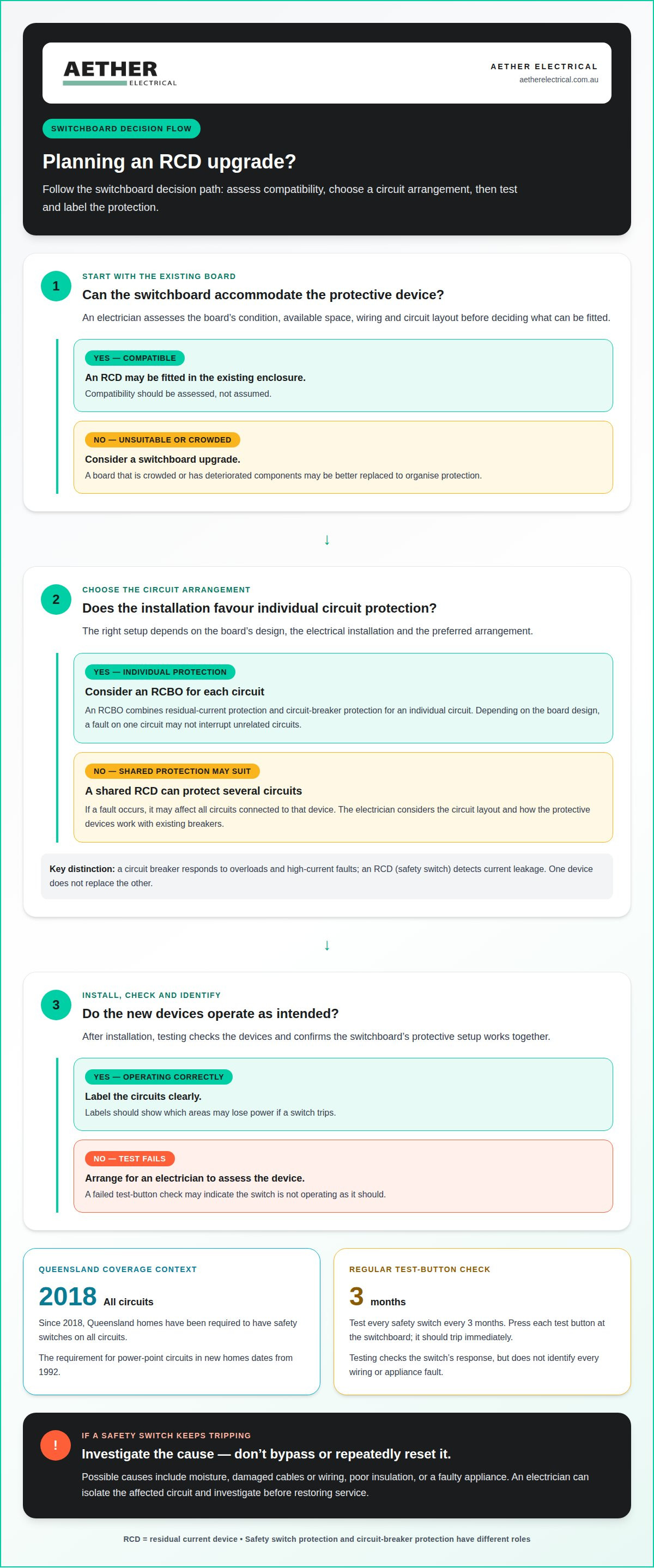
An RCD upgrade adds or replaces protective devices at the switchboard. Whether the existing board can accommodate them depends on its condition, layout and available space.
Replacing Outdated Safety Switches
An older safety switch may need replacement if it fails testing, shows visible damage or is unsuitable for the circuit it protects. The electrician checks its operation, connections and the wiring it serves. Replacing a device is not the same as upgrading coverage: a new switch may still protect only the circuits connected to it.
For Gold Coast homes, the circuit arrangement matters too. One device may protect several circuits, while a revised setup can provide individual protection for each circuit. The right arrangement depends on the switchboard and electrical installation, not just the device’s age.
Existing Switchboard Compatibility
An existing switchboard may be able to accommodate a safety switch, depending on its condition, available space, wiring and circuit layout. An electrician assesses these factors before deciding whether to fit an RCD in the existing enclosure or upgrade the board. Replacement is not automatic, but compatibility should not be assumed either.
If an older board is crowded or its components are deteriorated, a switchboard upgrade may offer a better way to organise protection. The assessment also considers which circuits need RCD protection and how the devices will work with existing breakers.
An RCBO combines residual current protection and circuit-breaker protection for an individual circuit. Depending on the board’s design, this can help prevent a fault on one circuit from interrupting unrelated circuits. A shared RCD, by contrast, can protect several circuits, so a fault may affect all the circuits connected to it. The choice depends on the installation and preferred circuit arrangement.
After installation, testing checks that the new devices operate as intended and that the switchboard’s protective setup works together. Testing isn’t a guarantee that an appliance or wiring fault won’t develop later. For switchboard upgrade advice, an electrician can assess the existing board and explain the practical options.
Installation, wiring and compliance advice
A proper installation involves more than fitting a device. The electrician checks the switchboard, identifies the circuits, connects the safety switch and tests its operation. Clear labels show which areas may lose power if the switch trips. For new electrical work, current wiring rules require RCD protection on power and lighting circuits.
Test every safety switch every 3 months. At the switchboard, press each device’s test button; it should trip immediately. If it doesn’t, arrange for an electrician to assess it. Testing checks the switch’s response, but it doesn’t identify every wiring or appliance fault.
DIY safety switch installation in Queensland can expose you to electric shock and leave wiring incorrectly connected. A poorly fitted device may not provide the intended protection or may cause unexpected tripping. A licensed electrician can install and test the device, then explain what each circuit label covers.
Compliance advice should consider the installation as a whole. AS/NZS 3000 is known as the Wiring Rules; electrical work needs to be assessed against the requirements that apply to the job. The electrician considers the switchboard, circuit arrangement, existing wiring and the protection required for new work. Labels should match the circuits they identify, so a future fault is easier to trace.
If a safety switch keeps tripping, don’t keep resetting it or bypass the device. Repeated tripping can indicate moisture, damaged wiring, poor insulation or a faulty appliance. An electrician can isolate the affected circuit and investigate the cause before restoring service. This helps distinguish a device problem from a fault elsewhere in the electrical installation.
After installation or wiring changes, ask for a clear explanation of which circuits are protected and how to test the switches. This handover helps occupants find the test button and understand what a trip means. Keep circuit labels legible, and arrange prompt investigation if testing fails or tripping continues.
Installing and replacing safety switches
Professional safety switch installation takes under 2 hours. A licensed electrician inspects the switchboard, selects the suitable device, completes the electrical work and tests its operation.
Installation Steps
The electrician first identifies the circuit needing protection and checks the switchboard’s condition and layout. This helps determine where the safety switch will fit and whether existing wiring needs attention. The electrician then installs and connects the device to its circuit, tests its operation and labels the protected circuit so occupants can identify what it controls.
For example, adding protection to a lighting circuit involves checking its wiring and connection at the board. Installation is not simply a matter of matching a safety switch to a circuit breaker. Correct integration and testing help ensure the device responds to an electrical fault as intended.
Installation and Replacement Time
Professional installation takes under 2 hours, although the work involved depends on the switchboard and circuit. Replacing an existing device may be straightforward if the board and wiring are in suitable condition. If inspection reveals damaged wiring or a crowded board, those issues can affect the work required.
If a safety switch doesn’t trip when you press its test button, it needs replacing. The electrician removes the faulty device, fits a suitable replacement and tests it before completing the work. Repeated tripping also needs investigation, as the cause may be a wiring or appliance fault rather than the switch itself.
Before work starts, note which areas lose power when the relevant circuit is switched off. This can help the electrician identify the circuit and explain the finished setup. After installation, ask which switch protects each circuit and how to test it. Clear labels make future checks easier.
For a safety switch inspection or replacement, arrange electrical work with a licensed electrician.
Aether Electrical
Aether Electrical helps Gold Coast property owners assess safety switch coverage, switchboard condition and options for installation or replacement. If a switchboard needs upgrading or a safety switch keeps tripping, an electrical assessment can clarify what needs attention and how the circuits are protected.
Through domestic electrical services and electrical maintenance, Aether Electrical can identify the issue and carry out the relevant electrical work. The right approach depends on the existing board, wiring and the fault or upgrade required. You’ll have a clearer picture of the work before deciding how to proceed.
Contact Aether Electrical to discuss safety switch or switchboard work for your property.
Plan your next electrical step
A switchboard decision can affect how readily your home accommodates future electrical changes. If you’re planning renovations or considering solar and battery storage, include the switchboard in the discussion. Understanding your current protection can help you plan the work in a sensible order rather than treating each electrical change as a separate decision.
For safety switch installation on the Gold Coast, Aether Electrical can assess your property’s electrical needs. Its services also include solar installation and servicing, plus battery storage installation, which may be relevant when planning broader electrical upgrades.
Share what you’ve noticed, such as a switch that won’t test or a circuit that keeps tripping. That gives the conversation a practical starting point. Contact Aether Electrical to discuss the next step for your property.
Frequently Asked Questions
Are safety switches compulsory in Queensland?
Yes. Queensland homes have required safety switches on all circuits since 2018. Older homes may have protection on some circuits but not others, so an electrician can assess the switchboard’s coverage. This is especially useful before renovating or adding electrical equipment, when the existing setup and any planned changes can be considered together.
Can old homes be upgraded with modern RCDs?
Yes, older homes can be upgraded with RCD protection. An electrician assesses the switchboard’s condition, available space, circuit layout and wiring to determine a suitable arrangement. For example, a renovation that changes the electrical layout can prompt a review of which circuits need protection. The board may accommodate new devices, or its condition may make a broader upgrade appropriate.
What does an RCD do?
An RCD detects an imbalance in electrical current and disconnects the affected circuit when it detects leakage, helping reduce the risk of electric shock. For example, if current escapes from a damaged appliance, the RCD can cut power. It does not provide the circuit breaker’s overload protection, so the two devices have distinct functions in a home.
What is a safety switch and what does it protect against?
A safety switch cuts power when it detects a risk of electric shock. It protects people from dangerous electrical faults on the circuits it covers. For example, a fault affecting a connected appliance may cause the switch to trip. Coverage depends on which circuits are connected to the device, so one switch may not protect every circuit.
Is a safety switch legally required in Queensland homes?
Yes. Queensland homes must have safety switches on all circuits under the requirements introduced in 2018. The requirement matters when assessing older properties, because an existing switchboard may have protection on only some circuits. An electrician can inspect the board and explain whether its current coverage meets the requirement or an upgrade is needed.
What are Queensland’s rules for safety switches in rental properties and homes for sale?
Safety switch requirements can depend on a home's circumstances, so checking circuit coverage before a sale or lease can be useful. Homes must also have safety switches on all circuits when sold, leased or when significant electrical work is performed. For landlords and sellers, the key step is having the switchboard’s actual circuit coverage assessed before a tenancy or sale.


