

A battery-powered smoke alarm may be simpler to fit, but its position matters just as much as its power source. In NSW, the minimum is one smoke alarm per level. For broader coverage, consider bedrooms, living areas and the hallways or stairways connecting them. To decide where to install smoke alarms in a house in Ocean Shores, start with the home’s layout and the installation requirements.
It’s reasonable to ask whether you can install a battery-powered smoke alarm yourself. Battery-powered and hardwired alarms have different installation requirements, and a licensed electrician must install hardwired alarms. Placement also needs care, particularly around sloping ceilings, corners, fans and vents.
This guide covers where smoke alarms belong, how ceiling shape affects placement, and what to consider when choosing battery-powered or hardwired installation. It also explains what a professional assesses to plan coverage for your home.
Key Takeaways
- Position alarms on the ceiling where possible, away from corners, fans and air vents that can disrupt airflow.
- Map each storey and sleeping area so alarms cover the routes people use to reach an exit.
- For sloping ceilings or unusual layouts, choose a position that gives smoke a clear path to the alarm.
- Factor in power source and interconnection when planning the installation; hardwired alarms require a licensed electrician.
Does the smoke alarm have to be in the centre of the bedroom?
Not necessarily. The ceiling’s centre is preferred where practical, but the alarm also needs a clear position that covers the room effectively. When deciding where to install smoke alarms in a house in Ocean Shores, consider bedrooms, connecting areas and airflow.
- Cover each bedroom. For new builds and major renovations, AS 3786:2014 requires smoke alarms in every bedroom. Position an alarm on the ceiling where practicable, rather than relying on a hallway alarm to cover a closed bedroom. This is especially useful when bedrooms sit at the end of a long corridor or have doors that are often shut.
- Include connecting hallways. If bedrooms are grouped together, place an alarm in the hallway outside that sleeping area. Where bedrooms sit in separate parts of the home, plan coverage outside each cluster. Fire and Rescue NSW recommends alarms in bedrooms, living spaces, hallways and stairways.
- Cover living areas as well. Place alarms in or near rooms where people spend time, such as a lounge, family room or rumpus room. In a home with a bedroom wing and separate living zone, account for both areas instead of relying on one alarm to cover the whole layout.
- Account for every level. NSW’s minimum is one smoke alarm per level, including a storey without bedrooms. In a two-storey home, plan at least one alarm on each floor. A bedroom-free level still needs coverage, even if the bedrooms are all upstairs.
For NSW rental properties, the minimum is one smoke alarm on each level. Alarms must also be installed in accordance with the manufacturer’s instructions.
Deciding where to install smoke alarms in your house in Ocean Shores means considering both room layout and ceiling position. Keep alarms away from ceiling fans and air vents, where moving air can interfere with operation. The centre of a bedroom ceiling isn’t essential if another clear position suits the room better.
Smoke alarm locations in single-storey and multi-storey homes
Map the home by storey, then consider kitchens, bathrooms and the route to an outside exit. Placement rules differ between NSW and Queensland, so the property’s location matters.
Map locations across each storey
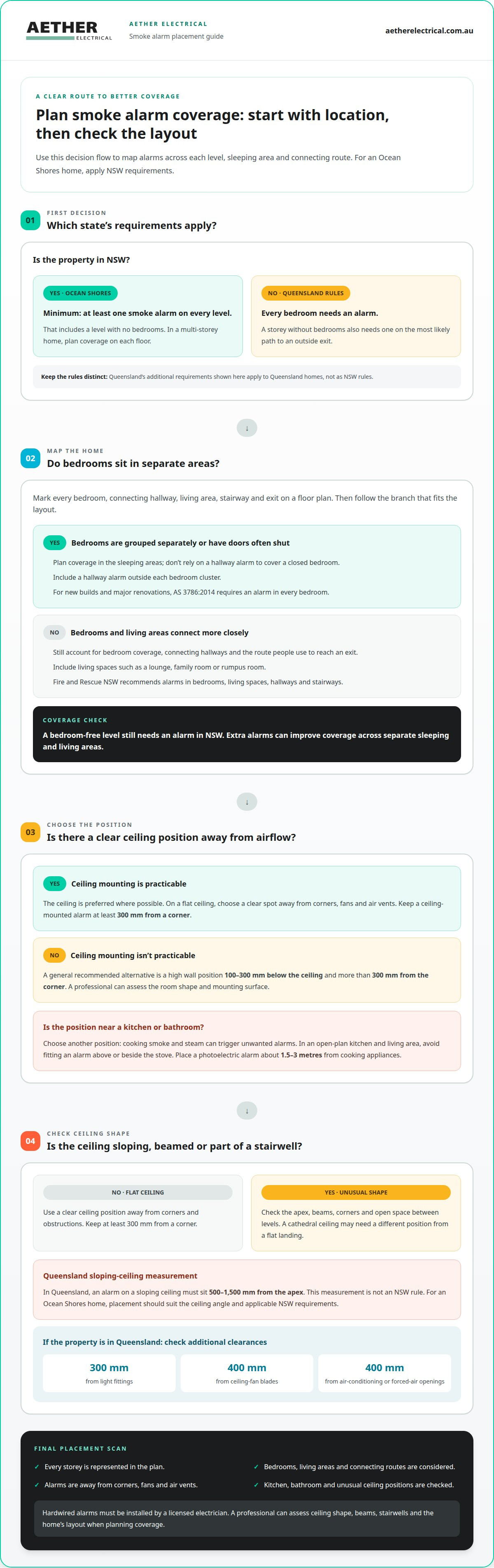
Start with a floor plan and mark each storey, bedroom, hallway and exit. In NSW, a house needs at least one smoke alarm per level, including a single-storey home. For a multi-storey layout, plan coverage on both the bedroom level and the living level. In Queensland, every bedroom needs an alarm. A storey without bedrooms also needs one on the most likely path to an outside exit. A professional can map these positions as part of smoke alarm installation and reports.
Avoid kitchen and bathroom areas
Keep smoke alarms out of kitchens and bathrooms, where cooking smoke or steam can trigger unwanted alarms. In a home with an open-plan kitchen and living area, avoid fitting an alarm above or beside the stove. Place a photoelectric alarm about 1.5-3 metres from cooking appliances. This helps separate the alarm from routine cooking while maintaining coverage nearby. Include ceiling fans, air vents and the room layout in the placement plan, since airflow can affect where an alarm works effectively.
Check applicable location requirements
For an Ocean Shores home, NSW rules set the minimum at one smoke alarm per level. The required number therefore depends on how many levels the house has. Extra alarms can improve coverage across separate sleeping and living areas. Queensland requires alarms in every bedroom, plus one on the likely route to an outside exit on any storey without bedrooms. Queensland also requires at least 300 mm clearance from light fittings and 400 mm from ceiling-fan blades and air-conditioning or forced-air openings. NSW requirements apply in Ocean Shores; Queensland’s additional placement rules are for Queensland homes. A licensed electrician handles hardwired installation and electrical work.
What about sloping ceilings, exposed beams and unusual layouts?
On angled ceilings, the highest point and nearby obstructions affect placement. A professional can assess the ceiling shape, corners, beams and stairwell before choosing a mounting position.
Choose ceiling or wall mounting positions
- Assess the ceiling first. On a flat ceiling, select a clear position away from corners. Keep ceiling-mounted alarms at least 300 mm from a corner. Check that a beam, light fitting or ceiling feature won’t obstruct the chosen position.
- Use a high wall position only when needed. If ceiling mounting isn’t practicable, a general recommended alternative is 100-300 mm below the ceiling. The position should also be more than 300 mm from the corner where two walls meet. A professional considers the room shape and mounting surface before settling on this option.
Account for beams and stairwells
- Assess sloping ceilings from the apex. In Queensland, a smoke alarm on a sloping ceiling must sit 500-1,500 mm from the apex. That Queensland measurement is not an NSW rule. For an Ocean Shores home, the installer should account for the ceiling angle and select a suitable position under the applicable requirements.
- Map beams and stairwells around the alarm. In a room with exposed beams, check whether a beam creates a corner or interrupts the intended mounting area. In a stairwell, consider the ceiling shape and the open space between levels. A cathedral ceiling, for example, may need a different position from a flat landing ceiling.
Don’t assume the highest point is always the right spot. If ceiling mounting isn’t suitable, a high wall position may be an option, provided required clearances are maintained. A professional can assess unusual layouts, including sloped ceilings, beams and stairwells, when planning smoke alarm placement.
Battery-powered and hardwired alarm installation
Consider the power source alongside alarm positions and the home’s existing wiring. The installation method affects who can fit the alarms and how they connect.
Install smoke alarms according to the manufacturer’s instructions. Hardwired alarms must be installed by a licensed electrician. Replace batteries as directed by the alarm manufacturer, since the interval depends on the alarm type.
Choose battery-powered or hardwired alarms
- Review the home’s existing setup. A professional considers the current alarms, wiring and coverage plan before recommending battery-powered or hardwired installation. In Queensland homes where battery-powered alarms are appropriate, non-removable 10-year battery-powered alarms can be installed without an electrician. That option doesn’t mean every home or alarm is suitable for battery-only installation.
- Keep existing mains wiring in view. In Queensland, if a required alarm is hardwired to the 240 V electricity supply, its replacement must also be hardwired. Mains electrical work must be performed by a licensed electrician. The same safety principle applies to hardwired installation in Ocean Shores: electrical work belongs with a licensed professional.
Install, test and maintain alarms
- Install and connect alarms as specified. The professional follows the manufacturer’s instructions for each alarm and checks that the selected positions suit the home. Interconnect alarms so that when one sounds, all sound. This helps the alert reach other rooms, including bedrooms behind closed doors.
- Test and maintain each alarm. Testing should follow the manufacturer’s instructions, including any guidance for interconnected units. Keep the instructions available for routine checks and battery replacement. Replace batteries at the interval specified for that alarm, rather than applying one schedule to every model. For sealed 10-year battery alarms, follow the maker’s directions for the complete unit.
For help selecting and fitting battery-powered or hardwired alarms, arrange professional smoke alarm installation.
Aether Electrical: Smoke alarm installation and reports
Aether Electrical provides smoke alarm installation and reports for Ocean Shores homes. Turn to the team when you need alarms positioned to suit your layout, or when hardwired installation calls for electrical work. The service can help bring placement, power source and interconnection into one clear plan.
For example, a home with bedrooms on one level and living areas on another needs a plan that covers both storeys. Sloping ceilings or existing hardwired alarms can also affect installation decisions. Aether Electrical assesses and installs smoke alarms, and provides compliance testing and reports as part of its electrical services.
For smoke alarm installation and reports, contact Aether Electrical.
Keep your alarm plan in step with your home
Keep the alarm plan up to date as the home changes. Renovations, changes in room use or electrical work can alter the layout, so revisit the plan after these changes. Keep the alarm instructions with household documents, and make sure everyone knows what the alarm sounds like and how to respond.
If you’re deciding where to install smoke alarms in a house in Ocean Shores, consider the alarm plan alongside the home’s broader electrical needs. Aether Electrical also provides domestic electrical services, solar installation and servicing, and battery storage installation for homeowners planning other electrical work.
Bring your questions and details of any existing alarm setup. Talk through your alarm plan with Aether Electrical, and take the next step with a clearer approach. Practical planning can make the work ahead feel more manageable.
Frequently Asked Questions
Should I hire a professional to install battery smoke alarms?
For hardwired alarms, use a licensed electrician. In Queensland, suitable non-removable 10-year battery alarms can be installed without an electrician, but that rule is specific to Queensland. In an Ocean Shores home, a professional can help plan positions across rooms, account for existing alarms and check the manufacturer’s installation instructions. This is especially useful when the home’s layout or alarm setup is complicated.
How far should a smoke alarm be from an air-conditioning outlet?
In Queensland, keep a smoke alarm at least 400 mm from an opening supplying air from an air conditioner or forced-air ventilation. This measurement is a Queensland requirement, not a stated NSW distance. For an Ocean Shores home, avoid placing an alarm where airflow could interfere with it, and follow the alarm manufacturer’s instructions for the installation position.
Should smoke alarms go in kitchens, bathrooms or laundries?
Avoid placing smoke alarms in or near kitchens or bathrooms, where cooking smoke or steam can trigger false alarms. In an open-plan home, position the alarm away from the stove while still covering the nearby living space. In a laundry, consider steam and airflow, and follow the manufacturer’s instructions for the alarm model.
What about a storey with no bedrooms?
In NSW, the minimum is one smoke alarm on every level, including a storey without bedrooms. Queensland has a more specific rule: on a storey with no bedrooms, an alarm is required on the most likely path of travel to an outside exit. The applicable rule depends on whether the home is in NSW or Queensland.
What if my home has two storeys?
In NSW, install at least one smoke alarm on each storey. For example, a two-level Ocean Shores home needs an alarm upstairs and downstairs to meet the per-level minimum. Consider how people move between bedrooms and exits when planning coverage, particularly if the upper floor has a separate sleeping area or the lower floor has a distinct living zone.
What if there is no hallway?
Use the home’s layout to identify the transition between sleeping and living areas. For example, in a compact home where bedroom doors open directly into a living room, a ceiling position between those zones may be a practical alternative to a hallway. Keep the alarm clear of fans and air vents, and follow the manufacturer’s placement instructions.


