
What if keeping your business powered isn’t about one major upgrade, but choosing the right electrical work at the right time? Gold Coast businesses rely on commercial electrical services to keep premises functional and support changing needs, from everyday lighting and power to new equipment and energy systems.
It isn’t always clear what your site needs now or how to plan upgrades around a working day. A fault needs attention. A new layout changes power requirements. Energy use shifts as the business grows. Start by identifying the affected areas, equipment and operating constraints, then use that information to set priorities and scope work.
This guide covers commercial electrical services such as power distribution, lighting, switchboard maintenance and electrical servicing. It also explains how solar, battery storage and EV charging can fit into a business’s energy plans. You’ll find practical considerations for comparing needs and preparing a project brief. Aether Electrical supports commercial premises across the Gold Coast and Northern Rivers with electrical and energy solutions tailored to each site.
Key Takeaways
- Separate planned installations, repairs and ongoing servicing to clarify what your premises needs now.
- Match lighting, power and switchboard work to how your business uses each area and its equipment.
- Compare operating patterns, essential equipment and planned changes to set practical electrical priorities.
- Before work is scoped, note the affected areas, access needs and equipment that must remain available.
- Consider how electrical work and energy upgrades can support changing requirements across Gold Coast and Northern Rivers premises.
What commercial electrical services help a business premises run reliably?
Commercial electrical services cover work that helps business premises operate safely and effectively. This can include installing or changing lighting and power, repairing faults, and maintaining existing systems so they continue to suit the site. The right scope depends on the building, how it’s used and what the business needs to keep operating.
Commercial electrical services include planned installations, repairs and ongoing care for the electrical systems a business relies on. Installations add or change systems, such as lighting or power distribution. Repairs address faults affecting equipment or part of the premises. Servicing keeps existing systems under attention and identifies issues that may need follow-up.
These needs arise in offices, shops, hospitality venues, workshops and other commercial properties. An electrical contractor may work across electrical system installation and maintenance. For a business, the practical priority is defining work that fits the premises and its daily use.
Which commercial properties need dedicated electrical support?
Different premises place different demands on electrical systems. An office may need power for workstations, computers, meeting rooms and shared equipment. In retail, lighting, tills, refrigeration or display equipment can shape the layout and power requirements. A workshop or multi-use premises may have several types of equipment and work areas to consider together.
Occupancy and operating hours matter, too. A busy shop has different usage patterns from an office occupied mainly during standard business hours. A customer-facing business may prioritise consistent lighting and accessible power, while a site with essential equipment needs to plan carefully around when that equipment can be switched off. Across Gold Coast and Northern Rivers towns, the details vary from property to property. Start with the actual site rather than a generic template.
How commercial electrical work differs from domestic work
Commercial properties can have different electrical loads, layouts and operating demands from homes. A larger or more complex site may need power distribution planned across several areas. The type and number of appliances, lighting needs, and the way staff or customers move through the premises all influence the scope.
That doesn’t mean every business needs a large-scale upgrade. A small office might need a focused change to lighting or power points, while another site may need broader installation work or switchboard maintenance. Begin by listing the equipment the property relies on, the areas that need to stay operational and any expected changes. Aether Electrical tailors commercial work to the premises and its business use, helping owners plan around real operating needs.
Which commercial electrical services can support your site?
Start with the job your premises needs done. A new area may need additional lighting and power; a switchboard may need maintenance; a growing business may be planning for solar, battery storage or EV charging. Aether Electrical provides commercial electrical services and related energy work, with the scope tailored to the site and its operations.
Commercial installations: Add or change electrical systems to support a new space, equipment or business requirement.
Lighting and power: Plan lighting and power distribution around how people use each area and the equipment that needs to run there.
Switchboard maintenance: Maintain the electrical infrastructure that distributes power around the premises.
Ongoing servicing: Keep electrical systems under attention as the property and its day-to-day demands change.
Power, lighting and switchboard work
Lighting affects how clearly staff can work and customers can move through a space. Power distribution determines where electricity is available for everyday equipment. Consider the floor plan and the purpose of each area before deciding where lighting or outlets are needed, rather than adding fittings or outlets based only on convenience.
Switchboard maintenance supports the infrastructure behind that power. If equipment, room use or business needs have changed, reviewing the electrical setup can help identify where the existing arrangement needs attention. The aim is to keep the system aligned with the premises without assuming every site needs the same work.
Solar, battery storage and commercial EV charging
Energy systems can be considered alongside a business’s core electrical needs. Solar installation and servicing, battery storage and EV charger installation each add a different function to a site. How they fit depends on the property, its power requirements and the business’s plans. Exploring energy use in commercial buildings can help put electricity use in a broader context.
Solar, battery storage and EV charging are separate parts of a wider energy setup. If staff or visitors charge vehicles on site, include the parking arrangement and expected use in the project discussion. For each option, consider how it connects to the existing electrical system and the way the premises operates, rather than treating it as an isolated add-on.
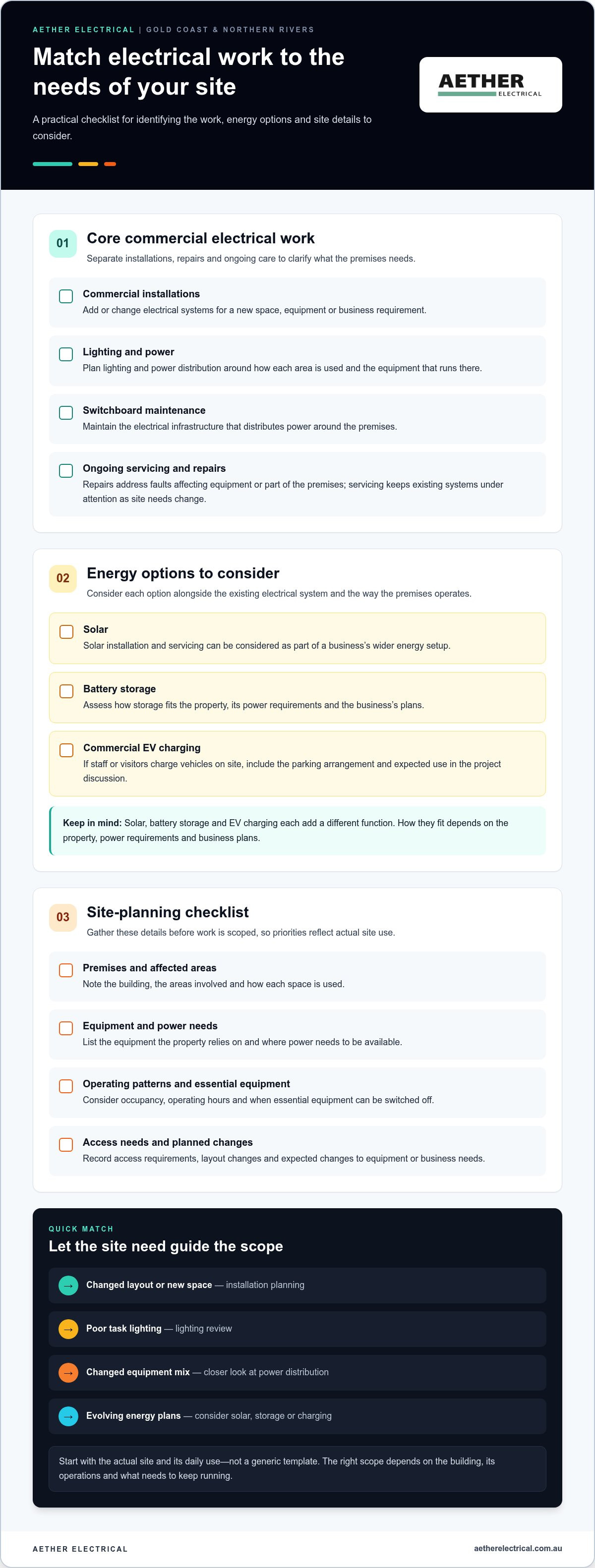
To set priorities, match the work to the need: a changed layout may call for installation planning; poor task lighting may point to a lighting review; a changed equipment mix may prompt a closer look at power distribution; and evolving energy plans may bring solar, storage or charging into scope. Aether Electrical provides commercial and related energy services across the Gold Coast and Northern Rivers. The company’s commercial electrical team can help shape a suitable scope for your site.
How to compare commercial electrical needs across different sites
Compare sites by how they operate, not just by floor area. Consider when the premises is occupied, which equipment is essential, where power is needed and whether those needs are likely to change. This gives you a practical basis for scoping commercial electrical services, from a focused lighting or power job to planning for new energy systems.
| Site type | Typical priorities | Planning considerations |
|---|---|---|
| Office | Power for workstations and shared equipment; suitable lighting across work and meeting areas. | Note occupied areas, equipment locations and access during business hours. |
| Retail | Lighting for customer areas and power for tills, displays or other business equipment. | Consider trading patterns, customer access and areas that need to stay operational. |
| Multi-use premises | Different power and lighting needs across work, storage, customer or shared spaces. | Map how each area is used and identify equipment or operations that affect other parts of the site. |
Office and retail premises: different operating demands
Office work often centres on desks, computers, meeting spaces and shared equipment. Retail has a more customer-facing rhythm, with lighting, displays and point-of-sale equipment shaping how the space functions. Trading hours and customer access affect how work can be planned around staff and visitors. These are starting points, not fixed rules: the building layout, existing electrical setup and actual equipment determine the scope.
When a business is adding energy or charging infrastructure
Solar, battery storage and EV charging can introduce new requirements alongside a business’s existing electrical use. Before defining the work, list the equipment that already relies on the site’s power and consider how the switchboard supports it. This helps establish how a proposed system fits the premises instead of treating it as a standalone addition. A solar installation guide can provide further context on that part of a project.
For a Gold Coast, Tweed, Tweed Heads or Northern Rivers business, the same planning principles apply across different premises: understand how each space is used, what equipment it supports and what may change. A shop adding vehicle charging, for instance, needs its parking arrangement considered alongside existing electrical demands. Site-specific planning helps ensure the scope reflects the property rather than assumptions or a one-size-fits-all solution.
How to plan commercial electrical work with less disruption
Good planning starts with the business, not the switchboard. A clear picture of the issue, the site’s daily use and the areas affected helps define work that fits the property. It also gives the project a useful basis for discussing access and timing, without assuming operations can pause or every task can happen outside business hours.
Clear project scoping makes electrical work easier to plan around the way your business operates. Use this sequence to prepare:
- Define the issue. Describe what needs attention, where it occurs and whether it affects a particular area, system or piece of equipment. Note any recent changes that may help explain the need.
- Describe site use. Outline how the affected space is used, when it’s occupied and which activities depend on its electrical systems.
- Scope the work. Identify the areas and equipment involved, along with planned changes that could affect the project. Aether Electrical tailors commercial electrical services to the property and its operational needs.
- Plan access. Discuss how the work area can be reached, what needs to remain accessible and how nearby business activity may shape the schedule.
What to outline before work is scoped
Prepare a short site brief. List affected rooms or work zones, the equipment involved and any changes the business is planning. Include operating hours, access arrangements and areas with sensitive activity, such as customer service or work that depends on specific equipment. Note how staff and customers move through the premises. These details give the project scope a useful starting point and reduce assumptions about how the site works.
Planning access and work around business activity
Scheduling discussions are more productive when the likely impact is clear. Note which areas must stay in use, when customer or staff activity is busiest, and whether essential equipment relies on the affected systems. This information helps shape a practical approach to access and the order of work. It does not guarantee uninterrupted operation, but it helps the scope reflect real constraints before work is arranged.
For example, a retail space may need customer routes kept clear, while an office may need staff to reach work areas and shared equipment. A multi-use site could have both needs, alongside storage or service areas. Flagging these details early helps the team understand priorities and where coordination may be needed.
Aether Electrical plans commercial installations and servicing around each property’s requirements and business activity. If you’re preparing a project brief, review Aether Electrical’s commercial services.
Commercial electrical services across the Gold Coast and Northern Rivers
Commercial electrical work is most useful when it reflects how a particular business uses its premises. Aether Electrical supports businesses across the Gold Coast and Northern Rivers with commercial installations, lighting and power solutions, switchboard maintenance and electrical servicing. Related solar, battery storage and EV charger work can also form part of a property’s broader electrical plans.
Start with the site itself. A shop, office or mixed-use property may have different priorities, even when the requested work sounds similar. Existing systems, equipment, access and business activity all help define a suitable scope. This keeps the project focused on what the premises needs, rather than applying a standard package to every building.
Local commercial electrical support from Tweed to Byron Bay
Aether Electrical serves the Gold Coast, Tweed, Tweed Heads, Northern Rivers, Ocean Shores and Byron Bay. For businesses managing premises in these communities, the project discussion can begin with the property, the work involved and how the business operates. Commercial electrical support and related energy-system planning can be considered together where they connect to the same site.
That matters when project requirements overlap. A business considering electrical changes alongside solar, battery storage or EV charging can plan how those elements relate to the premises instead of treating each decision in isolation. The right scope depends on the building and its needs. Aether tailors the work to the property and the way the business operates.
Take the next step with Aether Electrical
Before discussing a project, gather a few practical details. Note what needs attention, which parts of the site are affected and what equipment relies on them. Include how the premises is used, operating hours, access considerations and any planned changes. If energy or charging infrastructure is part of the plan, include that too. A clear brief helps focus the discussion on work that fits the property.
- The issue or planned electrical change
- The areas and equipment involved
- How the site operates during the day
- Any related solar, battery or EV charging plans
With these details in hand, Aether can discuss commercial electrical services in the context of your site and its priorities. Contact Aether Electrical about your commercial project and outline what your premises needs.
Set a clear direction for your next electrical project
Electrical decisions are easier to manage when they’re tied to a clear business priority. Rather than trying to solve every possible future need at once, identify what matters most to the site now and keep upcoming changes in view. This gives you a practical starting point for discussing scope and sequencing while keeping the premises’ day-to-day needs in focus.
For commercial electrical services, begin with a simple outline: what prompted the work, what the business needs it to achieve and what may change in the months ahead. You don’t need every technical answer before taking that step. Aether Electrical can shape an approach around your property and operations, with priorities clear from the outset.
Write down your key requirements and contact Aether Electrical to discuss your commercial electrical project. Talk to Aether Electrical about your site and its electrical needs.
Frequently Asked Questions
How much do commercial electrical services cost?
The cost depends on the work required, the condition of existing infrastructure and the complexity of the site. Replacing a fitting is a different scope from changing power distribution or adding equipment that affects the switchboard. For a clearer project discussion, outline the work area, the issue or upgrade and any access constraints. Aether Electrical tailors commercial electrical services to the property rather than assuming a standard scope.
Can commercial electrical work be scheduled outside business hours?
Work timing is planned around the project and the business’s operating needs, so outside-hours scheduling shouldn’t be assumed. Explain when the premises is occupied, which areas need access and whether essential equipment must remain available. For a Gold Coast or Northern Rivers site, this context helps shape practical scheduling discussions and identify possible impacts on staff, customers or daily operations.
How often should a business arrange electrical maintenance?
There isn’t one maintenance interval that suits every business. The right routine depends on the type of equipment, how intensively the premises uses it and any changes or faults that emerge. A site with heavily used equipment may need a different approach from a small office. Keep a record of maintenance and recurring issues, then use that history to plan servicing around the property’s needs.
Can a business add EV charging to its existing electrical system?
Yes, Aether Electrical installs EV chargers for commercial sites. Whether a charger can be added to the existing setup depends on the site’s electrical capacity, switchboard arrangement and other equipment drawing power. The parking location and intended use of the charger also help shape the project. Sharing those details early gives the installation scope a practical starting point.
What information helps scope a commercial electrical project?
Share the site address, a description of the work and the areas affected. Include the equipment involved, relevant changes to the premises, operating hours and access arrangements. A floor plan or clear photos can help explain layouts and equipment locations. Also note what the business needs to keep running during the work, so those priorities inform project planning.
What happens after commercial electrical work is completed?
Review the completed work and make sure you understand any changes to the electrical setup. Note which areas or equipment were affected, how relevant controls operate and whether follow-up work was discussed. Keep project records with your property documents, including any paperwork provided. This gives the business useful context for future servicing, renovations or changes to equipment and site use.


