
Could your home qualify for the 2026 cheaper home batteries program discount, yet receive less than the advertised amount? It’s a fair question. The program uses Small-scale Technology Certificates (STCs) to reduce the upfront price, and the discount depends on eligible battery capacity and current program rules, not one flat figure.
The rules have also changed. Since 1 May 2026, a tiered calculation applies, so the discount rate varies across portions of a battery’s usable capacity. Understanding that structure before comparing quotes helps you see what each proposal includes and whether the system suits your property.
This guide explains who can apply, which batteries and properties may qualify, and how the STC discount is calculated. You’ll also find practical checks to make before installation, including whether your battery connects to rooftop solar and how your home’s electrical setup fits the plan. If you’re considering a system on the Gold Coast, in Tweed or across the Northern Rivers, Aether Electrical can bring battery and solar planning into one installation plan.
Key Takeaways
- Assess whether your household or small business and proposed battery system meet the cheaper home batteries program requirements.
- Check both nominal and usable battery capacity when reviewing the eligible system size.
- Separate the STC discount from the full installation quote so you can see how the upfront amount is calculated.
- Gather recent electricity bills, solar-system details and site information before planning an installation.
- Choose a site-specific design that considers solar generation, energy use, electrical capacity and intended backup.
What is the Cheaper Home Batteries Program, and what changed in 2026?
The Cheaper Home Batteries Program is Australian Government support that can reduce the upfront cost of eligible small-scale battery systems. It operates through the Small-scale Renewable Energy Scheme (SRES), which uses Small-scale Technology Certificates (STCs) to calculate support for qualifying installations.
The program supports battery storage connected to rooftop solar. It is not a fixed rebate that every customer receives. Eligible capacity and the rules in force at the time of installation affect the STC calculation. A published estimate is a guide, not a guaranteed discount or a promise about the final installation quote.
For general background on how batteries store and supply energy at home, see this overview of home energy storage systems. The program has specific conditions for which battery installations may receive support and how that support is calculated.
Who administers the programme and how does support reach customers?
The Australian Government’s Department of Climate Change, Energy, the Environment and Water (DCCEEW) publishes program information and explains the policy settings. The Clean Energy Regulator (CER) administers the SRES and its certificate framework. STCs are certificates created for eligible renewable energy installations. Their value can be applied to reduce the customer’s upfront bill.
This reduction is often called an upfront discount. The eligible certificate value is taken off the amount payable at installation, rather than paid later as a separate rebate. An installer will typically claim the STCs on the customer’s behalf. The support can vary between systems, so batteries with different eligible capacities may receive different reductions.
Why did the programme change in 2026?
Amendments that commenced on 1 May 2026 introduced a tiered support calculation based on battery capacity and adjusted the STC settings to reflect changing battery costs. Support is calculated across capacity bands rather than at one rate for every usable kilowatt-hour. The system must still meet program requirements, and the applicable STC factor affects the calculation.
From 1 May 2026, the Australian Government’s Cheaper Home Batteries Program moved to a tiered, capacity-based discount calculation, according to DCCEEW program guidance.
Program settings can change, so an older article, advertisement or quote may refer to a previous calculation. Treat a published discount as indicative until the eligible equipment, usable capacity and current rules are considered together. Compare the program support shown in a proposal with the full installation scope. A discount reduces the upfront cost; it does not describe the battery’s total installed price or determine whether a system suits your property.
Who is eligible for the Cheaper Home Batteries Program?
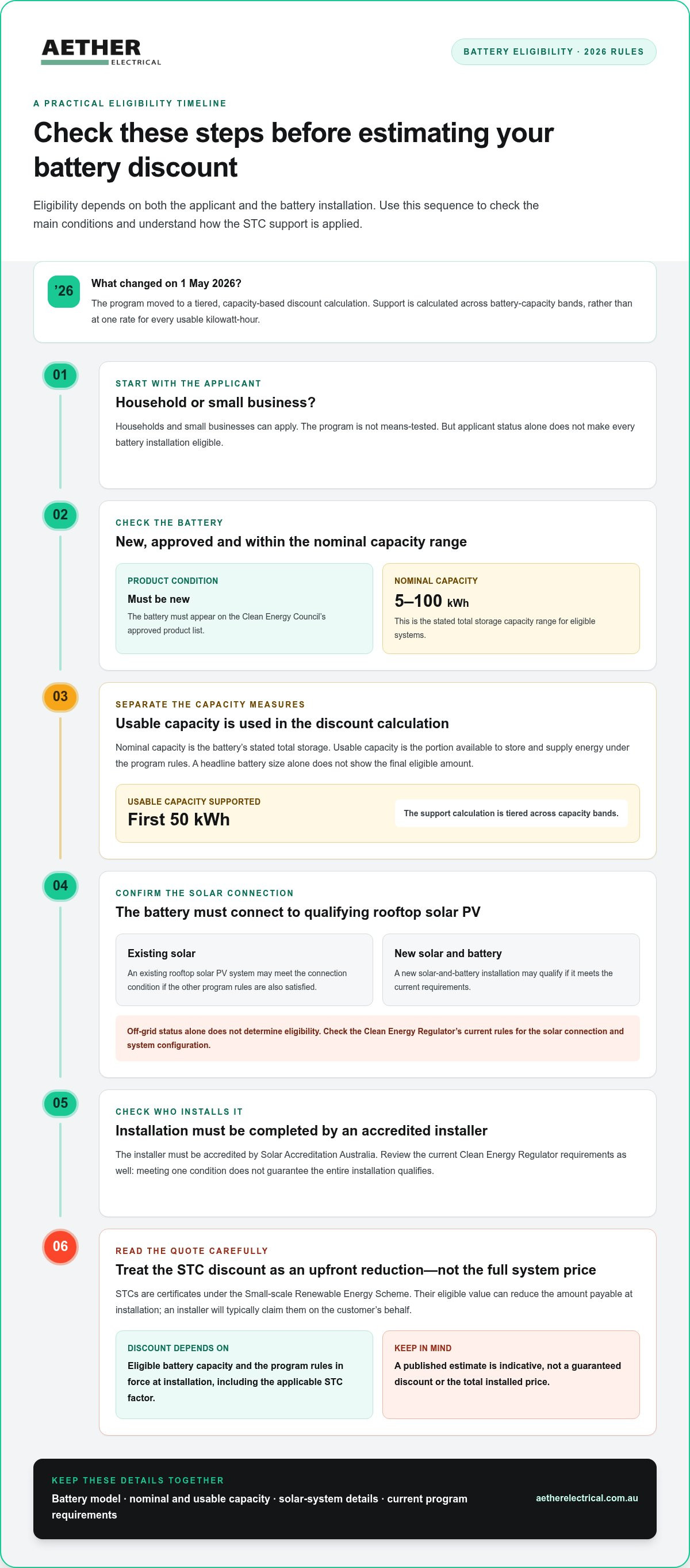
Eligibility depends on both the applicant and the battery system. Households and small businesses can apply, and the program is not means-tested. However, eligible customer status alone does not make every battery installation eligible. The equipment, solar connection and installation must also meet current requirements.
What battery and solar-system requirements apply?
The eligible battery must be new, appear on the Clean Energy Council’s approved product list and be installed by a Solar Accreditation Australia-accredited installer. It must connect to a new or existing rooftop solar PV system. The Australian Government’s Cheaper Home Batteries Program guidance sets out current program conditions, while the Clean Energy Regulator (CER) provides the scheme’s detailed rules.
Capacity terms are easy to mix up. The eligible system range is 5-100 kWh of nominal capacity, the battery’s stated total storage capacity. The discount calculation applies to usable capacity, the portion available to store and supply energy under the program’s rules. Support applies to the first 50 kWh of usable capacity. A battery’s headline size alone does not tell you the final eligible amount.
Check whether the battery will be added to an existing solar system or installed with a new one. The solar connection is part of eligibility, not a detail to leave until later. Keep the battery model and capacity information with your solar-system records when reviewing a proposed installation.
Can an existing solar system or off-grid property qualify?
An existing rooftop solar PV system can meet the solar-connection condition if the battery and installation also satisfy the other program rules. A new solar-and-battery installation may qualify too. Off-grid properties need a closer look: being off-grid does not by itself determine eligibility. The CER’s current requirements for the solar connection and system configuration apply.
CER eligibility checklist: the battery must be new, approved, within the eligible nominal capacity range and connected to qualifying solar PV, with installation completed by an accredited installer. Use this as a starting point, not a substitute for the full rules. Meeting one condition does not guarantee that the whole installation qualifies.
Before relying on an advertised discount, compare the proposed battery’s nominal and usable capacity, confirm its approved-product status, and review the solar arrangement against current CER criteria. These checks help establish whether a system meets the program rules, rather than simply appearing suitable.
For properties across the Gold Coast, Tweed, Tweed Heads, Ocean Shores, Byron Bay and the wider Northern Rivers, Aether Electrical can bring battery eligibility and the home’s electrical setup into one installation plan. Explore local battery installation planning as you assess the next steps.
How is the Cheaper Home Batteries Program discount calculated?
The discount is linked to eligible usable battery capacity and the Small-scale Technology Certificates (STCs) generated under the Small-scale Renewable Energy Scheme. More eligible capacity can mean more STCs, but the calculation is tiered and certificate value affects the reduction shown on a quote. There is no single discount that applies to every customer.
Under the settings effective from 1 May 2026, the STC factor applies at different rates across capacity bands: 100% for the first 14 kWh, 60% for the next 14 kWh, and 15% for the portion from 28 to 50 kWh of usable capacity. The applicable factor and certificate value can change. Treat published figures as indicative, not as a promised amount for your installation.
Keep the program discount separate from the full installation quote. The quote covers the battery system and the work included in the installation. The STC value is a potential reduction to the upfront amount, subject to eligibility and current rules. A larger battery does not automatically mean a proportionally larger discount.
What role do small-scale technology certificates play?
STCs are certificates created for eligible systems under the SRES. For a battery installation, eligible capacity and current STC settings help determine how many certificates can be created. One common route is to assign the right to create the certificates to a registered agent, who applies their value as an upfront discount. Creating or selling certificates independently follows separate CER requirements. The current process is explained in AGL’s guide to the Cheaper Home Batteries Program.
Use your proposal to see how the certificate value has been treated. Where the details are shown, compare usable capacity, the STC reduction and the remaining installation amount as separate line items. A headline saving alone can make it difficult to see what the figure includes.
Quote component | How it relates to support | What to resolve
Battery and installation scope | The full quoted system and installation work. | What equipment and electrical work are included?
Eligible capacity | Usable capacity informs the STC calculation, within the program’s tiers and limits. | What usable capacity is being used for the calculation?
STC value | May be assigned to a registered agent and applied upfront. | How is the certificate value shown in the proposal?
Other offers | Separate conditions may apply. | Are the current scheme rules compatible with the offer?
Can the battery discount be combined with other schemes?
Some state, territory or retailer offers may interact with federal support, but do not assume they can always be combined. Conditions depend on the specific scheme, property and location. Review the current official terms before including another incentive in your expected saving. For more context on what shapes a full installation proposal, read this solar battery price guide.
How to prepare for a battery installation under the programme
Start with your energy use, not the discount estimate. Gather a few details before comparing proposals, then work through the design, eligibility and paperwork. This helps you judge whether a proposed system fits your property as well as the Cheaper Home Batteries Program rules.
What should you check before comparing installation proposals?
Consider how your household or business uses electricity during the day, in the evening and at peak times. Gather recent bills, solar-system and inverter details, switchboard information, and notes about possible battery locations. These give an assessment a useful starting point and make proposals easier to compare.
- Review your energy use. Note when electricity demand is highest and which uses matter most. If backup is a priority, list the circuits or essential equipment you want powered during an outage.
- Gather existing system details. Record your solar system’s age and size if known, along with the inverter model and available system documents. Include site details, such as the switchboard location and possible battery positions.
- Discuss the system design. Compare proposed usable storage, how the battery connects with your solar system, backup arrangements and monitoring. A larger capacity is not automatically a better match for your energy use.
- Review the electrical work. Switchboard capacity, cable routes and battery location can shape the installation design. The site and relevant Australian and state requirements need to be considered rather than assuming every property is configured the same way.
- Check program details. Compare the proposed equipment with current eligibility requirements and review how the STC discount is shown. Make sure the scope, certificate treatment and remaining quote are clear before proceeding.
What happens from eligibility check to commissioning?
The process begins with a property assessment, followed by a system design based on solar generation and energy needs, confirmation of eligible equipment, installation and handover. Program paperwork and STC assignment are also part of the process. The installer explains the required steps and records under current rules. For a new solar-and-battery setup, this Gold Coast solar installation guide can help you understand the solar-planning side.
At handover, keep the system documents and operating information together. Make sure you understand the battery’s intended use, how backup is configured if included, and where to find the installation and program records. These details help you manage the system and refer back to the agreed design.
Aether Electrical plans and installs battery systems for homes and businesses across the Gold Coast, Tweed and Northern Rivers. Plan your battery installation with Aether Electrical around your site, solar system and energy use.
Plan a Cheaper Home Batteries installation with a local electrician
National program rules set the conditions for support. Your property shapes the design. A battery needs to work with the solar system, electrical setup and energy needs on site, whether it is for a home or business. Keeping both in view helps you plan an installation without treating an estimated discount as the whole decision.
Aether Electrical installs solar and battery systems for residential and commercial customers across the Gold Coast, Tweed and Northern Rivers. A practical plan connects program requirements with the property’s electrical setup, rather than selecting a battery by size alone.
What does a local battery assessment consider?
A site-specific assessment considers how much solar the property generates, when electricity is used and what you want the battery to do. Intended backup matters too: the design should reflect which needs are priorities, rather than assume the whole property will be powered during an outage. Switchboard condition, electrical capacity and battery location also shape the installation work.
Switchboards are part of the picture, not an afterthought. If you’re considering electrical capacity or potential switchboard work, the Gold Coast home electrical services guide provides useful context. Bringing these details into the plan early helps align the battery, solar system and required electrical work.
How can Aether Electrical help you take the next step?
Aether’s solar and battery installation work brings planning and practical installation together. The design can account for an existing or planned solar system, energy use, electrical capacity and intended backup. These property details shape the system proposal; program eligibility and any discount depend on the current official rules and assessment.
Eligibility is program-based, while system design is property-specific. Keep this distinction in mind as you move from comparing program information to planning work at your address. A suitable design should fit the site and intended use, while program criteria determine whether the installation can receive support. Neither an estimated discount nor a system proposal guarantees program approval or a particular bill outcome.
For an initial discussion, bring your solar-system details, recent electricity bills and a clear idea of what you want the battery to support. Aether Electrical can discuss a battery installation suited to your property and bring the electrical and solar planning into one conversation. Discuss your battery installation with Aether Electrical.
Take the next step towards a battery plan that fits
A battery decision is also a chance to clarify what you want your energy system to do. Is your priority using more of your solar generation, supporting selected equipment during an outage, or planning storage for a business? A clear goal gives the installation design a practical starting point. Let the cheaper home batteries program inform your budget, but let your property’s needs guide the system choice.
Aether Electrical provides residential and commercial battery storage installation, alongside solar installation and servicing across the Gold Coast, Tweed, Tweed Heads, Ocean Shores, Byron Bay and the Northern Rivers. The focus is on bringing the property, electrical setup and intended use into one considered plan, without assuming a particular discount or bill outcome.
When you’re ready to move from research to planning, plan your solar and battery installation with Aether Electrical. Start shaping a system around what matters at your property.
Frequently Asked Questions
Can renters access the Cheaper Home Batteries Program?
Renters may benefit from an eligible installation, but program eligibility and permission to alter a property are separate matters. Current rules determine whether the household and system qualify; they do not replace the need to agree who arranges and owns the installation. Get the property owner’s approval and settle installation responsibilities before making plans. Refer to current DCCEEW or CER guidance for applicable program requirements.
Will a home battery keep the lights on during a blackout?
Not automatically. A battery can supply power during an outage only if its equipment and installation are configured for backup, and only selected circuits may stay powered. For example, a system set up for a fridge and a few lights may not run every appliance in the home. Tell the designer which loads matter most, then confirm how backup will operate. Program support does not guarantee backup capability.
Does receiving a battery discount guarantee lower electricity bills?
No. The discount reduces eligible upfront installation costs, but it does not reduce electricity use or bills by itself. Bill outcomes depend on factors such as when you use power, how much your solar system generates, your tariff, battery size and how stored energy is used. Before making a financial decision, review your household’s usage pattern and current electricity tariff, then consider whether the proposed system matches them.
Can an off-grid home qualify for battery support?
Some off-grid systems may qualify under conditions set out in Clean Energy Regulator (CER) guidance, including requirements for the relevant solar PV and battery system. Being off-grid alone does not establish eligibility. Review the latest capacity, property and system requirements, including the certificate rules that apply to your setup. Program conditions can change, so use current official guidance rather than relying on an older quote or online summary.
Can a small business apply for the Cheaper Home Batteries Program?
Yes, small businesses are among the customer groups included in program information. The proposed system and premises still need to meet current requirements. CER guidance also addresses grid-connected systems and commercial sub-meters, so a business with separately metered areas should consider how the rules apply to its site. Review the requirements for the specific premises before committing to equipment or installation work, as eligibility is not based on business status alone.
Will a battery automatically provide backup power if it qualifies for the programme?
No. Program eligibility concerns support for an installation; backup is a separate design choice. A battery intended to store solar power for later use may not supply electricity during a grid outage. The result depends on compatible equipment, system configuration and which circuits are connected for backup. List essential loads, such as refrigeration or selected lighting, during design so the proposed setup reflects what you expect it to power.


