
What if the best solar system for your home isn’t the biggest one your roof can fit? A 5kw solar system can be a sensible match, but its value depends on more than the number on the inverter. Daily output, panel layout and roof space all matter, and online estimates can vary because they assume different conditions.
There isn’t one system size that suits every home. Generation changes with location, roof direction and pitch, shade and weather. How much of that electricity you use also depends on when your household needs power. If you’re planning for a battery or electric vehicle, include those plans in the design discussion.
This guide explains what a 5kW rating means, what affects likely output and how to compare system size with your electricity use and roof conditions. It also covers the information to prepare for a solar assessment, including daytime demand and future plans. With those details in hand, you can make a more informed decision about whether 5kW fits your home.
Key Takeaways
- A 5kw solar system describes its capacity, not a guaranteed amount of electricity generated each day.
- Use daily output estimates as a guide. Roof direction, pitch, shade and local weather all affect generation.
- Compare system size with your daytime electricity use, roof space and plans for a battery or EV.
- Your total power bill alone won’t show whether 5kW is the right fit. When you use electricity matters too.
- Recent usage records and roof details help shape a site-specific assessment.
What does a 5kW solar system mean for your home?
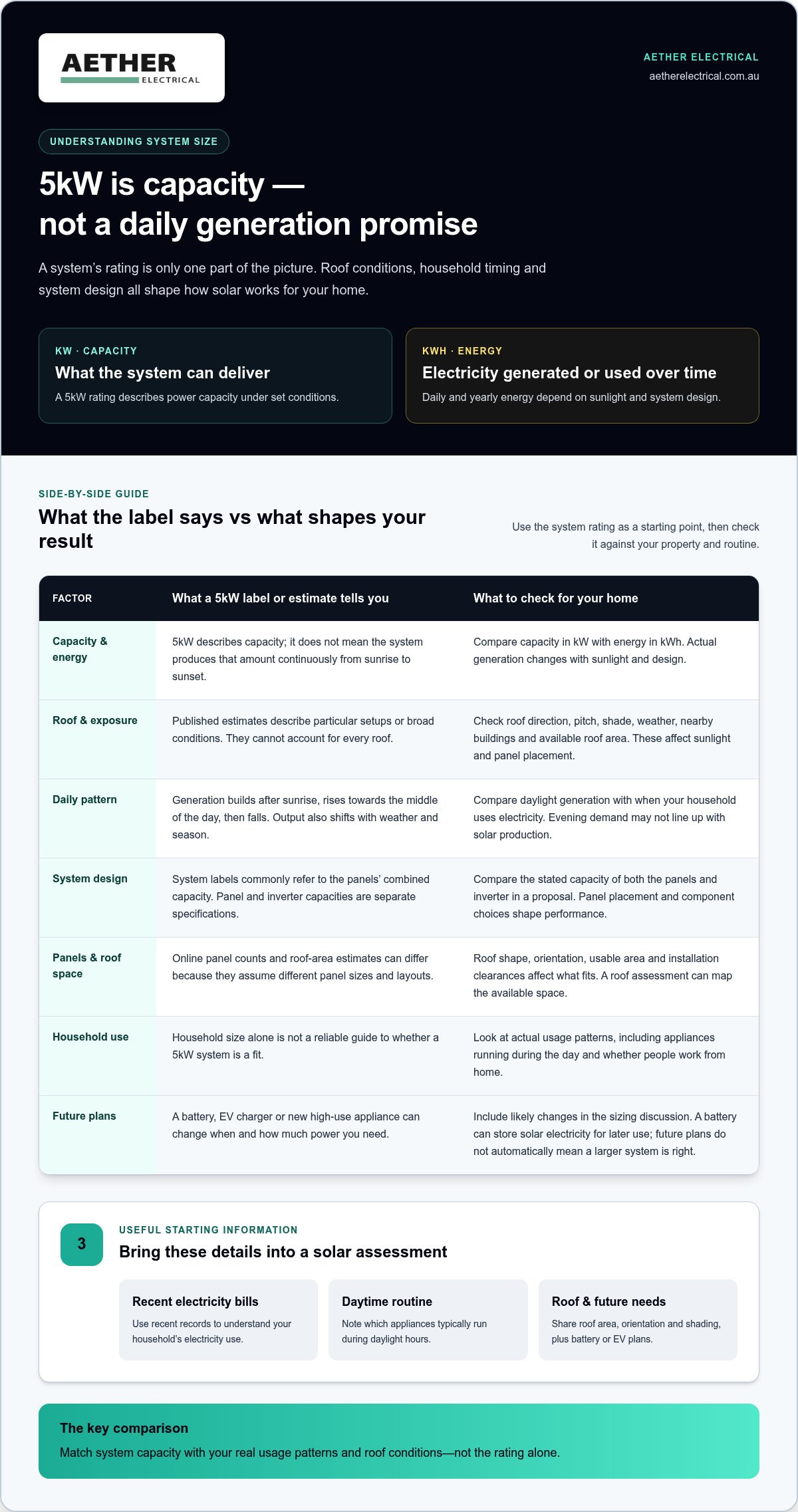
A 5kW rating describes the system’s power capacity under set conditions. It doesn’t tell you how much electricity the panels will produce across a day or year. That amount is measured in kilowatt-hours (kWh), and it changes with sunlight and system design.
In brief: kilowatts (kW) measure capacity; kilowatt-hours (kWh) measure energy generated or used over time. Think of kW as the system’s potential output at a moment, and kWh as the electricity accumulated over time. A 5kw solar system won’t produce its rated capacity continuously from sunrise to sunset.
Location, roof direction and pitch, shade from trees or nearby buildings, weather and system design all affect generation. Even on a clear day, output rises and falls as the sun moves. For a wider view of the Australian context, Solar power in Australia provides background on the country’s solar sector.
There’s also a timing gap to consider. Panels generate during daylight, while household demand changes throughout the day. If you’re out during sunny hours and use more power in the evening, generation and consumption may not line up hour by hour. The capacity label alone can’t tell you how much solar electricity your home will use directly.
Does 5kW describe the panels or the inverter?
System labels commonly refer to the solar array’s combined panel capacity, but panel capacity and inverter capacity are separate specifications. The inverter converts the panels’ electricity for household use, and systems don’t all use identical component sizing. In a proposal, compare the stated capacity of the panels with the inverter’s capacity. Clear specifications show what the 5kW label represents in that design.
Who might consider a 5kW solar system?
A 5kW system may suit a household that can use a good share of its solar generation during the day. Household size alone isn’t a reliable guide. A larger family with modest daytime use could have a different fit from a smaller household running appliances or working from home during daylight. Look at actual usage patterns, not just the number of people in the home.
Think ahead, too. A battery can store solar electricity for later use, while an EV charger or new high-use appliance may change when and how much power you need. These plans don’t automatically mean a larger system is right, but they should be part of the sizing discussion. That way, the proposed design can account for your current routine and likely changes.
Before comparing options, gather recent electricity bills and note which appliances typically run during the day. Pair that information with the roof’s available area, orientation and shading. Together, these details give a more useful starting point than the system label on its own.
How much power can a 5kW solar system generate in local conditions?
A daily generation estimate is a useful starting point, not a forecast for every home. The same 5kw solar system can produce different amounts depending on location, roof orientation and pitch, shade, weather and system design. Online figures often describe a particular setup or broad conditions. They can help you compare options, but they can’t account for every feature of your roof.
Site conditions determine whether published output estimates apply to your home. A north-facing, unshaded roof and a roof with afternoon shade won’t capture sunlight in the same way. Panel layout and the system’s components matter as well. For wider Australian clean energy information, the Clean Energy Council offers industry resources, but your property still needs an individual assessment.
Production also shifts through the year and across the day. A clear summer day may bring a longer period of strong generation, while a cloudy winter day may mean less overall production and a shorter peak. On either day, output builds after sunrise, rises towards the middle of the day, then falls. Household use may follow a different pattern, so total daily generation doesn’t mean the same amount is available at every hour.
- Orientation and pitch: affect how directly panels receive sunlight.
- Shade and weather: trees, nearby buildings and cloud cover can reduce or interrupt sunlight reaching the array.
- System design: panel placement and component choices shape how the array performs as a whole.
How Gold Coast and Northern Rivers conditions affect solar output
Across the Gold Coast, Tweed, Tweed Heads and the Northern Rivers, local sunshine is only part of the picture. Cloud, rain and changing weather influence generation, while coastal exposure and nearby buildings, trees or roof features can affect where panels fit. Conditions in Ocean Shores and Byron Bay can differ from one property to another, too. A broad regional average can’t account for these details, so a property-specific design gives a more useful view of likely performance.
Why panel count and roof space estimates vary
Online panel counts and roof-area estimates can differ because they assume different panel wattages, dimensions and layouts. A roof’s usable space also depends on its shape, orientation and installation clearances. Two proposals for systems of similar capacity may therefore show different panel numbers or footprints. Neither figure is a universal rule. A roof assessment can map the available area and show what fits your home.
For a tailored view, bring your roof details and recent electricity bills into the discussion. Aether Electrical installs residential solar systems across the Gold Coast and Northern Rivers, connecting site conditions with system design so estimates are considered in the context of your property. Read more about residential solar installation.
Is a 5kW solar system enough? Compare usage, roof and future plans
There’s no single system size that suits every home. A 5kW option may fit a household with useful daytime demand and a suitable roof, while another home may need a different design. Bigger isn’t automatically better: a larger array may provide more capacity, but its suitability still depends on roof space, household use and network export conditions. Start with your pattern of use, not a blanket rule.
A large electricity bill alone won’t tell you what size to choose. It shows how much electricity you buy, but not when you use it. A household with high evening demand may have a different solar fit from one using appliances through the day, even if their bills look similar. Compare your usage data with the times solar generation is available.
| What to compare | A 5kW system may fit when… | Look more closely when… |
|---|---|---|
| Daytime use | Appliances and household activity use power while the panels are generating. | Most electricity use happens after sunset. |
| Roof suitability | There’s suitable unshaded space for a practical panel layout. | Shade, roof shape or limited area may affect the design. |
| Future loads | Current demand is likely to remain similar. | You’re planning an EV charger or new high-use appliances. |
| Battery intentions | You’re focused on using solar during the day. | You want to store energy for later and need to plan the system as a whole. |
Match system size to when your household uses electricity
Check recent bills and any available interval usage data to see when electricity use rises. A home that runs a dishwasher, washing machine or pool equipment in daylight may use more solar onsite. Where practical, shifting suitable appliance use to sunny hours can change how much generated power is used directly. If your household’s busiest period is after sunset, include that timing in the sizing discussion.
For property-specific considerations, the Gold Coast solar installation guide explores how local roof and installation factors fit into planning.
Allow for batteries, EV charging and changing household needs
A battery changes when you can use solar electricity, not how much the panels generate. EV charging and planned appliances can also add or shift demand, so include them early in system planning. A larger system could offer more capacity, but roof limits, network export conditions and your actual usage still matter. For storage planning, see the home solar battery storage guide.
Use the comparison as a starting point, then weigh the details together. Recent usage data, roof suitability and future plans give a clearer basis for deciding whether a 5kw solar system is a sensible match or whether another system size deserves consideration.
What should you check before installing a 5kW solar system?
A little preparation makes it easier to shape a system around your home rather than relying on a generic package. Work through these checks in order. They connect your electricity use and roof conditions with the practical details of installation.
- Review your electricity use. Gather recent bills and note when your household uses the most power.
- Assess the roof. Consider its condition, direction, pitch, shaded areas, obstructions and usable space.
- Plan the system. Match the panel layout and system components to your roof, current demand and future plans.
- Consider the local network. Export settings and connection requirements can depend on your address and distributor.
- Arrange installation. A professional installation brings the system design and household electrical setup together.
Prepare useful information for a solar assessment
Have recent electricity bills handy, and note which appliances run during daylight and in the evening. Add planned changes, such as an EV, battery or new high-use appliance. From the ground, note visible roof shade, vents or other obstructions, as well as any access considerations. These details help make the assessment specific to your property and household.
Roof suitability involves more than available area. Roof condition, orientation and shade can influence where panels can go and how the system is arranged. A site assessment turns those observations into a practical layout, rather than assuming every roof can use the same design.
Understand local network and installation considerations
On the Gold Coast, Energex may be the relevant distributor; across parts of the Northern Rivers, it may be Essential Energy. The network serving your property depends on its location, so verify the distributor for your address. Connection and export conditions can vary by network and site and should be considered as part of system planning.
Installation also involves coordinating the solar equipment with your home’s electrical setup. A professional assessment can account for system integration and electrical capacity as the design is developed. If you’re reviewing the overall project, the solar panel installation cost guide explains factors that can shape an installation quote.
With your bills, roof observations and future plans ready, Aether Electrical can assess a 5kw solar system for your home across the Gold Coast and Northern Rivers. See Aether Electrical’s solar installation services for more about planning a design suited to your property.
How Aether Electrical helps plan a 5kW solar system
A suitable solar system starts with your property, not a standard package. Aether Electrical installs, services and repairs residential solar systems across the Gold Coast, Tweed and Northern Rivers. Planning brings together the roof, household electricity use and future needs, so a 5kw solar system can be assessed in context rather than treated as a one-size-fits-all answer.
From site assessment to a tailored solar design
Roof layout and household routines help shape the system recommendation. The assessment considers usable roof sections, orientation, shade and how your home uses electricity. It also takes future plans into account, such as adding a battery or EV charger. These details inform a proposed panel layout, equipment and configuration suited to the property.
Published generation estimates don’t account for every roof or household. Expected output, bill impact or payback depends on the property, system design and how electricity is used. An assessment can clarify the assumptions behind a proposal, so you can understand how its configuration relates to your home.
- Roof: available space, condition, orientation and shading.
- Household: typical electricity use and when demand occurs.
- Future plans: battery storage, EV charging or other electrical changes.
If a battery is part of the plan, consider its role alongside the solar system and your usage patterns. Electrical integration matters too. Aether Electrical installs battery storage and carries out switchboard work, which can be relevant when planning how solar fits with your home’s electrical setup. The design should connect these pieces without assuming every household needs the same additions.
Installation and ongoing solar servicing
Once the system design is settled, professional installation brings the proposed equipment and electrical setup together. Aether Electrical also provides solar servicing and repairs for residential systems across the local service region. Servicing can help assess the system’s condition and address issues over time, without promising a particular generation level or bill result.
For an existing system, servicing or repair work can help you understand its current condition before planning changes. For a new installation, sharing recent electricity bills, roof details and future energy plans gives the assessment a useful starting point. The system design can then be tailored to the property and the way your household expects to use electricity.
Learn more about solar for your home with Aether Electrical and the property-specific assessment process.
Take the next step with a clear solar plan
Choosing a 5kw solar system isn’t about finding a perfect number on a page. It’s about making a considered decision for the home you have and the way you expect to use it. Before moving ahead, decide what matters most: fitting the current roof, supporting daytime use or allowing for future energy changes. That gives your assessment a clear purpose and makes it easier to compare proposals on the details that matter to you.
You don’t need every answer before getting started. Bring your questions and priorities to the conversation, and use the assessment to understand which design choices suit your property. Recent bills, roof details and plans for a battery or EV provide a practical starting point.
Contact Aether Electrical to discuss a solar system tailored to your home.
Frequently Asked Questions
How much electricity does a 5kW solar system generate per day?
A 5kW solar system may generate around 15 to 25 kWh per day in Australia, but this is a broad estimate, not a property-specific forecast. A cloudy day or shaded roof can produce less than a clear day. Check your inverter or monitoring app to see actual generation, and compare results across different days and seasons. Make sure you’re viewing solar generation, not total household electricity use.
Is a 5kW solar system enough for a family home in Australia?
It can be enough for some family homes, but the number of people in the household doesn’t settle the question. Consider how often someone is home during the day, whether electric hot water or cooling runs regularly, and when cooking and laundry happen. A family that uses power mostly in the evening has a different pattern from one with daytime demand. Recent usage data gives a more useful starting point than household size alone.
How many panels are needed for a 5kW solar system?
A 5kW array commonly uses around 15 to 20 panels, depending on the capacity of each panel. Higher-wattage panels can reach the same combined capacity with fewer units than lower-wattage panels. The proposed layout also depends on the roof’s usable sections and the equipment selected. Compare the panel count and individual panel specifications in a proposal, rather than assuming every 5kW design has the same number.
How much roof space does a 5kW solar system need?
As a broad guide, a 5kW array may need about 25 to 35 square metres of roof area. Usable space can be less than the roof’s total area because of its shape, vents, shading and required installation clearances. Panel dimensions affect the layout too. For a home in Tweed Heads or Byron Bay, a roof plan or site assessment can show how much suitable space is actually available.
Can a 5kW solar system charge an electric vehicle?
Yes, it can contribute to EV charging, especially if the vehicle is parked at home during sunny hours. The amount of solar power available for charging varies with the car’s needs, household use at the same time and current generation. For instance, running appliances while charging leaves less solar electricity for the vehicle. Include your typical driving and charging routine when planning an EV charger and solar setup.
Can you add a battery to a 5kW solar system?
Yes, a battery can be added to many solar setups, subject to the existing system and electrical configuration. It stores surplus solar electricity for use later, but doesn’t increase the panels’ generation. Before planning a retrofit, identify the inverter and existing system details, along with where a battery could be installed. Aether Electrical provides battery storage installation, with system integration considered as part of the household’s electrical setup.
What affects the output of a 5kW solar system on the Gold Coast?
On the Gold Coast, output depends on the roof’s direction and pitch, shade from trees or neighbouring buildings, weather and the final system design. Coastal conditions and nearby obstructions can also affect panel placement and installation planning. Homes in Ocean Shores, Tweed and the Northern Rivers may face different roof and site conditions, even within the same region. A property-specific assessment is more useful than applying one local estimate to every home.


